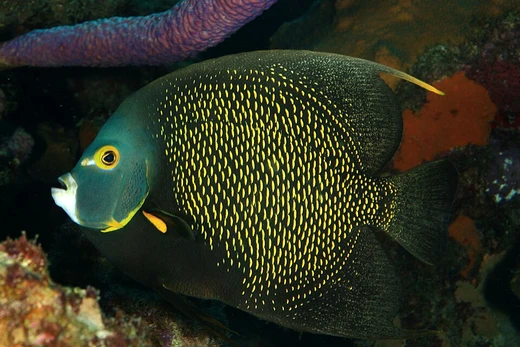
Centropyge venusta
A shy, blue-and-yellow angelfish of Western Pacific caves.

Centropyge venusta, the purplemask angelfish, is a species of marine ray-finned fish belonging to the family Pomacanthidae. It is found in the Western Pacific and is occasionally found in the aquarium trade, where it is rare and commands high prices.
Quick Facts
- Taxon
- Centropyge venusta
Facts from the source article.
Lore & Background
Centropyge venusta has a blue and yellow colouration. Yellow dominates the lower front part of the body and is also found around the snout area, with a wedge of blue on the nape separating the patches of yellow. There is an area of blue starting close to the front of the dorsal fin that covers the rear part of the body and the caudal fin. The anal and pelvic fins are yellow with blue margins. The distribution of the blue and yellow colour varies in individual fishes. The dorsal fin contains 14 spines and 16 soft rays, while the anal fin has 3 spines and 15 soft rays. This species attains a maximum total length of 12 centimetres (4.7 in).
It occurs in the western Pacific Ocean, around the Ryukyu Islands and Izu Islands of southern Japan, Taiwan, and northern Luzon in the Philippines. It is found at depths between 10 and 40 metres (33 and 131 ft). It is a shy and unapproachable species of caves and overhangs, where it is typically encountered as solitary individuals oriented upside down on the roofs. It does form pairs or small groups. Its diet in the wild is unknown, but in captivity it requires live food.
Centropyge venusta was first formally described as Holocanthus venustus in 1969 by the Japanese ichthyologists Fujio Yasuda and Yoshiaki Tominaga, with the type locality given as Izu Ōshima in Sagami Bay. The specific name venusta means 'beautiful'. Some authorities place this species in the subgenus Paracentropyge, which is sometimes treated as a valid genus.
Reader's Guide
Centropyge venusta is notable for its striking blue and yellow colouration, which varies among individuals, and its shy, upside-down resting behavior on cave roofs. It is found in the Western Pacific, specifically around the Ryukyu and Izu Islands of southern Japan, Taiwan, and northern Luzon in the Philippines, at depths between 10 and 40 metres. The species was first formally described in 1969 by Fujio Yasuda and Yoshiaki Tominaga as Holocanthus venustus, with the specific name meaning 'beautiful'. Some taxonomic uncertainty exists, as authorities sometimes place it in the subgenus Paracentropyge, which is occasionally treated as a valid genus. In the aquarium trade, it is rare and commands high prices when available, though it has now been bred and successfully reared in captivity. Its wild diet remains unknown, but captive specimens require live food. The species is typically solitary but may form pairs or small groups, and it is unapproachable in its natural habitat of caves and overhangs.
More in Marine Angelfish 1-24
Spotted an error? Know more?
Reader corrections go straight into our review queue. Suggest an edit · How this site is sourced