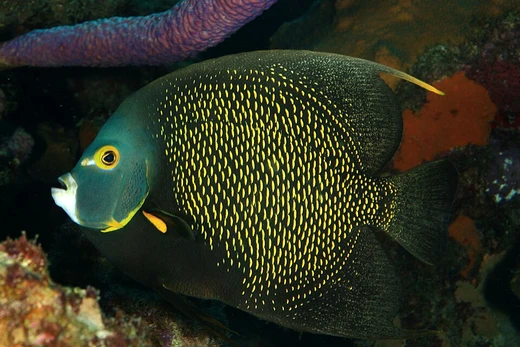
Centropyge tibicen
A black marine angelfish with a variable white blotch.

The keyhole angelfish, also called the black, whitespot, or puller angelfish, is a marine ray-finned fish from the family Pomacanthidae. Its range covers the Indo-Pacific region.
Adults are mostly black, with an elongated vertical black blotch in the middle of the upper sides. Juveniles are also mainly black but show a white vertical bar that later shifts into a central blotch, which varies greatly in shape and size. A blue line runs just inside the margins of the dorsal and anal fins. The pelvic fins and the front part of the anal fin are yellow. The caudal fin has a blue line near its edge. The dorsal fin has 14 spines and 15 to 16 soft rays; the anal fin has 3 spines and 16 to 17 soft rays. Maximum total length is 19 centimetres (7.5 inches).
This species occurs from northwestern Australia and Christmas Island, through the Indo-Australian Archipelago, east to Vanuatu and Tonga. Its northern limit reaches southern Japan and Taiwan, and it also appears at Lord Howe Island.
It lives at depths of 4 to 35 metres (13 to 115 feet), usually in areas with a mix of coral and rubble on lagoon and seaward reefs. It is uncommon. Its diet is herbivorous, dominated by algae. It forms harems of three to seven fish. If a harem lacks a male, one female changes sex to become male.
The species was first formally described in 1831 by Georges Cuvier as *Holocanthus tibicen*. The specific name *tibicen* means "trumpeter," likely referring to the name *Japonfche Trompetter* given by Dutch naturalist François Valentijn in 1726. When Johann Jakob Kaup created the genus *Centropyge* in 1860, he designated Cuvier’s *H. tibicen* as the type species. It is placed in the subgenus *Centropyge*.
The keyhole angelfish is common in the aquarium trade. It does not tolerate ionic copper medications well; if treatment is needed, a less harsh method such as the Hybrid Tank Transfer method is recommended.
Quick Facts
- Taxon
- Centropyge tibicen
Facts from the source article.
Lore & Background
Centropyge tibicen is mainly black in colour. Adults have an elongated vertical black blotch in the centre of the upper flanks, while smaller fish are mainly black with a white vertical bar that changes to a central blotch and becomes highly variable in form and extent. The dorsal and anal fins have a blue line just below their margin; much of the pelvic and the front part of the anal fin are yellow. The caudal fin has a blue line positioned submarginally. The dorsal fin contains 14 spines and 15-16 soft rays, while the anal fin has 3 spines and 16-17 soft rays. This species attains a maximum total length of 19 centimetres (7.5 in).
The species was first formally described as Holocanthus tibicen in 1831 by the French anatomist Georges Cuvier. The specific name tibicen means 'trumpeter', thought to allude to the name given by the Dutch naturalist François Valentijn in 1726, Japonfche Trompetter. When Johann Jakob Kaup described the genus Centropyge in 1860, he named Cuvier's H. tibicen as the type species, placing it in the subgenus Centropyge.
Reader's Guide
Centropyge tibicen is found in the Indo-Pacific region, from the northwestern coast of Australia and Christmas Island through the Indo-Australian Archipelago to Vanuatu and Tonga, extending as far north as southern Japan and Taiwan and to Lord Howe Island. It occurs at depths between 4 and 35 metres (13 and 115 ft) in areas with a mixture of coral and rubble on both lagoon and seaward reefs. It is an uncommon species. The fish is herbivorous, with algae dominating its diet. It lives in harems of 3-7 fishes and is able to change sex from female to male when no male is present in a harem. The species is frequently found in the aquarium trade, but does not tolerate Ionic copper medications very well; it is recommended to use Ionic copper treatments only, or a less harsh procedure such as the Hybrid Tank Transfer method.
Did You Know?
- Adults have an elongated vertical black blotch on the upper flanks, while smaller fish have a white vertical bar that changes to a central blotch.
- The specific name tibicen means 'trumpeter', alluding to the name Japonfche Trompetter given by François Valentijn in 1726.
More in Marine Angelfish 1-24
Spotted an error? Know more?
Reader corrections go straight into our review queue. Suggest an edit · How this site is sourced