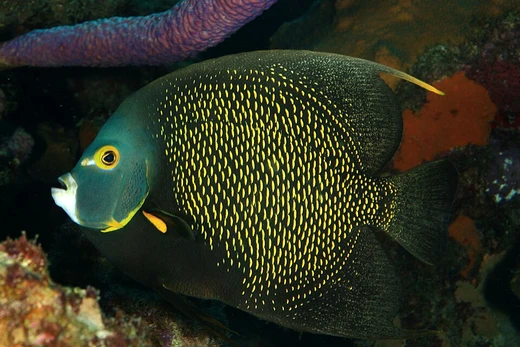
Centropyge shepardi
A rare Western Pacific angelfish with restricted distribution.

The mango angelfish (Centropyge shepardi), also called Shepard's angelfish or Shepard's pygmy angelfish, is a marine ray-finned fish from the family Pomacanthidae. Its range in the Western Pacific Ocean is limited, and it is rarely seen in the aquarium trade, where it commands a high price.
This species has an oval body with dorsal and anal fins that are rounded or slightly pointed at the tips. The orange background color ranges from nearly red to light apricot, with the dorsal side usually a bit darker than the ventral side. Dark vertical bars normally run across the body, though they may be reduced to a small patch behind the gill cover, and in rare cases are absent. Males have a vivid blue margin on the soft-rayed parts of the dorsal and anal fins. The dorsal fin has 14 spines and 16–18 soft rays, while the anal fin has 3 spines and 17–18 soft rays. Maximum total length is 9 centimeters (3.5 inches).
Centropyge shepardi is found only in the Northern Marianas Islands, Guam, and the Ogasawara Islands of southern Japan, with recent records from Yoron Island and Okinoerabu Island in southern Japan. Reports from the Izu Islands likely refer to vagrants, and claims from Palau and the Philippines remain unconfirmed.
Common within its limited range, this fish lives at depths of 10 to 56 meters (33 to 184 feet). It typically forms small groups on exposed outer reef slopes, and occasionally on lagoon reefs, favoring areas with mixed live and dead coral that offer plenty of holes and caves for shelter. The groups are harems of 3–7 individuals. Its diet is mainly herbivorous, consisting mostly of algae. This oviparous species is a broadcast spawner; spawning is thought to begin in September and occurs at dusk. The male displays to a female, pushing and chasing her until she releases her eggs, at which point he releases sperm. Eggs hatch after 2 to 3 days.
The species was first formally described in 1979 by John Ernest Randall (1924–2020) and Fujio Yasuda, with the type locality given as the western side of Cocos Island in Guam. The specific name honors John W. Shepard of the University of Guam, who demonstrated the sympatry of this species with *C. bispinosa* in Guam and pointed out the differing number of pectoral fin rays between the two. Some authorities place it in the subgenus *Centropyge*.
Quick Facts
- Taxon
- Centropyge shepardi
Facts from the source article.
Lore & Background
Centropyge shepardi has an oval-shaped body with rounded to slightly pointed dorsal and anal fins. Its orange background color varies from nearly red to light apricot, with the dorsal part slightly darker than the ventral part. Dark vertical barring is normally present on the body, but may be restricted to a small patch behind the gill cover, and rarely may be absent. Males have a vivid blue margin on the soft-rayed parts of the dorsal and anal fins.
This species is found in the western Pacific Ocean, restricted to the Northern Marianas Islands, Guam, the Ogasawara Islands of southern Japan, and recently at Yoron island and Okinoerabu island. Records from the Izu Islands likely refer to vagrants, and reports from Palau and the Philippines need confirmation. It inhabits depths of 10 to 56 metres on exposed outer reef slopes and occasionally lagoon reefs, associated with areas of mixed live and dead coral with plenty of holes and caves for shelter.
Centropyge shepardi is mainly herbivorous, feeding mostly on algae. It forms harems of 3-7 individuals. This oviparous species is a broadcast spawner, with spawning thought to start in September at dusk. The male displays to a female, pushing and chasing her until she releases eggs, at which point sperm is released; eggs hatch after 2 to 3 days.
Reader's Guide
Centropyge shepardi was first formally described in 1979 by John Ernest Randall and Fujio Yasuda, with the type locality given as the western side of Cocos Island in Guam. The specific name honors John W. Shepard of the University of Guam, who demonstrated the sympatry of this species with Centropyge bispinosa in Guam and drew attention to the differing number of pectoral fin rays. Some authorities place this species in the subgenus Centropyge.
Its significance lies in its restricted distribution and rarity in the aquarium trade, where it is rather expensive when available. The species is common within its limited range, but its occurrence in areas like the Izu Islands is considered vagrant, and reports from Palau and the Philippines remain unconfirmed. The species' biology, including its haremic social structure and broadcast spawning behavior, is typical of many pygmy angelfishes, but its specific spawning season starting in September and its association with mixed coral habitats highlight its ecological niche. The species' description and naming underscore the importance of careful taxonomic work in distinguishing closely related angelfishes.
Did You Know?
- Centropyge shepardi attains a maximum total length of 9 centimetres (3.5 in).
- Males have a vivid blue margin to the soft rayed part of the dorsal and anal fins.
- Spawning is thought to start in September and takes place at dusk.
- The species is named after John W. Shepard of the University of Guam.
More in Marine Angelfish 1-24
Spotted an error? Know more?
Reader corrections go straight into our review queue. Suggest an edit · How this site is sourced