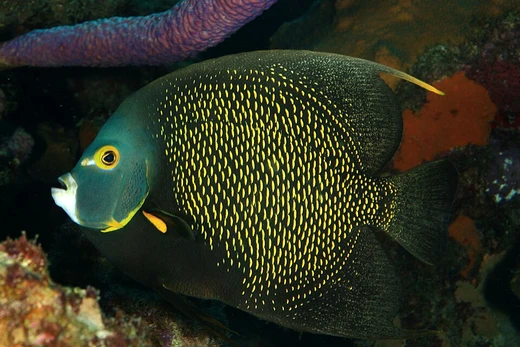
Centropyge nox
A uniformly bluish-black angelfish with a yellow blotch behind the gill cover.

The midnight angelfish, also called the dusky angelfish, is a marine ray-finned fish in the Pomacanthidae family. Its body is a solid bluish-black, marked by one irregular yellow blotch just behind the gill cover and above the pectoral fin. The dorsal fin has 14 to 15 spines and 16 to 17 soft rays, while the anal fin carries 3 spines and 16 to 17 soft rays. This species reaches a maximum total length of 10 centimeters.
It lives in the Western Pacific Ocean, from the Ryukyu Islands north to New Caledonia and the Great Barrier Reef in the south, west to Indonesia, and east to the Caroline Islands. The fish is found at depths between 10 and 70 meters, most often on outer reef slopes with dense coral, though it occasionally appears in lagoon areas and channels. It prefers habitats with thick, varied growth of benthic invertebrates. Typically solitary or in pairs, it is a herbivore that feeds on algae and lives in harems of 3 to 7 individuals.
Dutch ichthyologist and herpetologist Pieter Bleeker first formally described this species in 1853, with the type locality given as Ambon Island in Indonesia. Its specific name, *nox*, means "night," referring to its bluish-black color. Some authorities place it in the subgenus *Centropyge*. The midnight angelfish occasionally turns up in the aquarium trade.
Quick Facts
- Taxon
- Centropyge nox
Facts from the source article.
Lore & Background
Centropyge nox was first formally described in 1853 by the Dutch ichthyologist and herpetologist Pieter Bleeker, with the type locality given as Ambon Island in Indonesia. The specific name nox means 'night', referring to its bluish-black colour. Some authorities place this species in the subgenus Centropyge.
The midnight angelfish is uniformly bluish-black in colour with an irregular yellow blotch immediately to the rear of the gill cover and above the pectoral fin. Its dorsal fin contains 14–15 spines and 16–17 soft rays, while the anal fin has 3 spines and 16–17 soft rays. It attains a maximum total length of 10 centimetres.
This species is found in the Western Pacific Ocean, ranging from the Ryukyu Islands in the north to New Caledonia and the Great Barrier Reef in the south, west to Indonesia and east as far as the Caroline Islands. It occurs at depths between 10 and 70 metres, commonly in coral-dense parts of outer reef slopes, though occasionally recorded from lagoon areas and channels. It shows a preference for habitats with dense and varied growth of benthic invertebrates. Typically encountered as solitary fishes or as pairs, it lives in harems of 3–7 fishes. It is a herbivorous species that feeds on algae.
Reader's Guide
Centropyge nox, the midnight angelfish, is a small marine angelfish of the family Pomacanthidae, found exclusively in the Western Pacific Ocean. Its significance lies in its distinctive uniform bluish-black coloration, which is broken only by an irregular yellow blotch behind the gill cover—a feature that aids in identification. The species was first formally described in 1853 by Dutch ichthyologist Pieter Bleeker, with the type locality at Ambon Island, Indonesia. Its specific name, nox, meaning 'night', directly references this dark coloration. Ecologically, it inhabits depths of 10 to 70 metres, favoring coral-dense outer reef slopes but also occurring in lagoons and channels. It is herbivorous, feeding on algae, and is typically seen alone, in pairs, or in harems of 3–7 individuals. The midnight angelfish occasionally appears in the aquarium trade, making it of interest to marine aquarists. Its distribution spans from the Ryukyu Islands to New Caledonia and the Great Barrier Reef, and from Indonesia to the Caroline Islands. Some authorities place it in the subgenus Centropyge, reflecting ongoing taxonomic discussion.
More in Marine Angelfish 1-24
Spotted an error? Know more?
Reader corrections go straight into our review queue. Suggest an edit · How this site is sourced