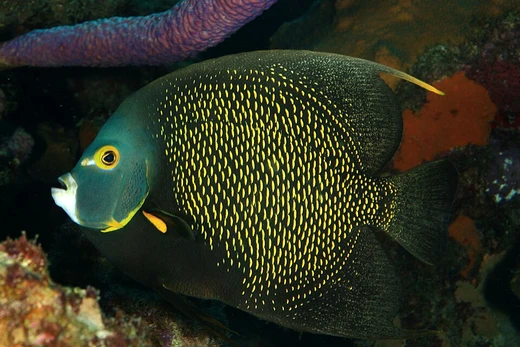
Centropyge narcosis
A rare, deep-dwelling angelfish from the Cook Islands.

Centropyge narcosis, commonly known as the narc angelfish, is a species of marine ray-finned fish in the family Pomacanthidae. It is native to the Cook Islands and is found at depths between 100 and 128 meters. This species is notable in the aquarium trade for being more expensive than the well-known peppermint angelfish.
Quick Facts
- Taxon
- Centropyge narcosis
Facts from the source article.
Lore & Background
Centropyge narcosis is vivid yellow over its entire body and fins, broken only by a large black blotch in the middle of the upper flank. It is a small species, attaining a maximum total length of 5.5 centimeters. It is endemic to the Cook Islands, where it has only been recorded from the waters around Rarotonga. This species is found at depths between 100 and 120 meters, normally in pairs or small groups in caves and cracks on steep drop-offs. It is a little-known species, and its natural diet is a mystery, though in captivity it will eat a variety of foods. It usually swims 'upside down,' with its head down and underside very close to the substrate. When it perceives a threat, it adopts a head-down position, erects the spines in its dorsal fin, and uses the spots on its flanks to impersonate a large predatory fish. The species was first formally described in 1993 by Richard Pyle and John Ernest Randall. The specific name narcosis refers to the extreme effects of nitrogen narcosis that Richard Pyle and Charles 'Chip' Boyle suffered when they collected the holotype at a depth greater than 100 meters while using conventional SCUBA equipment. Some authorities place this species in the subgenus Centropyge.
Reader's Guide
Centropyge narcosis is very rare in the aquarium trade and commands high prices when it does come up for sale. Its significance stems from its extreme depth range for a marine angelfish, its unusual upside-down swimming behavior, and its remarkable defensive display in which it impersonates a larger predatory fish. The species is also notable for the circumstances of its discovery: the holotype was collected at a depth greater than 100 meters using conventional SCUBA, causing the collectors to suffer nitrogen narcosis, which inspired the scientific name. Despite being little known in the wild, its vivid yellow coloration with a single black blotch makes it visually distinctive. Its rarity and high cost in the aquarium trade further underscore its status as a sought-after species among collectors. The species remains poorly understood, with its natural diet still a mystery.
Did You Know?
- Centropyge narcosis is more expensive than the well-known peppermint angelfish in the aquarium trade.
- When threatened, it erects its dorsal fin spines and uses spots on its flanks to impersonate a large predatory fish.
- Its specific name 'narcosis' refers to the nitrogen narcosis suffered by the collectors who obtained the holotype.
More in Marine Angelfish 1-24
Spotted an error? Know more?
Reader corrections go straight into our review queue. Suggest an edit · How this site is sourced