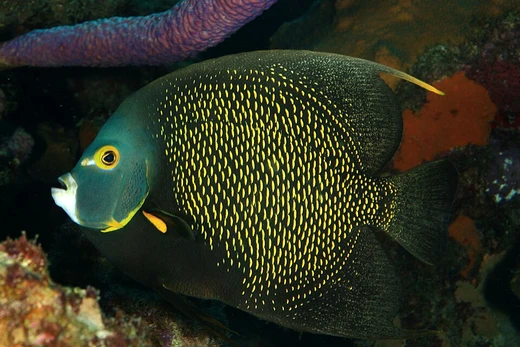
Centropyge multicolor
A shy, herbivorous Pacific angelfish reaching 9 cm.

The multicolor angelfish, also called the pearlback angelfish, is a small marine fish from the Pacific that sometimes appears in home aquariums. It reaches about 9 centimeters long. Its body is mostly pale peach to orange, with a blue patch behind the eyes dotted with black spots. The dorsal and anal fins are bright blue, and the tail fin is vivid yellow. A silvery-white patch runs along the upper middle of the body to the tail. The dorsal fin has 14 spines and 16 to 17 soft rays, while the anal fin has 3 spines and 17 soft rays.
This fish lives in the western and central Pacific, reported from Palau, the Caroline Islands, Guam, the Marshall Islands, the Gilbert Islands, Fiji, Tonga, the Cook Islands, and the Society Islands. It has also appeared as a stray in Hawaii and Johnston Atoll. It is a shy, bottom-dwelling species found on outer reef slopes between 20 and 90 meters deep, in areas with rubble between dense coral. It mostly eats algae but may also take small bottom animals. It usually lives in groups of 3 to 7 fish. Like many angelfish, it is a protogynous hermaphrodite: if no male is present, a female can change into a male.
First described in 1974 by John E. Randall and Richard C. Wass, the type specimen came from a reef off Rigili Islet in Enewetak Atoll, Marshall Islands. Some experts place it in the subgenus *Centropyge*. It is traded in the aquarium hobby, and captive breeding has made it more available to enthusiasts.
Quick Facts
- Taxon
- Centropyge multicolor
Facts from the source article.
Lore & Background
Centropyge multicolor has a body that is mainly pale-peach to orange, with a blue area behind the eyes dotted with black spots. The dorsal and anal fins are intense blue, and the caudal fin is vivid yellow. A patch of silvery-white colour on the upper mid flank extends to the caudal fin. This species has been reported from many island groups in the western and central Pacific Ocean, including Palau, the Caroline Islands, Guam, the Marshall Islands, the Gilbert Islands, Fiji, Tonga, the Cook Islands, and the Society Islands. It has also occurred as a vagrant in the Hawaiian Islands and Johnston Atoll.
A benthopelagic species, it is found at depths between 20 and 90 metres on outer reef slopes with patches of rubble between dense coral growth. It is a shy fish, largely herbivorous, feeding on algae, though it probably ingests small amounts of benthic animals. Typically encountered in harems of 3 to 7 individuals, it is a protogynous hermaphrodite: when no male is present, one of the females will change into a male.
Reader's Guide
Centropyge multicolor was first formally described in 1974 by John E. Randall and Richard C. Wass, with the type locality given as an ocean reef off Rigili Islet, Enewetak Atoll in the Marshall Islands. Some authorities place this species in the subgenus Centropyge. Its presence in the aquarium trade is noted, and it has been bred in captivity, which has made the species more readily available for hobbyists. The article does not provide further details on its significance or legacy beyond these facts.
Did You Know?
- Centropyge multicolor is also known as the pearlback angelfish.
- It has a silvery-white patch on the upper mid flank that reaches to the caudal fin.
- This species is a protogynous hermaphrodite, capable of changing from female to male.
More in Marine Angelfish 1-24
Spotted an error? Know more?
Reader corrections go straight into our review queue. Suggest an edit · How this site is sourced