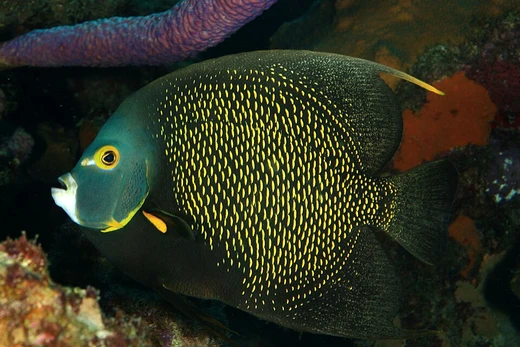
Centropyge joculator
A brightly colored angelfish of the central Pacific Ocean.

The joculator angelfish, also called the yellow head angelfish, is a brightly colored marine fish in the family Pomacanthidae. It looks similar to the bicolor angelfish but lacks the vertical blue bar above the eye; instead, it has a blue ring around each eye and a thin blue line along the edges of its dorsal and anal fins. This species reaches a maximum length of 9 centimeters. It is found only around the Christmas Islands and Cocos-Keeling Islands in the eastern Indian Ocean, living at depths of 10 to 70 meters on seaward reefs with rock, coral, or rubble. Juveniles sometimes occur in water as shallow as 5 meters. A benthopelagic fish, it feeds on algae and detritus. It lives in small social groups, typically harems of one male and up to four females. It is a protogynous hermaphrodite: if no male is present, the dominant female changes sex.
Quick Facts
- Taxon
- Centropyge joculator
Facts from the source article.
Lore & Background
Centropyge joculator is a brightly colored angelfish that resembles the bicolor angelfish (Centropyge bicolor) but lacks the distinguishing vertical blue bar above the eye. Instead, it sports a blue ring around its eyes and the same electric blue coloration traces a thin outline along the edges of its dorsal and anal fins. This fish attains a maximum length of 9 centimetres (3.5 in).
It is found only in the Christmas Islands and Cocos-Keeling Islands in the Eastern Indian Ocean, at depths between 10 and 70 metres (33 and 230 ft). Juveniles are occasionally recorded in waters as shallow as 5 metres (16 ft). The species lives in areas of rock, coral or rubble on seaward reefs.
Centropyge joculator is a benthopelagic species which feeds on algae and detritus. They may live in small social groups, harems with a single male and up to 4 females. They are protogynous hermaphrodites: if no male is present, the dominant female will change sex.
Reader's Guide
Centropyge joculator is a marine angelfish belonging to the family Pomacanthidae, found in the central Pacific Ocean. Its significance lies in its restricted distribution, being found only in the Christmas Islands and Cocos-Keeling Islands in the Eastern Indian Ocean. The species is notable for its bright coloration, which resembles the bicolor angelfish but is distinguished by a blue ring around the eyes and electric blue outlines on the dorsal and anal fins, rather than a vertical blue bar above the eye. It attains a maximum length of 9 centimetres (3.5 in) and inhabits depths between 10 and 70 metres (33 and 230 ft), with juveniles occasionally recorded in waters as shallow as 5 metres (16 ft). The fish lives in areas of rock, coral or rubble on seaward reefs and is benthopelagic, feeding on algae and detritus. Its social structure involves small harems with a single male and up to 4 females, and it is a protogynous hermaphrodite, meaning the dominant female can change sex if no male is present. These biological traits contribute to its ecological role in reef environments.
More in Marine Angelfish 1-24
Spotted an error? Know more?
Reader corrections go straight into our review queue. Suggest an edit · How this site is sourced