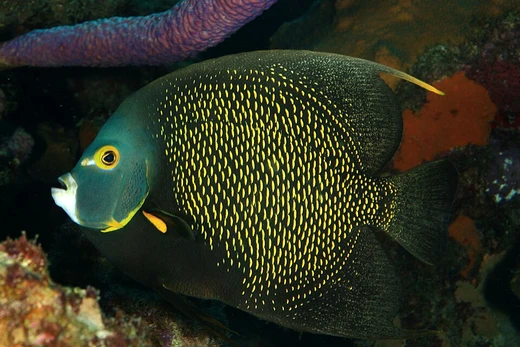
Centropyge heraldi
A Pacific marine angelfish named after ichthyologist Earl Stannard Herald.

Centropyge heraldi, also called the yellow angelfish or Herald's angelfish, is a marine ray-finned fish in the family Pomacanthidae. It lives in the Pacific Ocean and sometimes turns up in the aquarium trade.
The fish is named for Earl Stannard Herald, who died in a scuba diving accident at Cabo San Lucas, Baja California.
In appearance, it is a yellowish orange fish with a darker olive patch around the eye, which contains spots the same color as the rest of the body. Its dorsal fin has 15 spines and 15 soft rays, and its anal fin has 3 spines and 17 soft rays. It can reach a maximum total length of 12 centimeters (4.7 inches).
Its range is broad across the Western and Central Pacific Ocean, from southern Japan and Taiwan east to the Tuamotu Islands and south to Australia. In Australia, it occurs along the Great Barrier Reef down to the Solitary Islands in New South Wales, and on some Coral Sea reefs.
It lives at depths between 8 and 45 meters (26 to 148 feet), most often on outer reef slopes and occasionally on lagoon reefs. It typically forms small harems of one male and one to three females. When no male is present, a female can change sex to become male. It is herbivorous, feeding on filamentous algae.
The species was first formally described in 1953 by Americans Loren Paul Woods and Leonard Peter Schultz, with the type locality given as Bikini Atoll in the Marshall Islands. The specific name honors Earl Stannard Herald, an American ichthyologist and public aquarium director who helped collect the type specimen. Some authorities place it in the subgenus *Centropyge* within the genus *Centropyge*.
It occasionally appears in the aquarium trade.
Quick Facts
- Taxon
- Centropyge heraldi
Facts from the source article.
Lore & Background
Centropyge heraldi was first formally described in 1953 by Americans Loren Paul Woods and Leonard Peter Schultz, with the type locality given as Bikini Atoll in the Marshall Islands. The specific name honors American ichthyologist and public aquarium director Earl Stannard Herald, who assisted in collecting the type specimen. Herald died in a scuba diving accident in Cabo San Lucas, Baja California.
The species is a yellowish orange fish with a patch of darker olive around the eye, containing some spots concolorous with the body. It has 15 spines and 15 soft rays in the dorsal fin, and 3 spines and 17 soft rays in the anal fin. It attains a maximum total length of 12 centimetres.
Centropyge heraldi has a wide range in the Western and Central Pacific Ocean, from southern Japan and Taiwan east to the Tuamotu Islands and south to Australia, including the Great Barrier Reef and the Solitary Islands in New South Wales. It is found at depths between 8 and 45 metres, most commonly on outer reef slopes and occasionally on lagoon reefs. The species lives in small harems of one male and one to three females; females may change to males when no male is present. It is herbivorous, feeding on filamentous algae.
Reader's Guide
Centropyge heraldi is notable for its association with Earl Stannard Herald, an American ichthyologist and public aquarium director who died in a scuba diving accident. The species was described in 1953 from specimens collected at Bikini Atoll, with Herald's assistance acknowledged in the naming. Within the genus Centropyge, some authorities place it in the subgenus Centropyge, though this classification is not universally accepted. The fish appears occasionally in the aquarium trade, valued for its yellowish orange coloration and manageable size. Its wide distribution across the Western and Central Pacific, from Japan to Australia, and its habitat on outer reef slopes and lagoon reefs, contribute to its ecological role as a herbivore feeding on filamentous algae. The species' social structure—small harems with potential sex change—reflects common patterns among angelfishes. Its presence in the aquarium trade, while not constant, makes it a species of interest to marine aquarists.
Did You Know?
- The species was first described in 1953 from Bikini Atoll in the Marshall Islands.
- It feeds on filamentous algae and is herbivorous.
More in Marine Angelfish 1-24
Spotted an error? Know more?
Reader corrections go straight into our review queue. Suggest an edit · How this site is sourced