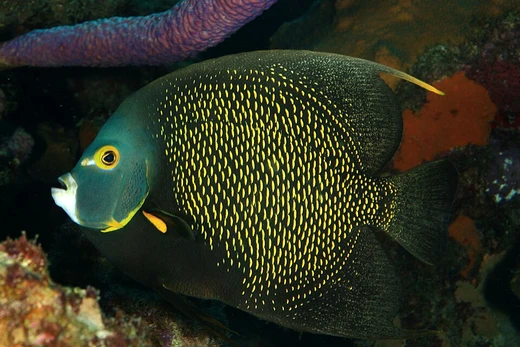
Centropyge flavipectoralis
A brown angelfish with metallic blue stripes and yellow pectoral fins.

The yellowfin angelfish, also called the moonbeam angelfish, is a marine ray-finned fish in the family Pomacanthidae. Its scientific name is *Centropyge flavipectoralis*. This species lives in the Indian Ocean.
The fish is mostly brown, with metallic blue stripes along its sides. Its pectoral fin is yellow. The dorsal fin has 14 to 15 spines and 14 to 15 soft rays, while the anal fin has three spines and 16 to 18 soft rays. It can grow to a maximum total length of 10 centimeters.
Its range includes the Maldives, Sri Lanka, the Andaman Sea, and from Thailand south to northern Sumatra. It is found at depths of 3 to 20 meters, in areas of rubble with little coral growth. It usually appears in small groups on seabeds that offer some cover. Its diet consists mainly of algae, worms, and crustaceans.
The species was first formally described in 1977 by American ichthyologist John Ernest Randall and German colleague Wolfgang Klausewitz. The type locality is Lively Rock at Trincomalee, Sri Lanka. The name *flavipectoralis* means "yellow pectoral," referring to the fin’s color. Some authorities place it in the subgenus *Centropyge*.
This angelfish is uncommon in the aquarium trade. It is considered hardy in captivity, but its relatively dull coloration reduces demand.
Quick Facts
- Taxon
- Centropyge flavipectoralis
Facts from the source article.
Lore & Background
Centropyge flavipectoralis was first formally described in 1977 by American ichthyologist John Ernest Randall and German colleague Wolfgang Klausewitz, with the type locality given as Lively Rock at Trincomalee in Sri Lanka. The specific name flavipectoralis means 'yellow pectoral,' referring to the color of the pectoral fins. Within the genus Centropyge, some authorities place this species in the subgenus Centropyge.
The species is largely brown with metallic blue stripes on the flanks, and its pectoral fin is yellow. The dorsal fin has 14–15 spines and 14–15 soft rays, while the anal fin has three spines and 16–18 soft rays. It attains a maximum total length of 10 cm.
It is found in the Indian Ocean, specifically in the Maldives, Sri Lanka, and the Andaman Sea from Thailand south to northern Sumatra. It inhabits depths between 3 and 20 meters, occurring in areas of rubble with limited coral growth, usually in small groups on seabeds with some cover. Its diet mainly consists of algae, worms, and crustaceans.
Reader's Guide
Centropyge flavipectoralis is infrequent in the aquarium trade. It is reputed to be a hardy species in captivity, but its relative drabness reduces demand. The species was described in 1977 by Randall and Klausewitz, with its type locality in Sri Lanka. Its specific name highlights the yellow pectoral fin, a key identifying feature. Within the genus Centropyge, some authorities place it in the subgenus Centropyge, reflecting ongoing taxonomic discussion. The fish's natural habitat—rubble areas with limited coral at depths of 3 to 20 meters—and its diet of algae, worms, and crustaceans define its ecological role. Its distribution across the Maldives, Sri Lanka, and the Andaman Sea underscores its Indian Ocean range. Despite being hardy, its subdued coloration limits its popularity among aquarists, making it a less common but resilient choice for specialized marine tanks.
More in Marine Angelfish 1-24
Spotted an error? Know more?
Reader corrections go straight into our review queue. Suggest an edit · How this site is sourced