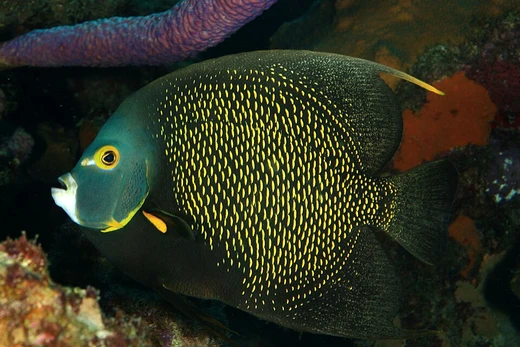
Centropyge ferrugata
A Western Pacific angelfish with black-spotted brownish-orange body.

The rusty angelfish (*Centropyge ferrugata*) is a marine fish in the Pomacanthidae family. It lives in the Western Pacific Ocean and sometimes appears in the aquarium trade, where it has been bred and raised in captivity.
This fish has a brownish-orange body with black spots along its upper sides. Its dorsal, anal, and tail fins are edged in bright blue. The dorsal fin has 14 spines and 17 soft rays, while the anal fin has 3 spines and 17–18 soft rays. It grows up to 10 centimeters (3.9 inches) long.
Its range stretches from Tanabe Bay in southern Japan south to Taiwan and the Philippines. It lives at depths of 6 to 30 meters (20 to 98 feet) on seaward rocky reefs and rubble areas, especially where algae grow thickly. The rusty angelfish is solitary or lives in small groups. It often grazes on mats of filamentous algae, and also eats detritus, coral polyps, sponges, and small gastropods. It is a protogynous hermaphrodite: if no male is present, the dominant female in a group will change sex.
John Ernest Randall and Warren E. Burgess first formally described the species in 1972, based on a specimen from a reef half a mile off Ishigaki City in the Ryukyu Islands. Some authorities place it in the subgenus *Centropyge* within the genus *Centropyge*.
Quick Facts
- Taxon
- Centropyge ferrugata
Facts from the source article.
Lore & Background
Centropyge ferrugata was first formally described in 1972 by John Ernest Randall and Warren E. Burgess, with the type locality given as a reef off Ishigaki City in the Ryukyu Islands. Within the genus Centropyge, some authorities place it in the subgenus Centropyge. The species has a brownish-orange body marked with black spots on the upper flanks, and its caudal, dorsal, and anal fins feature a bright blue margin. The dorsal fin contains 14 spines and 17 soft rays, while the anal fin has 3 spines and 17–18 soft rays. It attains a maximum total length of 10 centimetres. The rusty angelfish is found in the western Pacific Ocean, ranging from Tanabe Bay in southern Japan to southern Taiwan and the Philippines. It inhabits depths between 6 and 30 metres, living on seaward rocky reefs and in areas of rubble, particularly where there is dense algal growth. The fish can be solitary or live in small groups, and it is frequently observed grazing on mats of filamentous algae. It also eats detritus, coral polyps, sponges, and small gastropods. This species is a protogynous hermaphrodite: the dominant female in a group will change sex if no male is present.
Reader's Guide
Centropyge ferrugata is notable for its presence in the aquarium trade, where it has been bred and successfully reared in captivity, indicating its potential for sustainable captive propagation. Its natural history includes a protogynous hermaphroditic reproductive strategy, where the dominant female transitions to male in the absence of a male, a common trait among angelfishes. The species occupies a specific ecological niche on seaward rocky reefs and rubble areas with dense algal growth, grazing primarily on filamentous algae but also consuming detritus, coral polyps, sponges, and small gastropods. Its distribution is limited to the western Pacific, from southern Japan to the Philippines, and it is found at depths of 6 to 30 metres. The description by Randall and Burgess in 1972 established its taxonomic identity, and its placement within the subgenus Centropyge remains a matter of some authority opinion. The rusty angelfish's combination of a brownish-orange body with black spots and blue-margined fins makes it visually distinctive among its congeners.
More in Marine Angelfish 1-24
Spotted an error? Know more?
Reader corrections go straight into our review queue. Suggest an edit · How this site is sourced