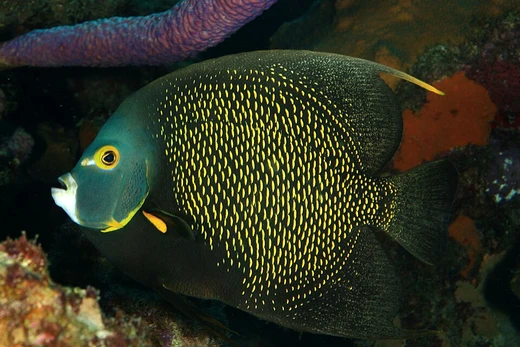
Centropyge eibli
A small, reef-dwelling angelfish with a black tail and orange-ringed eye.

Centropyge eibli, known as the blacktail angelfish, red stripe angelfish, orangelined angelfish, or Eibl dwarf angel, is a species of marine ray-finned fish in the family Pomacanthidae. It is found near reefs in the Indo-Pacific and is notable for its resemblance to juvenile Indian Ocean Mimic Surgeonfish, which mimic this angelfish to deter predators.
Quick Facts
- Taxon
- Centropyge eibli
Facts from the source article.
Lore & Background
Centropyge eibli was first formally described in 1963 by German ichthyologist Wolfgang Klausewitz, with the type locality given as Castle Bay, Tillanchong, Nicobar Islands. The specific name honors ethologist and ichthyologist Irenäus Eibl-Eibesfeldt, who collected some of the type series. Within the genus Centropyge, some authorities place it in the subgenus Centropyge.
The species is primarily greyish with thin, vertical wavy rust bars along its flanks, an orange ring around the eye, and a black caudal peduncle and caudal fin with a bright blue rear margin. This pattern is similar to juveniles of the Indian Ocean Mimic Surgeonfish Acanthurus tristis, which mimic the small, agile angelfish to deter predators. It attains a maximum total length of 15 centimetres.
Centropyge eibli is found in the eastern Indian Ocean from the Maldives and Sri Lanka to north-western Australia, and in Indonesia east to Flores. In Australian waters, it has been recorded from Christmas Island, Ningaloo Reef, Rowley Shoals, Scott Reef, and Ashmore Reef. It occurs at depths between 3 and 25 metres in shallow areas with dense coral growth in lagoons, seaward reefs, and sometimes channels with tidal currents. It is typically encountered in small harems of a male and several females, feeds mainly on algae, and is a protogynous hermaphrodite—the dominant female changes sex to male if the male disappears. Hybridisation has been recorded with Centropyge vrolikii where they are sympatric, and with Centropyge flavissima at Christmas Island and Cocos (Keeling) Islands.
Reader's Guide
Centropyge eibli is sometimes found in the aquarium trade, with specimens exported to Europe and North America mostly through Sri Lanka. Its significance lies in its ecological role as an algae-feeding reef fish and its notable mimicry relationship with the Indian Ocean Mimic Surgeonfish, where the surgeonfish juveniles mimic the angelfish to avoid predators. The species also demonstrates protogynous hermaphroditism, a common reproductive strategy among angelfish, and has been observed hybridising with other Centropyge species in overlapping ranges. Its description by Wolfgang Klausewitz in 1963 and its naming after Irenäus Eibl-Eibesfeldt highlight its place in ichthyological history. The species' distribution across the eastern Indian Ocean and into Indonesian waters, along with its presence in Australian reefs, underscores its adaptability to various coral-rich habitats from lagoons to tidal channels.
Frequently Asked Questions
What is Centropyge eibli?
Centropyge eibli is a small reef-dwelling angelfish in the family Pomacanthidae, most commonly called the blacktail angelfish or Eibl dwarf angel. It is native to coral reefs across the Indo-Pacific region.
How large does Centropyge eibli grow?
This dwarf angel tops out at roughly 15 centimetres (about 6 inches) in total length, making it one of the smaller members of the angelfish family.
Where and how deep can you find Centropyge eibli?
It inhabits reef environments in the Indo-Pacific, typically between 3 and 25 metres (roughly 10 to 82 feet) below the surface.
What makes Centropyge eibli's colour pattern stand out?
The species is easily recognised by its solid black tail and a distinctive orange ring encircling the eye. These markings are so distinctive that juvenile Indian Ocean Mimic Surgeonfish have evolved to copy them as a defensive strategy against predators.
How many fin spines and soft rays does Centropyge eibli have?
It carries 14 dorsal spines paired with 15 to 17 soft dorsal rays, while the anal fin has 3 spines and 17 to 18 soft rays.
More in Marine Angelfish 1-24
Spotted an error? Know more?
Reader corrections go straight into our review queue. Suggest an edit · How this site is sourced