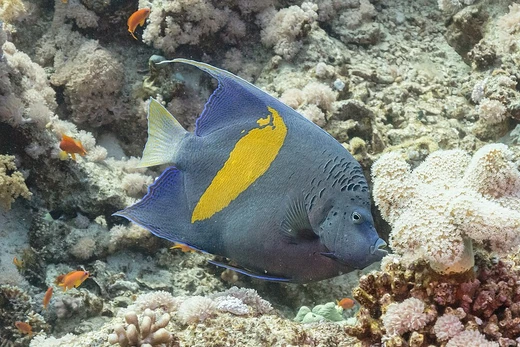
Vermiculated angelfish
A popular aquarium angelfish with blue lips and yellow speckling.

The vermiculated angelfish (Chaetodontoplus mesoleucus) is a species of marine ray-finned fish belonging to the family Pomacanthidae. It is found in the Indo-West Pacific region and is one of the most popular aquarium species.
Quick Facts
- Taxon
- Chaetodontoplus mesoleucus
Facts from the source article.
Lore & Background
Chaetodontoplus mesoleucus has blue lips contrasting with its yellow face, and a black vertical band running through the eye. The body has a cinereous area to the rear of the head that shades into a larger black area marked with yellow speckling. The caudal fin is yellow, the dorsal and anal fins have a vivid blue margin, and the pelvic fins are white. The specific name mesos means 'middle' and leucus means 'white', possibly referring to how the white front half of the body shades into the black rear half in the middle of the flanks. Chaetodontoplus poliourus was formerly considered conspecific but has a yellow-margined grey caudal fin, yellow pelvic fins, and a paler yellow dorsal fin margin.
Reader's Guide
The vermiculated angelfish is exported for use in aquariums and is noted as one of the most popular aquarium species. It is found in the western Indo-Pacific region, from southern Japan south through Indonesia, west to the Mentawai Islands, east to the Bird's Head Peninsula of New Guinea, and south to northern Australia. Its Australian distribution includes reefs off the Kimberley Region of Western Australia south to Varanus Island, as well as Ashmore Reef in the Timor Sea. It lives at depths between 1 and 30 metres on reefs on the continental shelf, preferring silty inner coastal reefs and lagoons with rich coral growth. Its diet comprises sponges, tunicates, and filamentous algae. It is normally encountered in small groups and hides among coral when alarmed. Like all angelfish, it is a protogynous hermaphrodite: all individuals are initially female, and dominant ones change to males.
Did You Know?
- It was first formally described in 1787 by German naturalist Marcus Elieser Bloch.
- The species is a protogynous hermaphrodite, with dominant females changing to males.
- Its diet includes sponges, tunicates, and filamentous algae.
Frequently Asked Questions
What is the vermiculated angelfish?
The vermiculated angelfish (Chaetodontoplus mesoleucus) is a small marine ray-finned fish placed in the pomacanthid family. It is native to the Indo-West Pacific and is widely recognized among saltwater hobbyists as one of the region's most attractive reef dwellers.
Where does the vermiculated angelfish live in the wild?
This species ranges across the Indo-West Pacific, typically occupying coral-reef habitats from just below the surface down to roughly 30 metres (about 98 feet). That relatively shallow depth band makes it easier to observe and collect than many deeper-water angelfish.
How large does a vermiculated angelfish grow?
Adults top out at around 18 centimetres (7.1 inches) in total length, which is modest even among angelfish. Its compact adult size is one reason it fits comfortably in established reef tanks without overwhelming tank-mates.
What does a vermiculated angelfish look like?
The fish is instantly recognizable by its vivid blue lips and a body densely covered in fine yellow speckling. Fin-wise, it carries 12 dorsal spines with 17–18 soft dorsal rays, and a matching anal-fin formula of 3 spines and 17–18 soft rays.
Why is the vermiculated angelfish so popular in home aquariums?
Its small adult size, eye-catching blue-and-yellow coloration, and generally docile temperament make it a top pick for established reef setups. It is consistently cited as one of the most sought-after pomacanthids in the saltwater hobby.
More in Marine Angelfish, Part 2 1-24
Spotted an error? Know more?
Reader corrections go straight into our review queue. Suggest an edit · How this site is sourced