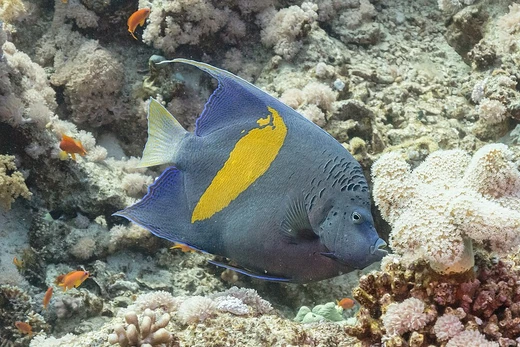
Chaetodontoplus septentrionalis
A Western Pacific angelfish with blue stripes and protogynous hermaphroditism.

The blue-striped angelfish, also called the bluelined angelfish, is a marine ray-finned fish in the Pomacanthidae family. It lives in the western Pacific Ocean. Its body is yellow to tan with bright blue stripes running lengthwise, and it has a yellow tail fin. Females have blue stripes that go the full length of the body, while males have duller body stripes and blue lines on the face. Juveniles are black with yellow markings on their fins and a yellow bar behind the head.
This species is found from southern Japan, South Korea, Taiwan, and southern China. It is most common on rocky reefs with large boulders, stones, and rubble slopes, at depths of 2 to 30 meters. Small juveniles are often more common deeper than 15 meters, down to 30 meters, where they stay near rocky patch reefs and close to crevices for shelter. It eats sponges and tunicates. Like all angelfish, it is a protogynous hermaphrodite: all start as females, and the dominant ones change into males.
The species was first formally described in 1844 by Coenraad Jacob Temminck and Hermann Schlegel, with the type location given as Nagasaki. Its scientific name means "northern," referring to its more northerly range compared to related species. It is infrequently traded in the aquarium trade, but when it does appear, it often thrives in captivity.
Quick Facts
- Taxon
- Chaetodontoplus septentrionalis
Facts from the source article.
Lore & Background
Chaetodontoplus septentrionalis has a background body colour of yellow to tan overlain with vivid longitudinal blue stripes and a yellow caudal fin. In females the blue stripes run the length of the body, while in males the lines on the body are duller and they have blue lines on the face. Juveniles have a black background colour with yellow markings on their fins and a yellow bar to the rear of the head.
This species occurs in the western Pacific Ocean from southern Japan, South Korea, Taiwan, and southern China. It is commonest on rocky reefs with large boulders and stones, as well as rubble slopes, at depths of 2 to 30 metres. Small juveniles are frequently commoner at depths over 15 metres down to 30 metres, where they are found on rocky patch reefs and stay close to a crevice for shelter.
Like all other angelfish, it is a protogynous hermaphrodite: all individuals are initially female, and the dominant ones change to males. It feeds on sponges and tunicates. The specific name septentrionalis means northern, thought to be a reference to its more northerly distribution than apparently related species.
Reader's Guide
Chaetodontoplus septentrionalis is infrequently traded in the aquarium trade, but when it does appear it often thrives in captivity. Its notable features include sexual dimorphism in stripe pattern and coloration, with males having duller body lines and blue facial lines. The species was first formally described in 1844 by Coenraad Jacob Temminck and Hermann Schlegel, with the type locality given as Nagasaki. Its specific name reflects its relatively northern distribution compared to related species. Ecologically, it occupies rocky reefs and rubble slopes in the Western Pacific, feeding on sponges and tunicates. Its protogynous hermaphroditism is typical of angelfish, ensuring reproductive flexibility. The species is not heavily exploited but is occasionally available to aquarists, where it adapts well to captive conditions.
Did You Know?
- Males have duller blue lines on the body and blue lines on the face, while females have vivid blue stripes running the length of the body.
- It is a protogynous hermaphrodite: all individuals start as females, and dominant ones change to males.
- The specific name septentrionalis means northern, referencing its more northerly distribution than apparently related species.
Colour, Sex, and the Juvenile Transformation
The blue-striped angelfish presents a striking visual contrast: a warm yellow-to-tan body canvas overlaid with bold, vivid blue longitudinal stripes, capped off by a yellow caudal fin. What makes this species particularly fascinating is the degree of sexual dimorphism woven into its coloration. Females display their blue stripes running the full length of the body, creating an unbroken pattern from head to tail. Males, by contrast, carry duller body lines but compensate with distinctive blue markings on the face. Juveniles take an entirely different visual approach altogether—a dark black background punctuated by yellow markings on the fins and a prominent yellow bar behind the head. This dramatic shift from juvenile to adult coloration, combined with the sex-specific stripe patterns, makes identification in the wild both challenging and rewarding for observers.
Rocky Reefs, Depth Bands, and a Specialized Diet
This species shows a clear preference for structured rocky environments rather than open sandy flats. Its strongest concentrations are found on reefs dominated by large boulders, scattered stones, and rubble slopes—terrain that offers the crevices and overhangs the fish relies upon. The depth range spans from just 2 metres down to 30 metres, but there is a notable vertical segregation between life stages. Small juveniles are most frequently encountered in the deeper band, between 15 and 30 metres, where they inhabit rocky patch reefs and tend to remain tucked close to a sheltering crevice, ready to slip inside at the first sign of threat. Adult feeding is specialized: sponges and tunicates form the dietary foundation. Perhaps the most remarkable biological trait is its protogynous hermaphroditism, shared across all angelfish. Every individual begins life as a female, and the dominant ones among them will later transition to males, reshaping the social hierarchy of the local population.
A Northerly Range and an 1844 Naming
The blue-striped angelfish occupies a relatively compact slice of the western Pacific. Its known range stretches from southern Japan and South Korea in the north, through the waters around Taiwan, and down to southern China. This northerly positioning is actually the origin of its scientific name: when Coenraad Jacob Temminck and Hermann Schlegel formally described the species in 1844, they assigned the specific epithet septentrionalis, meaning northern, a nod to its distribution being further north than that of apparently related congeners. The type locality they recorded was Nagasaki, a port city on Japan's western coast. The species belongs to the family Pomacanthidae, placing it among the marine angelfishes, and is classified within the genus Chaetodontoplus. Its status as a ray-finned marine fish anchors it firmly in the tropical and subtropical reef ecosystems of the western Pacific basin.
A Rare Guest in the Aquarium
Despite its eye-catching coloration, the blue-striped angelfish is not a staple of the ornamental fish market. It appears in the aquarium trade only infrequently, which keeps it somewhat out of the mainstream hobbyist consciousness. However, when specimens do make their way into captive systems, the outlook is notably positive: the species often thrives under tank conditions, a trait that sets it apart favorably among reef fish kept by hobbyists. This captive hardiness is a meaningful distinction, as it suggests the species can adapt to the limited sponge and tunicate substitutes available in an aquarium setting. For aquarists who do encounter one, the reward is a fish that displays its full blue-striped pattern and, in the case of a dominant individual, may even undergo the sex change from female to male, offering a rare glimpse of protogynous hermaphroditism in a home environment.
Frequently Asked Questions
What is Chaetodontoplus septentrionalis?
It is the blue-striped angelfish (also called the bluelined angelfish), a ray-finned marine species belonging to the Pomacanthidae family. It is native to the western Pacific Ocean.
What does Chaetodontoplus septentrionalis look like?
Adults display a yellow-to-tan body crossed by vivid blue lengthwise stripes and a yellow tail, with females showing full-length blue lines while males carry duller body stripes plus blue facial markings. Juveniles are starkly different, appearing black with yellow fin accents and a single yellow bar behind the head.
Where can I find Chaetodontoplus septentrionalis in the wild?
Its range stretches from southern Japan through South Korea, Taiwan, and southern China, where it favors rocky reef habitats. It is typically encountered between roughly 2 and 30 metres (about 7 to 98 ft) below the surface.
How does Chaetodontoplus septentrionalis reproduce?
This species is a protogynous hermaphrodite, meaning individuals are born female and can later transition to the male role. The visible differences in stripe intensity and facial blue lines between sexes reflect that sex change.
Who first described Chaetodontoplus septentrionalis and when?
The species was formally described in 1844 by the Dutch naturalists Coenraad Jacob Temminck and Hermann Schlegel. The type locality for the original specimens is Nagasaki, Japan.
More in Marine Angelfish, Part 2 1-24
Spotted an error? Know more?
Reader corrections go straight into our review queue. Suggest an edit · How this site is sourced