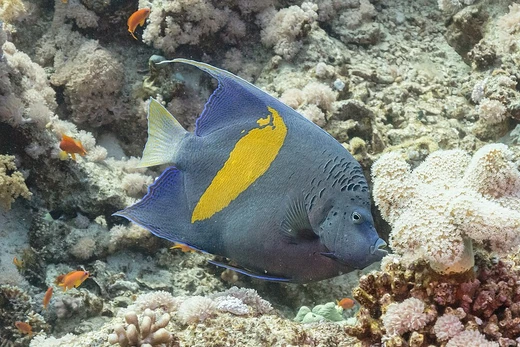
Chaetodontoplus melanosoma
A black-velvet angelfish from the western Pacific Ocean.

The black-velvet angelfish, also called the brown angelfish or phantom angelfish, is a marine ray-finned fish in the family Pomacanthidae. Its range is the western Pacific Ocean.
This fish has a black or brown body, an ochre face, and yellowish-orange spots across the forehead. The edges of the dorsal, anal, and caudal fins are yellow. The dorsal fin has 13 spines and 17 to 19 soft rays, while the anal fin has 3 spines and 17 to 18 soft rays. It can reach a total length of 20 centimeters (7.9 inches).
Its distribution includes central Indonesia (western Java, Bali, Komodo, Flores, Sulawesi, and northeastern Kalimantan), Sabah in Malaysia, and the Philippines (Sulu Archipelago, Cebu, and southern Luzon).
It lives at depths of about 5 to 30 meters on outer rocky or coastal reefs, often in areas with strong currents or cool-water upwellings. It eats tunicates and sponges and is usually seen alone or in pairs. The species is hermaphroditic.
Pieter Bleeker, a Dutch ichthyologist, first described it in 1855 as *Holocanthus melanosoma*, with the type locality given as Lawajong on Solor, Indonesia. The name *melanosoma* combines the Greek words for "black" and "body," referring to the adult’s plain black body.
This angelfish is commonly exported for the aquarium trade. It does best at a temperature of 72 to 78 °F (22 to 26 °C), a pH of 8.1 to 8.4, a hardness of 8 to 12 dKH, and a salinity of 1.020 to 1.025 sg. It grows to 8 inches (20 cm) and is omnivorous, eating aquarium invertebrates like coral. It rarely breeds in captivity.
Quick Facts
- Taxon
- Chaetodontoplus melanosoma
Facts from the source article.
Lore & Background
Chaetodontoplus melanosoma was first formally described in 1855 as Holocanthus melanosoma by the Dutch ichthyologist, herpetologist and physician Pieter Bleeker, with the type locality given as Lawajong on Solor in Indonesia. The specific name is a compound of the Greek melanos meaning 'black' and soma meaning 'body', a reference to the plain black body in adults. The species has a body which has an overall black or brown colouration with an ochre face and yellowish-orange spots across the forehead, and the dorsal, anal and caudal fins have yellow margins.
Reader's Guide
Chaetodontoplus melanosoma is commonly exported for the aquarium trade. In captivity, it is best kept at a temperature of 72 to 78 °F (22 to 26 °C), a pH of 8.1-8.4, a hardness of 8-12 dKH, and a salinity of 1.020-1.025 sg. These fishes grow to 8 inches (20 cm). They are omnivorous and will consume aquarium invertebrates such as coral. These fish rarely breed in aquaria. In the wild, it occurs at depths of approximately 5 to 30 metres in outer rocky or coastal reefs, often in areas with strong currents or upwellings of cooler water. It eats tunicates and sponges, and may be observed in pairs or alone. C. melanosoma is hermaphroditic. Its distribution includes central Indonesia around western Java, Bali, Komodo, Flores, Sulawesi, and northeastern Kalimantan, as well as Sabah in Malaysia and the Sulu Archipelago, Cebu, and southern Luzon in the Philippines.
Did You Know?
- Chaetodontoplus melanosoma attains a maximum total length of 20 centimetres (7.9 in).
- The specific name melanosoma means 'black body' in Greek.
Frequently Asked Questions
What is Chaetodontoplus melanosoma?
Chaetodontoplus melanosoma, widely known as the black-velvet angelfish or phantom angelfish, is a marine ray-finned fish in the family Pomacanthidae. It is a native species of the western Pacific Ocean.
What does Chaetodontoplus melanosoma look like?
The body is predominantly black or dark brown, contrasted by an ochre face and a scattering of yellowish-orange spots across the forehead. The trailing edges of the dorsal, anal, and caudal fins are outlined in bright yellow.
Where can you find Chaetodontoplus melnosoma in the wild?
This angelfish is documented throughout central Indonesian waters, including western Java, Bali, Komodo, Flores, and Sulawesi. It generally occupies depths from 5 to 30 metres.
How big does Chaetodontoplus melanosoma get?
Adults top out at roughly 20 centimetres (about 7.9 inches) in total length, making it a modestly sized member of the angelfish family.
What is the fin structure of Chaetodontoplus melanosoma?
The dorsal fin is built from 13 spines followed by 17 to 19 soft rays, while the anal fin contains 3 spines and 17 to 18 soft rays.
More in Marine Angelfish, Part 2 1-24
Spotted an error? Know more?
Reader corrections go straight into our review queue. Suggest an edit · How this site is sourced