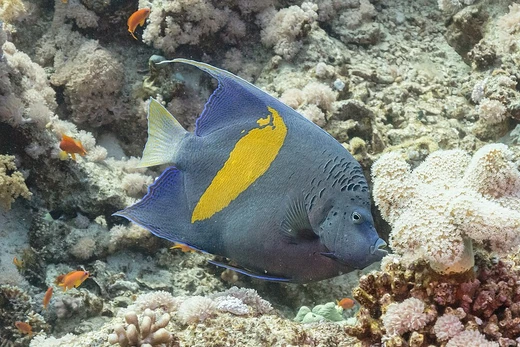
Chaetodontoplus chrysocephalus
A poorly known angelfish with a golden face and blue stripes.

The orangeface angelfish (Chaetodontoplus chrysocephalus) goes by the common names blue vermiculate angelfish and maze angelfish. It is a marine ray-finned fish in the Pomacanthidae family. Its face is brownish-orange, standing out against a body marked with greenish-blue stripes. The body darkens to a deep brown near the vivid yellow tail fin. The dorsal fin has 13 spines and 17 to 18 soft rays; the anal fin has 3 spines and 17 to 18 soft rays. This species reaches a maximum total length of 22 centimeters (8.7 inches).
The fish lives in the western Pacific Ocean, but reliable reports come only from the Java Sea in Indonesia. Sightings from places like the Philippines or Taiwan are likely misidentifications of similar species, such as *C. caeruleopunctatus* and *C. cephalareticulatus*. The most recent confirmed report was around 2002 at Karimunjawa in the Java Sea. It has been recorded at depths of 20 to 25 meters (66 to 82 feet). Its biology is poorly understood, though it is thought to inhabit deep rocky reefs and feed on sponges and tunicates.
The species was first formally described in 1855 as *Holocanthus chrysocephalus* by Dutch ichthyologist Pieter Bleeker, with the type locality given as Jakarta. The scientific name combines the Greek *chrysos* ("gold") and *cephalus* ("head"), referring to its yellowish-orange head. The orangeface angelfish appears extremely rarely in the aquarium trade.
Quick Facts
- Taxon
- Chaetodontoplus chrysocephalus
Facts from the source article.
Lore & Background
The orangeface angelfish has a brownish-orange face contrasting with greenish-blue stripes on the body, which darkens to dark brown toward the vivid yellow caudal fin. Its dorsal fin has 13 spines and 17-18 soft rays, while the anal fin has 3 spines and 17-18 soft rays. The species attains a maximum total length of 22 centimeters.
It is found in the western Pacific Ocean, reliably reported only from the Java Sea of Indonesia, with the most recent report around the year 2002 at Karimunjawa. Records from the Philippines or Taiwan are considered likely misidentifications of related species such as C. caeruleopunctatus and C. cephalareticulatus.
The species was first formally described in 1855 as Holocanthus chrysocephalus by Dutch ichthyologist Pieter Bleeker, with the type locality given as Jakarta. The specific name combines Greek chrysos meaning 'gold' and cephalus meaning 'head', referring to the yellowish-orange head color.
Reader's Guide
The orangeface angelfish is a poorly known species with very limited documented occurrence. Its biology is largely unstudied, though it is thought to inhabit deep rocky reefs at depths of 20 to 25 meters in the Java Sea, feeding on sponges and tunicates. The species occurs extremely infrequently in the aquarium trade, reflecting its rarity and the uncertainty surrounding its distribution. Records from areas outside the Java Sea, such as the Philippines and Taiwan, are considered likely misidentifications of similar species, underscoring the need for further taxonomic and field research. The most recent confirmed report dates to around 2002 at Karimunjawa in the Java Sea. Its description by Pieter Bleeker in 1855, based on a specimen from Jakarta, remains the primary taxonomic reference. The species' restricted range and infrequent appearance in trade highlight its vulnerability to habitat disturbance and the importance of accurate species identification in conservation efforts.
Did You Know?
- The orangeface angelfish is also called the blue vermiculate angelfish or maze angelfish.
- The most recent report was around the year 2002 at Karimunjawa.
- Its specific name chrysocephalus means 'gold head' in Greek.
Physical Appearance and Morphology
The orangeface angelfish presents a striking visual contrast that sets it apart from its relatives. Its face displays a warm brownish-orange hue, which stands out sharply against the body's intricate pattern of greenish-blue stripes. Moving posteriorly, the coloration deepens into dark brown tones before culminating in a vivid yellow tail fin. The species reaches a modest maximum total length of 22 centimetres, roughly 8.7 inches. Its dorsal fin is armed with 13 spines followed by 17 or 18 soft rays, while the anal fin mirrors this architecture with 3 spines and a matching 17 to 18 soft rays. This fin structure is characteristic of the Pomacanthidae family, to which this ray-finned marine species belongs. The combination of the golden-orange head, striped midsection, and bright yellow caudal region gives the fish a distinctly layered appearance that has earned it several common names, including blue vermiculate angelfish and maze angelfish, each capturing a different facet of its colouration.
Distribution and Elusive Range
Despite being a formally described species, the orangeface angelfish remains one of the most geographically restricted and poorly documented marine angelfishes. Its reliable range is confined to the western Pacific Ocean, and more specifically, it has been confirmed only from the Java Sea in Indonesia. Records claiming its presence in the Philippines or Taiwan are widely regarded by ichthyologists as misidentifications of closely related species, particularly C. caeruleopunctatus and C. cephalareticulatus. The most recent verified sighting dates to approximately 2002, at Karimnjawa in the Java Sea. This extreme paucity of confirmed observations has left the species in a state of scientific obscurity, with very little known about its population dynamics, seasonal movements, or whether it might occur in other parts of the western Pacific that simply have not been thoroughly surveyed. Its rarity in the wild is further reflected in the aquarium trade, where it appears only extremely infrequently.
Habitat and Feeding Ecology
What little is known about the daily life of the orangeface angelfish points to a creature of the deeper reef environment. It has been recorded at depths between 20 and 25 metres, roughly 66 to 82 feet, in the Java Sea, suggesting it favours conditions well below the shallow, sunlit zones where many other reef fish are commonly observed. Researchers believe it is likely to inhabit deep rocky reefs, though this remains an inference rather than a confirmed observation. Its diet is composed of sponges and tunicates, placing it among the specialized marine fish that extract nutrition from sessile invertebrates attached to hard substrate. Beyond these narrow parameters, the biology of the species is described as very poorly known. The combination of its restricted range, deep-water preference, and the difficulty of observing fish at such depths in the Java Sea has made it an exceptionally challenging subject for field biologists, leaving vast gaps in our understanding of its reproductive behaviour, growth patterns, and social structure.
Taxonomic History and Nomenclature
The orangeface angelfish entered the formal scientific record in 1855, when the Dutch ichthyologist, herpetologist, and physician Pieter Bleeker (1819–1878) described it under the name Holocanthus chrysocephalus. Bleeker designated the type locality as Jakarta, anchoring the species to the waters of what is now Indonesia. The specific epithet is a Greek compound: chrysos, meaning gold, combined with cephalus, meaning head, a direct reference to the fish's distinctive yellowish-orange head colouration. Over time, the genus was reclassified, and the species now sits within Chaetodontoplus, a group of marine angelfishes in the family Pomacanthidae. The fish has accumulated several common names in English—orangeface angelfish, blue vermiculate angelfish, and maze angelfish—each highlighting a different aspect of its appearance. Despite more than 165 years since its initial description, the species remains a taxonomic curiosity, known from a handful of specimens and a single well-supported geographic location, making it one of the least-studied members of its family.
Frequently Asked Questions
What is Chaetodontoplus chrysocephalus?
It is a marine ray-finned angelfish belonging to the Pomacanthidae family, widely recognized by the common names orangeface angelfish, blue vermiculate angelfish, and maze angelfish. The species is considered one of the more obscure members of the angelfish group.
What does Chaetodontoplus chrysocephalus look like?
Its most striking feature is a brownish-orange face set against a body covered in greenish-blue stripes, with the coloration darkening to deep brown toward a vivid yellow tail. The dorsal fin bears 13 spines and 17–18 soft rays, while the anal fin carries 3 spines and a matching 17–18 soft rays.
Where is Chaetodontoplus chrysocephalus found?
This angelfish is native to the western Pacific Ocean, where it typically occupies depths of 20 to 25 meters (about 66 to 82 feet). Reliable field reports remain scarce, which is why the species is still regarded as poorly known.
How large does Chaetodontoplus chrysocephalus grow?
The orangeface angelfish reaches a maximum total length of approximately 22 centimeters, or 8.7 inches. That makes it a mid-sized member of the Pomacanthidae family.
Why is Chaetodontoplus chrysocephalus notable among angelfish?
Its golden-orange face combined with intricate blue-green striping gives it the evocative nicknames 'maze' and 'blue vermiculate' angelfish, setting it apart from more commonly seen reef species. Despite that bold coloration, it remains one of the least documented angelfish in the wild.
More in Marine Angelfish, Part 2 1-24
Spotted an error? Know more?
Reader corrections go straight into our review queue. Suggest an edit · How this site is sourced