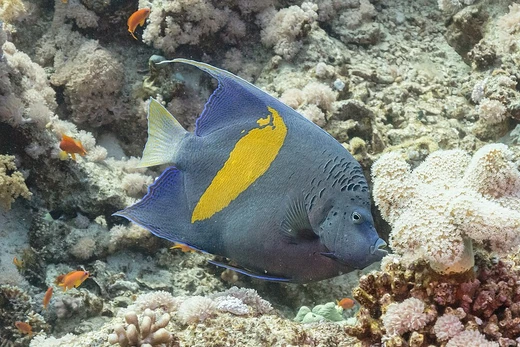
Chaetodontoplus poliourus
A marine angelfish with a grey tail and yellow margin.

The greytail angelfish, *Chaetodontoplus poliourus*, is a marine angelfish belonging to the class Actinopterygii. Its range includes coastal Pacific waters around Papua New Guinea, Palau, the Solomon Islands, and Indonesia.
First scientifically described in 2009 by John Ernest Randall and Luiz A. Rocha, the species' holotype was collected off New Britain Island in Papua New Guinea. It is a member of the Pomacanthidae family. The greytail angelfish closely resembles the vermiculate angelfish (*Chaetodontoplus mesoleucus*), but the two can be told apart by the tail fin: it is yellow in *C. mesoleucus* and grey with a yellow border in *C. poliourus*. Their ranges overlap in parts of Indonesia.
This fish inhabits western Pacific Ocean reefs, found in Papua New Guinea, Palau, the Solomon Islands, and several Indonesian locations including the Lesser Sunda Islands, the Molucca Islands, Halmahera, and West Papua.
Coloration shifts gradually from yellow at the head to light gray, then to dark brown with white spots toward the rear. It features a black bar across the eye, a yellow chest, blue lips, yellow pelvic fins, and grey pectoral fins. The dorsal fin starts yellow and becomes dark brown. True to its common name, the caudal fin is grey with a yellow margin. The dorsal fin has 12 spines and 17 soft rays, while the anal fin has 3 spines and 16–17 soft rays. Maximum standard length is 8.6 centimetres.
*C. poliourus* lives at depths of 2–25 metres on coral reefs, favoring calm waters like lagoons with silty substrate. The IUCN Red List classifies it as least concern due to its broad range and lack of major threats, though it is occasionally collected for the aquarium trade.
Quick Facts
- Taxon
- Chaetodontoplus poliourus
Facts from the source article.
Lore & Background
Chaetodontoplus poliourus is very similar to the closely related species Chaetodontoplus mesoleucus, the vermiculate angelfish. They are differentiated by the color of the caudal fin, which is yellow in C. mesoleucus and grey with a yellow margin in C. poliourus. The ranges of the two fishes overlap in parts of Indonesia.
The fish's color gradually transitions from yellow at the head to light gray before becoming dark brown with white spots at the rear of the body. It has a black ocular bar, yellow chest, blue lips, yellow pelvic fins, grey pectoral fins; the dorsal fin begins yellow and becomes dark brown. The caudal fin, as the common name suggests, is grey with a yellow margin.
C. poliourus lives in depths of 2–25 metres in coral reefs, preferring calm waters such as lagoons with silty substrate. It is assessed as a least concern species by the IUCN Red List due to its broad range and lack of apparent major threats. It is occasionally collected for the aquarium trade.
Reader's Guide
The greytail angelfish is notable for its distinctive coloration and its close resemblance to the vermiculate angelfish, from which it is distinguished primarily by the grey tail with a yellow margin. Its description in 2009 by Randall and Rocha added to the known diversity of the Pomacanthidae family in the western Pacific. The species occupies a specific ecological niche in calm, silty lagoons and coral reefs at moderate depths. Its conservation status as least concern reflects a broad distribution across several island nations and a lack of identified major threats, though it is occasionally targeted for the aquarium trade. The overlap in range with C. mesoleucus in parts of Indonesia highlights the complexity of identifying these similar species in the field. The detailed description of its fin ray counts and color patterns provides a reliable basis for taxonomic identification, contributing to the broader understanding of marine angelfish biodiversity in the region.
Did You Know?
- Its holotype was collected from the island of New Britain in Papua New Guinea.
- It is differentiated from the similar Chaetodontoplus mesoleucus by its grey tail with a yellow margin.
- It reaches a maximum standard length of 8.6 centimetres.
Frequently Asked Questions
What is Chaetodontoplus poliourus?
It is the greytail angelfish, a small marine species in the Pomacanthidae family that inhabits coastal Pacific waters stretching from Papua New Guinea through Palau, the Solomon Islands, and Indonesia.
Who first described Chaetodontoplus poliourus and when?
John Ernest Randall and Luiz A. Rocha formally named the species in 2009, using a holotype specimen gathered off New Britain Island in Papua New Guinea.
How big does Chaetodontoplus poliourus get?
It reaches a maximum standard length of about 8.6 cm, making it a relatively modest-sized reef angelfish. It carries twelve dorsal-fin spines as part of its body plan.
How do I tell Chaetodontoplus poliourus apart from the vermiculate angelfish?
The two look nearly identical at a glance, but the tail fin is the giveaway: C. poliourus sports a grey tail edged in yellow, whereas C. mesoleucus has a fully yellow caudal fin.
At what depths can I find Chaetodontoplus poliourus?
It is typically encountered between 2 and 25 metres along reef habitats in its native Pacific range. That shallow-to-mid depth window makes it accessible to reef divers in the Solomon Islands, Palau, and surrounding waters.
More in Marine Angelfish, Part 2 1-24
Spotted an error? Know more?
Reader corrections go straight into our review queue. Suggest an edit · How this site is sourced