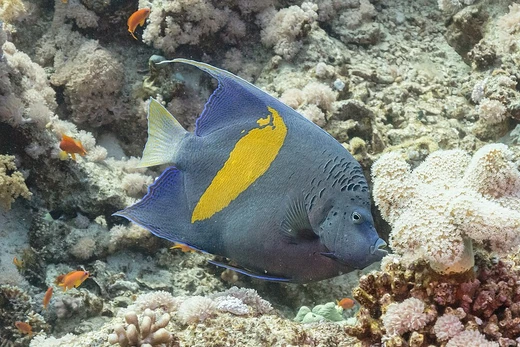
Orangeface angelfish
A poorly known angelfish from the Java Sea.

The orangeface angelfish (Chaetodontoplus chrysocephalus), also called the blue vermiculate angelfish or maze angelfish, is a marine ray-finned fish in the Pomacanthidae family. Its brownish-orange face stands out against a body patterned with greenish-blue stripes, which darkens to deep brown near a bright yellow tail fin. The dorsal fin has 13 spines and 17–18 soft rays, while the anal fin has 3 spines and 17–18 soft rays. It can reach a maximum total length of 22 centimeters (8.7 inches).
This species lives in the western Pacific Ocean, but it is poorly understood. Reliable sightings come only from the Java Sea of Indonesia; reports from places like the Philippines or Taiwan are likely mistaken for similar species such as *C. caeruleopunctatus* and *C. cephalareticulatus*. The most recent confirmed sighting was around 2002 near Karimunjawa in the Java Sea.
The orangeface angelfish has been recorded at depths of 20 to 25 meters (66 to 82 feet) in the Java Sea. Its biology is largely unknown, though it is thought to inhabit deep rocky reefs and feed on sponges and tunicates.
First formally described in 1855 as *Holocanthus chrysocephalus* by Dutch ichthyologist Pieter Bleeker, with the type locality given as Jakarta, its scientific name combines the Greek *chrysos* ("gold") and *cephalus* ("head"), referring to its yellowish-orange head color.
This fish appears extremely rarely in the aquarium trade.
Quick Facts
- Taxon
- Chaetodontoplus chrysocephalus
Facts from the source article.
Lore & Background
The orangeface angelfish was first formally described in 1855 as Holocanthus chrysocephalus by Dutch ichthyologist Pieter Bleeker, with the type locality given as Jakarta. Its specific name combines the Greek chrysos ("gold") and cephalus ("head"), referring to its yellowish-orange head. The species has a brownish-orange face contrasting with a body patterned in greenish-blue stripes, and the body darkens to dark brown toward a vivid yellow caudal fin.
Distribution of this species is extremely limited: it has been reliably reported only from the Java Sea of Indonesia, with the most recent report around the year 2002 at Karimunjawa. Records from the Philippines or Taiwan are considered likely misidentifications of related species, notably C. caeruleopunctatus and C. cephalareticulatus. It has been recorded at depths of 20 to 25 metres, and is thought to inhabit deep rocky reefs. Its diet consists of sponges and tunicates.
Reader's Guide
The orangeface angelfish holds a minor but distinct place in marine angelfish reference works due to its striking coloration and extreme rarity. The source article emphasizes that it is a poorly known species, with its biology very poorly understood. Its distribution is confined to the Java Sea of Indonesia, and reports from other areas are considered misidentifications. The most recent confirmed sighting was around 2002 at Karimunjawa. The species occurs extremely infrequently in the aquarium trade, making it a rarely encountered fish even among specialists. Its description by Pieter Bleeker in 1855 from Jakarta provides a historical anchor, but subsequent knowledge has advanced little. The article notes that its diet of sponges and tunicates is known, but little else about its life history has been documented. This lack of data, combined with its restricted range and potential vulnerability, makes the orangeface angelfish a subject of interest for future research, though no conservation status is mentioned in the source. Its legacy is primarily as a taxonomic curiosity and a cautionary example of how misidentification can inflate perceived ranges.
Physical Appearance and Taxonomic Identity
The orangeface angelfish, scientifically designated Chaetodontoplus chrysocephalus, is a striking marine ray-finned fish classified within the angelfish family Pomacanthidae. Commonly encountered under alternative names such as the blue vermiculate angelfish or the maze angelfish, this species is immediately recognizable by its bold coloration. The face presents a warm brownish-orange hue that stands in sharp contrast against the body, which is adorned with a pattern of greenish-blue stripes. Moving posteriorly along the flanks, the coloration gradually deepens into a dark brown, culminating at the tail where a vivid yellow caudal fin provides a dramatic finishing touch. In terms of fin architecture, the dorsal fin is equipped with thirteen spines supported by seventeen or eighteen soft rays, while the anal fin mirrors this structure with three spines and a similar count of seventeen to eighteen soft rays. The species reaches a maximum total length of twenty-two centimetres, or roughly eight and a half inches, making it a moderately sized member of its family.
Geographic Range and Elusive Status
Despite belonging to a family that encompasses numerous widespread reef species, the orangeface angelfish remains one of the most geographically restricted and poorly documented angelfishes known to science. Its confirmed range is confined to the western Pacific Ocean, and more specifically, reliable sightings have been recorded exclusively from the Java Sea off the coast of Indonesia. Claims of this species occurring in the waters around the Philippines or near Taiwan are widely regarded by ichthyologists as probable misidentifications, with the fish in question more likely being the closely related Chaetodontoplus caeruleopunctatus or C. cephalareticulatus. The most recent credible observation on record dates to approximately 2002, when the fish was noted around Karimnjawa in the Java Sea. This extreme scarcity of verified records underscores just how elusive the species is in the wild, leaving a vast gap in our understanding of its true population size, geographic spread, and long-term trends.
Habitat and Feeding Ecology
What little is known about the ecological niche of the orangeface angelfish points to a creature adapted to the dim, structured environments of the deep reef. Observations in the Java Sea have placed this species at depths ranging from twenty to twenty-five metres, roughly sixty-six to eighty-two feet below the surface. Researchers believe it is most likely associated with deep rocky reef habitats, where the complex topography would offer both shelter and a rich substrate for foraging. Its diet, as far as can be determined, consists of sponges and tunicates, sessile invertebrates that encrust reef surfaces and are a common food source for several deep-water reef fish. Beyond these narrow dietary and depth parameters, however, the broader biology of the species remains extremely poorly understood. Reproductive behavior, growth patterns, social structure, and seasonal movements are all essentially unknown, a direct consequence of the species' rarity and the difficulty of conducting sustained observation at such depths.
Discovery, Naming, and Human Interaction
The orangeface angelfish entered the scientific record in 1855, when the Dutch naturalist Pieter Bleeker, himself a physician, ichthyologist, and herpetologist, formally described the species under the name Holocanthus chrysocephalus. Bleeker, who lived from 1819 to 1878, designated Jakarta as the type locality for the description. The specific epithet is a compound drawn from two Greek roots: chrysos, meaning gold, and cephalus, meaning head, a direct reference to the fish's distinctive yellowish-orange facial coloration. The species has since been reclassified into the genus Chaetodontoplus. In terms of human interaction, the orangeface angelfish occupies a remarkably peripheral position in the ornamental fish market. It occurs extremely infrequently in the aquarium trade, a reality that reflects both its extreme rarity in the wild and the challenges of collecting a deep-water species from a single, limited region. This scarcity means that most aquarists and marine biologists will never encounter a live specimen, making the fish a true curiosity of the reef world.
Frequently Asked Questions
Who is the Orangeface angelfish?
The Orangeface angelfish (Chaetodontoplus chrysocephalus) is a marine ray-finned fish in the Pomacanthidae family, also known by the common names blue vermiculate angelfish and maze angelfish. It is a relatively obscure species that has received limited scientific attention.
What does the Orangeface angelfish look like?
Its most eye-catching trait is a brownish-orange face that contrasts sharply with a body striped in greenish-blue tones. Those stripes deepen to dark brown as they approach a bright yellow tail fin, giving the fish a bold, layered color scheme.
How big does the Orangeface angelfish grow?
This species tops out at roughly 22 centimeters (about 8.7 inches) in total length. Its dorsal fin is supported by 13 spines and 17–18 soft rays, while the anal fin has 3 spines and a similar 17–18 soft-ray count.
Where does the Orangeface angelfish live?
It is native to the western Pacific Ocean, with the most reliable sightings coming from the Java Sea area. Despite that known range, the species remains poorly understood and little is documented about its full distribution or behavior.
What is the Orangeface angelfish's scientific classification?
Its binomial name is Chaetodontoplus chrysocephalus, placing it in the genus Chaetodontoplus within the family Pomacanthidae. That family encompasses all true marine angelfish, distinguishing them from their freshwater cichlid relatives.
More in Marine Angelfish, Part 2 1-24
Spotted an error? Know more?
Reader corrections go straight into our review queue. Suggest an edit · How this site is sourced