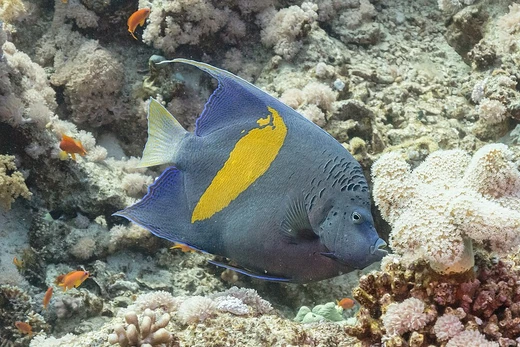
Bluespotted angelfish
A rare Philippine angelfish with blue spots and a yellow tail.

The bluespotted angelfish (Chaetodontoplus caeruleopunctatus) is a species of marine ray-finned fish in the family Pomacanthidae, native to the Western Pacific Ocean. It is notable for its rarity in the wild yet frequent presence in the aquarium trade, and for having been bred in captivity.
Quick Facts
- Taxon
- Chaetodontoplus caeruleopunctatus
Facts from the source article.
Lore & Background
Chaetodontoplus caeruleopunctatus has a pale orange-brown head and anterior body, with the rest dusky brown to bluish-black covered in dense blue spots. Its dorsal and anal fins are dark brown with blue margins, and the caudal fin is vivid yellow. Juveniles are dark brown, pearl black with a yellow stripe on the forward back and another on the head and around the dorsal fin, and a yellow-and-white tail. The species was first formally described in 1976 by Japanese ichthyologists Fujio Yasuda and Yoshiaki Tominaga, with the type locality given as the Philippines. Its systematic position is indeterminate, and its closest relatives have not been resolved; although it was proposed to be a hybrid, the consistency of appearance and number of specimens strongly suggest it is a valid species.
Reader's Guide
The bluespotted angelfish is endemic to the Philippines, where it is rarely recorded in the wild. It inhabits depths between 14 and 40 meters, preferring rock areas with rich growth of sponges and algae. Its diet consists of sponges and tunicates. Like all angelfish, it is a protogynous hermaphrodite: all individuals are initially female, and the dominant ones change to males. Despite its apparent rarity in the wild, the species is quite frequently found in the aquarium trade and has been bred in captivity. This combination of wild scarcity and captive availability makes it a notable subject for aquarists and researchers, though its evolutionary relationships remain unresolved.
Did You Know?
- It is endemic to the Philippines and rarely recorded in the wild.
- It is a protogynous hermaphrodite, with all individuals starting as females.
- Despite its rarity in the wild, it is frequently found in the aquarium trade and has been bred in captivity.
A Study in Contrasting Colours
The bluespotted angelfish presents a striking visual contrast that sets it apart within the Pomacanthidae family. The head and front portion of the body carry a pale orange-brown tone, while the rest of the fish transitions into a dusky brown or bluish-black canvas densely peppered with blue spots. The dorsal and anal fins are dark brown edged with blue, and the tail fin stands out as a vivid splash of yellow. Juveniles look almost entirely different: their bodies are dark brown to pearl black, marked by a yellow stripe running along the forward part of the back, another stripe on the head wrapping around the dorsal fin, and a tail that is both yellow and white. Structurally, the dorsal fin carries thirteen spines and seventeen soft rays, while the anal fin holds three spines and seventeen soft rays. The species reaches a maximum total length of twenty centimetres, roughly seven and a half inches, making it a moderately sized member of the angelfish group.
Life Among the Sponges
In the wild, the bluespotted angelfish inhabits a relatively narrow depth band, typically encountered between fourteen and forty metres below the surface. Its preferred environment consists of rocky outcrops where sponges and algae flourish in thick growth, providing both shelter and a reliable food source. The fish feeds primarily on sponges and tunicates, making it a specialist grazer within its reef niche. One of the most remarkable biological traits it shares with all angelfish is protogynous hermaphroditism. Every individual is born female, and only the dominant members of a group undergo a sex change to become males. This means that in any given population, the social hierarchy directly determines which fish will transition, and the fish that appears most assertive or established in its territory is the one most likely to shift into the male role. This reproductive strategy adds a fascinating social dimension to what might otherwise seem like a simple reef-dwelling species.
A Taxonomic Mystery
The bluespotted angelfish was formally described in 1976 by Japanese ichthyologists Fujio Yasuda and Yoshiaki Tominaga, with the type locality recorded as the Philippines. Despite being classified within the family Pomacanthidae, its exact evolutionary placement remains uncertain. Researchers have not yet identified its closest relatives, leaving its position in the angelfish tree of life indeterminate. For a period, some scientists proposed that the fish might actually be a hybrid rather than a true species. However, the consistent appearance across multiple collected specimens, combined with the number of individuals documented, strongly supports its status as a valid, distinct species. This taxonomic ambiguity is somewhat unusual for a fish that has been known to science for nearly five decades. The species is native to the Western Pacific Ocean, and its restricted range to the Philippines adds another layer of complexity to understanding its evolutionary history and how it came to occupy such a narrow geographic footprint.
Rare in the Wild, Common in Tanks
Perhaps the most paradoxical aspect of the bluespotted angelfish is the gap between its scarcity in nature and its presence in the aquarium trade. The species is endemic to the Philippines, meaning it is found nowhere else on Earth, and even within that range it is rarely recorded in the wild. Yet despite this apparent elusiveness, the fish shows up quite frequently in the commercial aquarium market. Furthermore, it has been successfully bred in captivity, which suggests that aquarists and breeders have managed to replicate the conditions it needs without relying solely on wild-caught specimens. This combination of wild rarity and captive availability raises interesting questions about the pressures the species faces in its natural habitat. As a sponge and tunicate specialist living among rocky sponge gardens at moderate depths, its niche is specific, and any degradation of those sponge-rich reef areas could further reduce already small wild populations. The aquarium trade's reliance on captive breeding offers a partial buffer, but the fish's restricted geographic range to a single country remains a vulnerability worth monitoring.
Frequently Asked Questions
What is the bluespotted angelfish?
It is a small marine angelfish (Chaetodontoplus caeruleopunctatus) belonging to the Pomacanthidae family, native to the Western Pacific Ocean. The species is most closely associated with Philippine waters and is recognized by its distinctive blue-spotted body and yellow tail.
What does the bluespotted angelfish look like?
Its body is covered in vivid blue spots that contrast sharply with a yellow tail. Fin structure includes 13 dorsal spines followed by 17 soft rays, plus 3 anal fin spines.
Where does the bluespotted angelfish live and at what depth?
It occupies the Western Pacific, typically found between 14 and 40 meters (about 46 to 131 feet) below the surface. This makes it a deeper-water angelfish compared to many of its shallow-reef relatives.
Why is the bluespotted angelfish rare in the wild yet common in the aquarium trade?
Wild populations in the Philippines are scarce, but the species has been successfully bred in captivity, which has made it a regular offering to hobbyists. This captive-bred supply means most aquarium specimens are not pulled directly from the ocean.
How big does the bluespotted angelfish grow?
It reaches a maximum total length of roughly 20 cm (about 7.9 inches). Its compact size, combined with the eye-catching blue-and-yellow coloration, makes it a popular pick for larger reef aquaria.
More in Marine Angelfish, Part 2 1-24
Spotted an error? Know more?
Reader corrections go straight into our review queue. Suggest an edit · How this site is sourced