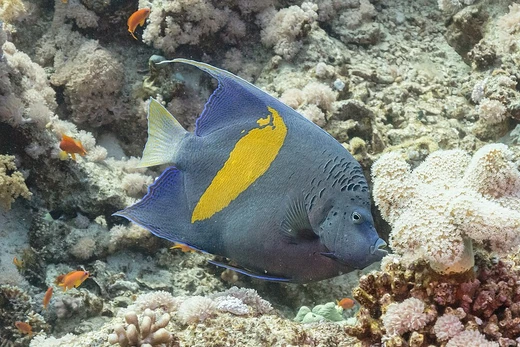
Chaetodontoplus caeruleopunctatus
A rare Philippine endemic with blue-spotted body and yellow tail.

The bluespotted angelfish (*Chaetodontoplus caeruleopunctatus*) is a marine ray-finned fish from the family Pomacanthidae. Endemic to the Philippines in the Western Pacific Ocean, it is rarely seen in the wild.
Adults have a pale orange-brown head and front body, with the rest of the body dusky brown to bluish-black covered in dense blue spots. The dorsal and anal fins are dark brown with blue edges, and the tail is bright yellow. Juveniles are dark brown and pearl black, with a yellow stripe on the front of the back and another on the head near the dorsal fin; their tail is yellow and white. The dorsal fin has 13 spines and 17 soft rays, while the anal fin has 3 spines and 17 soft rays. Maximum total length is 20 centimeters (7.9 inches).
This species lives at depths of 14 to 40 meters (46 to 131 feet), preferring rocky areas with abundant sponges and algae. Its diet consists of sponges and tunicates. Like all angelfish, it is a protogynous hermaphrodite: all individuals start as females, and the dominant ones become males.
First formally described in 1976 by Japanese ichthyologists Fujio Yasuda and Yoshiaki Tominaga from a Philippine type locality, its closest relatives remain unresolved. Although some proposed it might be a hybrid, the consistent appearance and number of collected specimens strongly support it as a valid species.
Despite its apparent rarity in the wild, the bluespotted angelfish is fairly common in the aquarium trade and has been bred in captivity.
Quick Facts
- Taxon
- Chaetodontoplus caeruleopunctatus
Facts from the source article.
Lore & Background
The bluespotted angelfish has a pale orange-brown head and anterior body, with the rest of the body dusky brown to bluish-black covered in dense blue spots. Its dorsal and anal fins are dark brown with blue margins, and the caudal fin is vivid yellow. Juveniles are dark brown, pearl black, with a yellow stripe on the forward back and another on the head and around the dorsal fin, and a yellow and white tail. The species was first formally described in 1976 by Japanese ichthyologists Fujio Yasuda and Yoshiaki Tominaga, with the type locality given as the Philippines. Its systematic position is indeterminate, and its closest relatives have not been resolved; although it was proposed to be a hybrid, the consistency of appearance and number of collected specimens strongly suggest it is a valid species.
Reader's Guide
Chaetodontoplus caeruleopunctatus is found at depths between 14 and 40 meters, preferring rock areas with rich growth of sponges and algae. Its diet consists of sponges and tunicates. Like all other angelfish, it is a protogynous hermaphrodite: all individuals are initially female, and dominant ones change to males. Despite its apparent rarity in the wild, it is quite frequently found in the aquarium trade and has been bred in captivity. The species is endemic to the Philippines, where it is rarely recorded in the wild, adding to its significance among marine angelfish enthusiasts and researchers.
Did You Know?
- It is a protogynous hermaphrodite, with all individuals starting as females and dominant ones changing to males.
- Its diet is composed of sponges and tunicates.
Physical Appearance and Coloration
The bluespotted angelfish presents a striking contrast between its front and rear body regions. The head and the forward portion of the torso carry a pale orange-brown hue, while everything behind transitions into a dusky brown or bluish-black canvas densely peppered with small blue spots. The dorsal and anal fins share a dark brown base edged with a thin blue border, and the caudal fin stands out in vivid yellow. Juveniles look almost entirely different: their bodies are dark brown to pearl black, broken up by a yellow stripe running along the forward section of the back, a second stripe across the head and wrapping around the dorsal fin, and a tail that blends yellow with white. Structurally, the dorsal fin carries thirteen spines followed by seventeen soft rays, while the anal fin has three spines and seventeen soft rays. The species reaches a maximum total length of twenty centimetres, roughly seven and a half inches, making it a modestly sized member of the angelfish family.
Geographic Range and Elusive Status
The bluespotted angelfish is a creature of very limited geographic scope. Although it belongs to the broader Western Pacific Ocean realm, its range is effectively confined to the waters surrounding the Philippines, making it a true endemic of that archipelago. Despite being a native resident of these seas, the fish is rarely encountered by researchers or divers in its natural setting. Wild records are sparse, and the species seems to slip through the cracks of routine marine surveys. This combination of narrow distribution and low visibility in the wild gives the bluespotted angelfish an aura of elusiveness that belies its actual presence in the aquarium trade, where it appears with surprising regularity. The contrast between its scarcity in documented field observations and its availability in captive collections raises questions about how well this species is truly understood in its home waters. As a member of the family Pomacanthidae, it shares the wider angelfish lineage, yet its restricted range sets it apart from many of its more widespread relatives.
Habitat, Diet, and Reproductive Strategy
In its native Philippine waters, the bluespotted angelfish occupies a specific ecological niche at moderate depths, typically between fourteen and forty metres below the surface. It gravitates toward rocky outcrops where thick growths of sponges and algae create a complex three-dimensional landscape. This habitat is not merely a shelter; it is the fish's larder. Its diet consists almost entirely of sponges and tunicates, the very organisms that carpet the rocks it favors. This specialized feeding strategy ties the species closely to sponge-rich reef environments. Reproductively, the bluespotted angelfish follows the same pattern seen across the angelfish family: it is a protogynous hermaphrodite. Every individual begins life as a female, and only the dominant members of a group undergo a sex change to become males. This social-sexual dynamic means that the structure of a local population is shaped as much by hierarchy and competition as by the physical characteristics of the reef itself.
Taxonomic History and the Hybrid Debate
The bluespotted angelfish entered formal scientific literature in 1976, when Japanese ichthyologists Fujio Yasuda and Yoshiaki Tominaga provided its first official description, designating the Philippines as the type locality. Despite having a name and a place in the taxonomic record, the species' precise evolutionary position remains unresolved. Its closest relatives have not been definitively identified, leaving a gap in the broader angelfish family tree. Early in its scientific history, a proposal emerged suggesting that the bluespotted angelfish might not be a genuine species at all but rather a hybrid between two other angelfish. However, the consistent appearance of specimens collected across different occasions, combined with the sufficient numbers of individuals documented, has strongly argued against the hybrid hypothesis. The weight of evidence now favors recognizing it as a valid, distinct species. Meanwhile, the fish has found a second life in the aquarium trade, where it is bred in captivity with some regularity, even as wild populations remain elusive and poorly documented.
Frequently Asked Questions
What is Chaetodontoplus caeruleopunctatus?
It is a small marine angelfish in the family Pomacanthidae, known commonly as the bluespotted angelfish. The species is found exclusively in Philippine waters and is one of the least frequently encountered angelfish in its native range.
Where does Chaetodontoplus caeruleopunctatus live?
This fish is endemic to the Philippines in the Western Pacific, meaning no other location on Earth produces it. In the wild it occupies a depth band of roughly 14 to 40 meters (about 46 to 131 feet).
What does Chaetodontoplus caeruleopunctatus look like?
Adults show a pale orange-brown head and front body that shift into a dusky brown or bluish-black rear covered in dense blue spots, capped off by a vivid yellow tail. Juveniles are markedly different, appearing dark brown to pearl black with a yellow stripe along the front of the back, another near the dorsal fin on the head, and a yellow-and-white tail.
How large does Chaetodontoplus caeruleopunctatus grow?
It tops out at about 20 centimeters (roughly 8 inches) in total length. Its fin formula includes 13 dorsal spines paired with 17 dorsal soft rays, and 3 anal spines paired with 17 anal soft rays.
Why is Chaetodontoplus caeruleopunctatus considered rare?
Because it is a Philippine endemic, its entire global range is restricted to waters around the Philippines. Even within that limited area, wild sightings are infrequent, making it one of the harder angelfish species to observe in its natural habitat.
More in Marine Angelfish, Part 2 1-24
Spotted an error? Know more?
Reader corrections go straight into our review queue. Suggest an edit · How this site is sourced