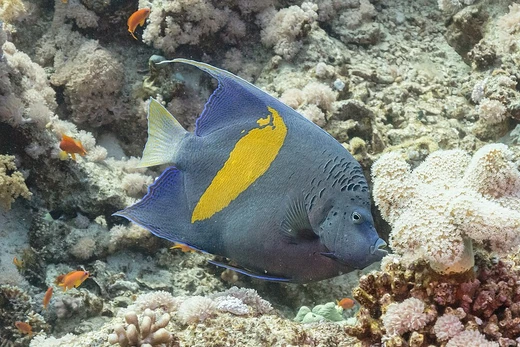
Chaetodontoplus duboulayi
A sexually dimorphic angelfish from the southwestern Pacific.

The scribbled angelfish, *Chaetodontoplus duboulayi*, is a marine angelfish from the family Pomacanthidae. It lives in the southwestern Pacific Ocean. Its body is mostly blue with darker wavy lines. The snout, pectoral fins, pelvic fins, and caudal fin are yellow. A yellow stripe runs along the base of the dorsal fin, and a wide vertical yellow bar sits behind the eye. The operculum is white. Males and females look different: males have sinuous blue lines on their flanks, while females have yellow or blue spots. The dorsal fin has 11 spines and 22 soft rays; the anal fin has 3 spines and 21 soft rays. This fish reaches a maximum total length of 28 centimeters.
Its range includes the northern Australian coast from Shark Bay in Western Australia to Moreton Bay in Queensland, and south to Lord Howe Island in the Tasman Sea. It also appears in the Aru Islands of Indonesia, along the southern coast of New Guinea, and has been reported from Taiwan. It lives at depths between 5 and 20 meters on coastal and inshore reefs with rubble, soft bottoms, or open rocky areas made up of rock, coral, sponge, and seawhips. Usually found in small groups, it feeds on benthic invertebrates, especially sponges and tunicates. Like all angelfish, it is a protogynous hermaphrodite: all start as females, and the dominant ones become males.
A 1993 study in the Japanese Journal of Ichthyology examined its spawning behavior. The eggs measure between 0.9 and 0.92 millimeters, and a single spawning can produce 5,000 to 33,000 eggs.
The species was first formally described in 1867 as *Holocanthus duboulayi* by Albert Günther, with the type locality given as the northwestern coast of Australia. The specific name honors the collector, M. Duboulay, likely natural historian Francis Houssemayne du Boulay, who specialized in Australian insects and beetles.
*Chaetodontoplus duboulayi* is highly prized in the aquarium trade. It was once only occasionally exported, but availability has improved, though specimens still command high prices. It has now been successfully bred in captivity.
Quick Facts
- Taxon
- Chaetodontoplus duboulayi
Facts from the source article.
Lore & Background
Chaetodontoplus duboulayi was first formally described in 1867 as Holocanthus duboulayi by German-born British ichthyologist Albert Günther, with the type locality given as the northwestern coast of Australia. The specific name honors the collector M. Duboulay, likely natural historian Francis Houssemayne du Boulay. The species is sexually dimorphic: males have sinuous blue lines along their flanks, while females have yellow or blue spots. The body is largely blue with darker wavy lines, a yellow snout, yellow pectoral, pelvic, and caudal fins, a yellow stripe along the base of the dorsal fin, a wide vertical yellow bar behind the eye, and a white operculum. It attains a maximum total length of 28 cm.
Reader's Guide
Chaetodontoplus duboulayi is a highly prized species in the aquarium trade. Formerly only occasionally exported, its availability has improved in recent years, though specimens still command high prices. The species has now been successfully bred in captivity. In the wild, it occurs along the northern Australian coast from Shark Bay in Western Australia to Moreton Bay in Queensland, and as far south as Lord Howe Island in the Tasman Sea. It is also found in the Aru Islands of Indonesia and along the southern coast of New Guinea, with reports from Taiwan. It inhabits coastal and inshore reefs at depths between 5 and 20 meters, preferring areas of rubble, soft bottoms, or open rocky substrates with outcroppings of rock, coral, sponge, and seawhips. Normally encountered in small groups, it feeds on benthic invertebrates, especially sponges and tunicates. Like all angelfish, it is a protogynous hermaphrodite: all individuals are initially female, and dominant ones change to males. A 1993 study in the Japanese Journal of Ichthyology found that spawned eggs range from 0.9 to 0.92 mm, and the number of eggs per spawning can vary from 5,000 to 33,000.
Did You Know?
- The scribbled angelfish was first described in 1867 as Holocanthus duboulayi by Albert Günther.
- Eggs of this species range from 0.9 to 0.92 mm in size.
- Spawning can produce between 5,000 and 33,000 eggs.
Frequently Asked Questions
Who is Chaetodontoplus duboulayi?
The scribbled angelfish is a species of marine angelfish in the family Pomacanthidae, native to the southwestern Pacific Ocean. It is best known for its striking blue body patterned with darker wavy markings and bright yellow accents.
What does a Chaetodontoplus duboulayi look like?
Its body is predominantly blue with darker sinuous lines, while the snout, pectoral fins, pelvic fins, and tail fin are yellow. A broad vertical yellow bar sits just behind the eye, a yellow stripe runs along the dorsal-fin base, and the operculum is white.
How do male and female Chaetodontoplus duboulayi differ?
The species is sexually dimorphic: males show sinuous blue lines along their flanks, whereas females display yellow or blue spots in the same region.
Where does Chaetodontoplus duboulayi live and at what depth?
It is found in the southwestern Pacific Ocean, typically at depths between roughly 5 and 20 meters (about 16 to 66 feet).
How big does Chaetodontoplus duboulayi get?
Adults reach a maximum total length of 28 centimeters, or about 11 inches. The dorsal fin is built with 11 spines and 22 soft rays, and the anal fin carries 3 spines and 21 soft rays.
More in Marine Angelfish, Part 2 1-24
Spotted an error? Know more?
Reader corrections go straight into our review queue. Suggest an edit · How this site is sourced