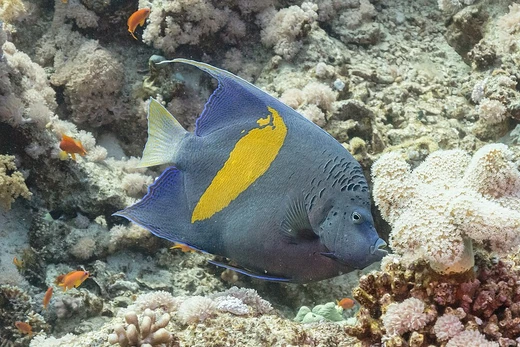
Scribbled angelfish
A blue-bodied angelfish with wavy lines from the southwestern Pacific.

The scribbled angelfish (Chaetodontoplus duboulayi) is a species of marine ray-finned fish in the family Pomacanthidae, found in the southwestern Pacific Ocean. It is notable for its striking blue body with darker wavy lines and its value in the aquarium trade, where it commands high prices and has been successfully bred in captivity.
Quick Facts
- Taxon
- Chaetodontoplus duboulayi
Facts from the source article.
Lore & Background
Chaetodontoplus duboulayi has a largely blue body marked with darker wavy lines, a yellow snout, and yellow pectoral, pelvic, and caudal fins. A yellow stripe extends along the base of the dorsal fin, and a wide vertical yellow bar sits behind the eye, with a white operculum. The species is sexually dimorphic: males have sinuous blue lines along their flanks, while females have yellow or blue spots.
It occurs along the northern Australian coast from Shark Bay in Western Australia to Moreton Bay in Queensland, south to Lord Howe Island, and also in the Aru Islands of Indonesia, along the southern coast of New Guinea, with reports from Taiwan. It inhabits coastal and inshore reefs at depths between 5 and 20 metres, preferring areas of rubble, soft bottoms, or open rocky substrates with outcroppings of rock, coral, sponge, and seawhips.
The species feeds on benthic invertebrates, especially sponges and tunicates, and is normally encountered in small groups. Like all angelfish, it is a protogynous hermaphrodite: all individuals start as females, and the dominant ones change to males.
Reader's Guide
The scribbled angelfish is a highly prized species in the aquarium trade. Formerly only occasionally exported, its availability has improved in recent years, though specimens still command high prices. It has now been successfully bred in captivity, which may help reduce pressure on wild populations. The species was first formally described in 1867 by Albert Günther as Holocanthus duboulayi, with the type locality given as the northwestern coast of Australia. The specific name honors the collector of the type, M. Duboulay, likely the natural historian Francis Houssemayne du Boulay, who specialized in Australian insects and beetles. A 1993 study in the Japanese Journal of Ichthyology examined its spawning behavior, finding that eggs range from 0.92 mm to 0.9 mm and that spawns can produce between 5,000 and 33,000 eggs. Its distribution spans northern Australia, Indonesia, southern New Guinea, and possibly Taiwan, and it is found on coastal reefs with rubble or soft bottoms. The species' sexual dimorphism and protogynous hermaphroditism are notable biological traits.
Did You Know?
- The scribbled angelfish is sexually dimorphic: males have sinuous blue lines, females have yellow or blue spots.
- Its eggs range from 0.92 mm to 0.9 mm, and a single spawn can produce 5,000 to 33,000 eggs.
- The species is a protogynous hermaphrodite, with all individuals starting as females.
Spatial Demands and the Challenge of Scale
These large marine angelfish are regarded as fairly hardy creatures, yet their sheer physical size makes them a formidable undertaking for any aquarist. A single specimen requires a tank of up to 180 gallons to be housed comfortably over its full adult lifespan, a demand that immediately places them in the advanced-keeper category. For those who wish to keep a pair, the conditions are strict: the aquarium must be exceptionally large, the two fish must have been introduced together as juveniles so they acclimate to each other's presence, and they must display clearly different colouration and body shapes to reduce territorial aggression. Because every angelfish species shares essentially the same dietary profile, the risk of resource-based conflict is high, making cohabitation a task best reserved for experienced hobbyists who can manage the subtle social dynamics at play within such a demanding setup.
Feeding and the Importance of Plant Matter
A critical aspect of caring for any angelfish, whether large or dwarf, is providing a diet rich in vegetable matter. The larger species, in particular, require substantial amounts of plant-based food alongside their other nutritional needs. Dwarf angelfish are true omnivores, and hobbyists are strongly encouraged to offer macroalgae so the fish can graze naturally, mimicking their wild foraging behaviour. This grazing requirement carries an important practical warning: if you maintain a reef tank stocked with expensive decorative macroalgae, a dwarf angelfish will not leave it untouched. The dietary overlap among angelfish species also means that when two are kept together, they are competing for the exact same food sources, which is one reason cohabitation is considered an advanced-keeper challenge. In short, a well-stocked supply of greens and algae is not optional but a cornerstone of a healthy angelfish regimen.
Reef Safety: A Matter of Debate and Caution
The question of whether angelfish belong in a reef aquarium is far from settled. Most large angelfish are straightforwardly not reef safe, meaning they will consume corals and invertebrates, and a prospective owner must factor this into tank planning from the outset. Dwarf angelfish occupy a greyer zone: their reef suitability is described as hotly debated within the aquarium community, and the prevailing advice is to add them to a reef system only at your own risk. That said, there are documented successes. The Flame and Coral Beauty angels, for instance, have been maintained in reef aquaria without incident. The broader reef-safety framework also includes a caution category for species where some individuals may nip at invertebrates or damage coral tissue, even if the species as a whole is not universally destructive. In every case, the keeper must weigh the specific specimen's behaviour against the fragility of the reef ecosystem before committing.
Colour Transformation and the Juvenile-to-Adult Shift
One of the most remarkable aspects of angelfish biology is the dramatic shift in colouration that occurs as the fish matures from juvenile to adult. The visual identity you see in a pet shop or online listing may bear little resemblance to the adult form the fish will eventually display. Because of this, species descriptions in reference materials typically describe the adult colouration unless a specific juvenile form is called out. This transformation has a direct practical implication for anyone considering keeping a pair: the two individuals must end up with very different adult colouring and body shapes to minimize aggression. If they are introduced as juveniles and grow up together, they are more likely to tolerate one another, but the keeper must still ensure their mature appearances diverge sufficiently. The colour change also means a fish purchased for its juvenile patterning may look entirely different once it reaches full size, a fact that surprises many first-time angelfish owners.
Frequently Asked Questions
What is a scribbled angelfish?
The scribbled angelfish (Chaetodontoplus duboulayi) is a marine ray-finned fish in the angelfish family Pomacanthidae. It is instantly recognizable by its vivid blue body covered in darker, wavy line patterns that give the species its 'scribbled' nickname.
Where do scribbled angelfish live?
This species is native to the southwestern Pacific Ocean, typically cruising at depths of 5 to 20 metres (about 16 to 66 feet). It is a reef-associated fish restricted to that region.
How large does a scribbled angelfish grow?
Adults top out at roughly 28 cm (11 inches) in total length. Their dorsal fin carries 11 spines and 22 soft rays, while the anal fin has 3 spines and 21 soft rays.
Can scribbled angelfish be kept in home aquariums?
Yes—they are a sought-after species in the marine aquarium trade and often fetch premium prices. They have also been successfully bred in captivity, a feat that is notable among many reef angelfish.
How do scribbled angelfish reproduce?
A single spawning can yield anywhere from 5,000 to 33,000 eggs, each only about 0.9 to 0.92 mm across. This high egg output is typical of many reef-dwelling marine fish that rely on sheer numbers for offspring survival.
More in Marine Angelfish, Part 2 1-24
Spotted an error? Know more?
Reader corrections go straight into our review queue. Suggest an edit · How this site is sourced