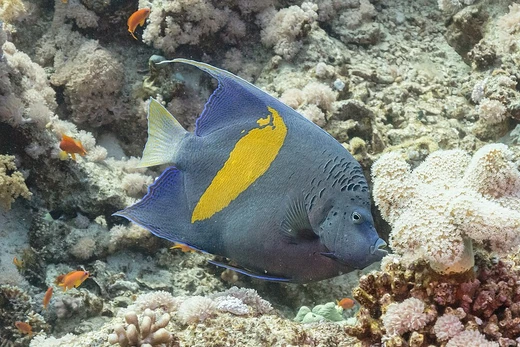
Chaetodontoplus mesoleucus
A popular aquarium angelfish with blue lips and yellow speckling.

The vermiculated angelfish (*Chaetodontoplus mesoleucus*) is a marine ray-finned fish from the family Pomacanthidae, found across the Indo-West Pacific. Its face is yellow with blue lips, and a black vertical band runs through the eye. Behind the head, the body is a cinereous color that transitions into a larger black area covered in yellow speckles. The caudal fin is yellow, while the dorsal and anal fins have vivid blue margins; the pelvic fins are white. The dorsal fin has 12 spines and 17–18 soft rays, and the anal fin has 3 spines and 17–18 soft rays. This species reaches a maximum total length of 18 centimeters (7.1 inches).
Its range extends from southern Japan south through Indonesia, west to the Mentawai Islands, east to the Bird’s Head Peninsula of New Guinea, and south to northern Australia. In Australia, it occurs from the Kimberley Region reefs south to Varanus Island, and at Ashmore Reef in the Timor Sea. It lives at depths of 1 to 30 meters (3.3 to 98.4 feet), on continental shelf reefs with rich coral growth in silty inner coastal reefs and lagoons, and is rare around oceanic islands. The diet consists of sponges, tunicates, and filamentous algae. It is usually seen in small groups and hides among coral when alarmed. Like all angelfish, it is a protogynous hermaphrodite—all individuals start as females, and the dominant ones change to males.
The species was first formally described in 1787 by German naturalist Marcus Elieser Bloch, with the type locality given as Japan. The specific name *mesoleucus* combines *mesos* (middle) and *leucus* (white), possibly referring to how the white front half of the body shades into the black rear half at the flanks. *Chaetodontoplus poliourus* was once considered the same species but differs in having a yellow-margined grey caudal fin, yellow pelvic fins, and a paler yellow dorsal fin margin. The vermiculated angelfish is exported for aquariums and is one of the most popular aquarium species.
Quick Facts
- Taxon
- Chaetodontoplus mesoleucus
Facts from the source article.
Lore & Background
Chaetodontoplus mesoleucus has blue lips contrasting with its yellow face, and a black vertical band through the eye. The body has a cinereous area behind the head that shades into a larger black area marked with yellow speckling. The caudal fin is yellow, the dorsal and anal fins have a vivid blue margin, and the pelvic fins are white. The specific name mesos means 'middle' and leucus means 'white', possibly referring to the white front half shading into the black rear half in the middle of the flanks. Chaetodontoplus poliourus was formerly considered conspecific but differs in having a yellow-margined grey caudal fin, yellow pelvic fins, and a paler yellow dorsal fin margin.
Reader's Guide
Chaetodontoplus mesoleucus is exported for use in aquariums and is one of the most popular aquarium species. It is found in the western Indo-Pacific region, from southern Japan south through Indonesia, west to the Mentawai Islands, east to the Bird's Head Peninsula of New Guinea, and south to northern Australia. Its Australian distribution includes reefs off the Kimberley Region of Western Australia south to Varanus Island, as well as Ashmore Reef in the Timor Sea. It lives at depths between 1 and 30 meters on reefs of the continental shelf, preferring silty inner coastal reefs and lagoons with rich coral growth. Its diet comprises sponges, tunicates, and filamentous algae. It is normally encountered in small groups and hides among coral when alarmed. Like all angelfish, it is a protogynous hermaphrodite: all individuals are initially female, and dominant ones change to males.
Did You Know?
- It attains a maximum total length of 18 cm (7.1 in).
- It is a protogynous hermaphrodite, with all individuals initially female.
Frequently Asked Questions
Who is Chaetodontoplus mesoleucus?
Chaetodontoplus mesoleucus, commonly known as the vermiculated angelfish, is a marine ray-finned fish in the family Pomacanthidae. It is native to the broad Indo-West Pacific region and is well recognized among saltwater aquarium enthusiasts.
What does Chaetodontoplus mesoleucus look like?
The fish displays a yellow face with striking blue lips and a bold black vertical stripe running through the eye. Behind the head the body shifts to a cinereous tone before giving way to a larger black patch dotted with yellow speckles, while the caudal fin is yellow and the dorsal and anal fins carry vivid blue edges.
Where does Chaetodontoplus mesoleucus live?
This angelfish is found across the Indo-West Pacific and typically inhabits depths from about 1 meter down to roughly 30 meters (3.3 to 98.4 feet). It is a reef-associated species within that depth range.
How big does Chaetodontoplus mesoleucus get?
An adult vermiculated angelfish reaches a maximum total length of approximately 18 centimeters (about 7.1 inches). Its dorsal fin bears 12 spines alongside 17 to 18 soft rays, and the anal fin has 3 spines with a similar 17-to-18 soft-ray count.
Why is Chaetodontoplus mesoleucus popular in the aquarium trade?
Aquarists prize this species for its eye-catching blend of blue lips, yellow speckling, and vivid fin coloration, which makes it a standout display fish. Its moderate adult size of around 18 cm also makes it more manageable in a home or public aquarium than many larger angelfish relatives.
More in Marine Angelfish, Part 2 1-24
Spotted an error? Know more?
Reader corrections go straight into our review queue. Suggest an edit · How this site is sourced