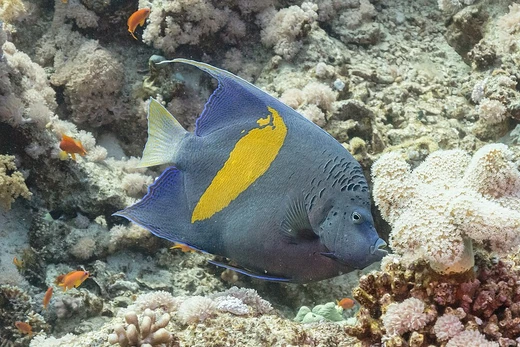
Bluestriped angelfish
A Western Pacific angelfish with blue stripes and protogynous hermaphroditism.

The bluestriped angelfish (Chaetodontoplus septentrionalis), also known as the blue-striped angelfish or bluelined angelfish, is a species of marine ray-finned fish in the family Pomacanthidae. It is found in the Western Pacific Ocean and is notable for its vivid longitudinal blue stripes on a yellow to tan body.
Quick Facts
- Taxon
- Chaetodontoplus septentrionalis
Facts from the source article.
Lore & Background
Chaetodontoplus septentrionalis has a background body colour of yellow to tan overlain with vivid longitudinal blue stripes and a yellow caudal fin. In females the blue stripes run the length of the body; in males the lines on the body are duller and they have blue lines on the face. Juveniles have a black background colour with yellow markings on their fins and a yellow bar to the rear of the head. The species is commonest on rocky reefs with large boulders and stones, as well as rubble slopes, at depths of 2 to 30 metres. Small juveniles are frequently commoner at depths over 15 metres down to 30 metres, found on rocky patch reefs and often staying close to a crevice for shelter. It feeds on sponges and tunicates. Like all other angelfish, it is a protogynous hermaphrodite: all individuals are initially female, and the dominant ones change to males.
Reader's Guide
The bluestriped angelfish is infrequently traded in the aquarium trade, but when it does appear it often thrives in captivity. Its specific name, septentrionalis, means northern, thought to be a reference to its more northerly distribution than apparently related species. The species was first formally described in 1844 by Coenraad Jacob Temminck and Hermann Schlegel, with the type locality given as Nagasaki. Its occurrence in the Western Pacific Ocean from southern Japan and South Korea and Taiwan and southern China places it in a relatively restricted range compared to some other angelfish. The species' biology, including its protogynous hermaphroditism and diet of sponges and tunicates, aligns with typical pomacanthid traits. Its colour pattern—vivid blue stripes on a yellow to tan body in adults, and black with yellow markings in juveniles—makes it distinctive among marine angelfish.
Did You Know?
- The bluestriped angelfish is a protogynous hermaphrodite: all individuals start as females, and dominant ones change to males.
- The specific name septentrionalis means northern, likely referring to its more northerly distribution than related species.
Striking Coloration and Sexual Dimorphism
The bluestriped angelfish presents one of the most visually arresting color patterns among marine reef fish. Its body carries a warm yellow-to-tan base tone that is dramatically interrupted by bold, vivid blue stripes running longitudinally along the flanks, while the tail fin glows in a matching yellow. What makes this species particularly fascinating to observe is the clear difference between the sexes. In females, those brilliant blue lines extend uninterrupted from head to tail, tracing the full length of the body. Males, by contrast, display noticeably duller striping along the torso and instead carry distinctive blue markings across the face, giving them a subtly different facial pattern. The juvenile phase is yet another transformation: young fish wear a dark, almost black body accented with yellow markings on their fins and a conspicuous yellow bar positioned just behind the head. This progression from dark juvenile to vividly striped adult, further split by sex, makes identification in the wild a rewarding exercise for any reef observer.
Reef Life and the Mystery of Sex Change
The bluestriped angelfish is most at home on rocky reef structures, favoring areas scattered with large boulders, loose stones, and rubble slopes rather than open sandy flats or coral-dominated zones. Its depth range spans from just two metres down to thirty metres, though the distribution within that range shifts with age. Small juveniles are notably more common at greater depths, typically between fifteen and thirty metres, where they cling to rocky patch reefs and tuck themselves close to crevices that offer quick shelter from predators. Their diet is specialized, consisting of sponges and tunicates, which they pick from the reef substrate. Perhaps the most remarkable biological trait shared with all angelfish is protogynous hermaphroditism. Every individual is born female, and only the dominant members of a group undergo a sex change to become males. This means that in any given reef population, the social hierarchy directly determines reproductive roles, and a single dominant female can transform into a male, reshaping the breeding dynamics of the local group.
A Northern Range and a Nineteenth-Century Naming
The bluestriped angelfish occupies a relatively restricted stretch of the western Pacific Ocean. Its known range stretches from southern Japan and the waters around South Korea, through the seas near Taiwan, and down to the coastal waters of southern China. This northerly positioning within the broader angelfish family was clearly noted by the species' original describers. In 1844, the Dutch naturalists Coenraad Jacob Temminck and Hermann Schlegel formally described the fish, assigning it the type locality of Nagasaki, a port city on Japan's western coast. They chose the specific epithet septentrionalis, a Latin term meaning northern, which appears to be a deliberate reference to the fact that this species inhabits more northerly waters than its apparently related congeners. The genus name Chaetodontoplus places it firmly within the family Pomacanthidae, the marine angelfishes, a group of ray-finned fish known for their laterally compressed bodies and vivid coloration. The 1844 description from Nagasaki thus anchors the species in both a precise geographic location and a particular moment in Pacific marine ichthyology.
A Rare but Rewarding Aquarium Subject
Despite its striking coloration, the bluestriped angelfish is not a common sight in the commercial aquarium trade. It is infrequently offered by suppliers, and when specimens do make their way into the hands of hobbyists, they tend to be few and far between. What makes this scarcity all the more interesting is the fish's reported performance once it is in a tank. When a bluestriped angelfish does appear in the trade and is acquired by an aquarist, it frequently thrives in captivity, adapting well to tank life rather than succumbing to the stress that fells many wild-caught reef species. This combination of rarity and captive hardiness gives the species a particular allure among dedicated marine fish keepers. Those who manage to obtain one get a fish that displays the full spectrum of its natural beauty, the vivid blue stripes, the warm yellow body, and, in the case of a female, the unbroken lines running the length of the flanks, without the high mortality that often accompanies more commonly traded reef fish.
Frequently Asked Questions
Who is Bluestriped angelfish?
The Bluestriped angelfish (Chaetodontoplus septentrionalis) is a marine ray-finned fish in the angelfish family Pomacanthidae, first formally described in 1844 by Temminck and Schlegel. It is instantly recognizable by its vivid longitudinal blue stripes set against a yellow-to-tan body.
What are Bluestriped angelfish's powers/role?
This species is a protogynous hermaphrodite, so every individual starts life as a female and can later shift into a male role within its social group. In its reef habitat it forages on small invertebrates and algae, helping keep the Western Pacific ecosystem in balance.
Why is Bluestriped angelfish important?
As a Pomacanthid in the Western Pacific, it contributes to reef biodiversity and serves as a useful indicator of healthy coral habitats. Its bold coloration also makes it a sought-after subject in the marine aquarium trade and a favorite among angelfish enthusiasts.
Where does Bluestriped angelfish live?
Its range spans the Western Pacific, stretching from southern Japan and South Korea down through Taiwan and southern China. It typically occupies depths of roughly 2 to 30 metres, favoring reef and rocky areas within that band.
More in Marine Angelfish, Part 2 1-24
Spotted an error? Know more?
Reader corrections go straight into our review queue. Suggest an edit · How this site is sourced