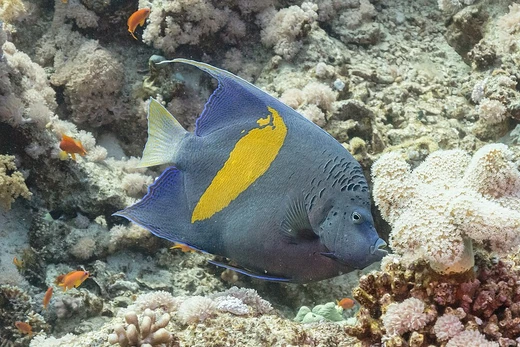
Black-velvet angelfish
A black-bodied angelfish with ochre face and yellow fin margins.

The black-velvet angelfish (Chaetodontoplus melanosoma), also known as the brown angelfish or phantom angelfish, is a species of marine ray-finned fish belonging to the family Pomacanthidae. It is found in the western Pacific Ocean and is notable for its distinctive coloration and presence in the aquarium trade.
Quick Facts
- Taxon
- Chaetodontoplus melanosoma
Facts from the source article.
Lore & Background
Chaetodontoplus melanosoma was first formally described in 1855 as Holocanthus melanosoma by the Dutch ichthyologist, herpetologist and physician Pieter Bleeker, with the type locality given as Lawajong on Solor in Indonesia. The specific name is a compound of the Greek melanos meaning 'black' and soma meaning 'body', a reference to the plain black body in adults. The species has a body which has an overall black or brown colouration with an ochre face and yellowish-orange spots across the forehead, and the dorsal, anal and caudal fins have yellow margins.
Reader's Guide
The black-velvet angelfish is commonly exported for the aquarium trade. It is best kept at a temperature of 72 to 78 °F (22 to 26 °C), a pH of 8.1-8.4, a hardness of 8-12 dKH, and a salinity of 1.020-1.025 sg. These fishes grow to 8 inches (20 cm). They are omnivorous and will consume aquarium invertebrates such as coral. These fish rarely breed in aquaria. In the wild, it occurs at depths of approximately 5 to 30 metres in outer rocky or coastal reefs, often in areas with strong currents or upwellings of cooler water. It eats tunicates and sponges, and may be observed in pairs or alone. C. melanosoma is hermaphroditic. Its distribution includes central Indonesia around western Java, Bali, Komodo, Flores, Sulawesi, and northeastern Kalimantan, as well as Sabah in Malaysia and the Sulu Archipelago, Cebu, and southern Luzon in the Philippines.
Did You Know?
- The specific name melanosoma means 'black body' in Greek.
- It was first described in 1855 by Pieter Bleeker from a specimen collected at Lawajong on Solor, Indonesia.
- It feeds on tunicates and sponges in the wild.
Taxonomic Journey & Formal Recognition
The blue velvet angelfish, scientifically designated Centropyge deborae, spent years in taxonomic obscurity before earning its own species name. For a time, specimens of this small marine angelfish were lumped together with the midnight pygmy angelfish (C. nox), treated merely as a variety or subspecies of that better-known relative. The turning point came when researchers at the National Taiwan University conducted genetic analysis that revealed the blue-tinged fish was, in fact, a distinct species. This finding led to its formal scientific description in 2012 by Kang-Ning Shen, Hsuan-Ching Ho, and Chih-Wei Chang, who designated Bligh Water, located east of Yasawa Island in Fiji, as the type locality. Despite this recognition, the species occupies an uncertain position within its genus; taxonomists classify it as incertae sedis, meaning its exact placement among other Centropyge members remains unresolved. The fish also carries the common name Fiji blue twilight angelfish, a nod to both its restricted range and its dusky coloration.
Morphology & Coloration
Standing as one of the smallest members of the angelfish family Pomacanthidae, Centropyge deborae reaches a maximum total length of just seven centimetres, roughly 2.8 inches. Its most striking visual feature is an overall bluish-black body coloration that, in dim or poor lighting conditions, simply reads as solid black. The caudal fin displays a distinctive white rear margin that provides a sharp contrast against the dark body. The pectoral fins present an intricate pattern: their rays are black, separated by a transparent membrane that gives the fin a lacy, see-through appearance. Structurally, the dorsal fin carries between 13 and 14 spines followed by 16 to 17 soft rays, while the anal fin is supported by 3 spines and 17 to 18 soft rays. These fin counts serve as important diagnostic characters that help distinguish this species from its close relatives, particularly the midnight pygmy angelfish from which it was long thought to be merely a color variant.
Range & Behavioral Ecology
The blue velvet angelfish is a true endemic of Fiji, with no confirmed records from any other part of the world's oceans. Its known range is confined entirely to the waters surrounding this island nation. Within that limited geographic scope, the species favors seamount habitats, where it can exploit the complex terrain of rocky outcrops and scattered rubble. Behaviorally, Centropyge deborae is described as extremely shy, a temperament that likely shapes much of its daily life on the reef. When it senses a threat or becomes alarmed, the fish's instinctive response is to retreat and conceal itself among the rubble and rocks that characterize its preferred environment. This cryptic, reclusive behavior makes the species very difficult to observe in the wild and probably contributed to its long misidentification as a variant of the midnight pygmy angelfish. The combination of a narrow geographic range, a preference for specific seamount structures, and an inherently elusive disposition means that relatively little is known about the full breadth of its ecological interactions.
Naming Legacy & Aquarium Trade Presence
The specific epithet deborae was chosen to honor Deborah Smith, the wife of Walt Smith, a collector and trader operating in the marine aquarium trade. It was Walt who gathered the type series of specimens that ultimately allowed the species to be formally described, making the Smiths' contribution a foundational part of this fish's scientific story. The naming thus embeds a personal tribute within the taxonomic record, linking the species directly to the people who brought it to the attention of the scientific community. In terms of commercial presence, the blue velvet angelfish makes only an occasional appearance in the aquarium trade, a rarity that likely reflects both its extreme shyness in the wild and its restricted distribution to Fiji. Its small size, striking bluish-black coloration, and white-tipped tail make it an attractive prospect for hobbyists, yet its elusive nature and limited availability keep it firmly in the realm of a collector's curiosity rather than a commonly stocked marine aquarium species.
Frequently Asked Questions
What is the black-velvet angelfish?
The black-velvet angelfish (Chaetodontoplus melanosoma) is a small marine ray-finned fish in the angelfish family Pomacanthidae, also called the brown or phantom angelfish. It is native to the western Pacific Ocean and is recognized for its striking dark body contrasted with an ochre-colored face and yellow-edged fins.
How large does the black-velvet angelfish grow?
Adults reach a maximum total length of about 20 cm (roughly 8 inches), making it one of the smaller members of the angelfish family. Its fin structure includes 13 dorsal spines paired with 17 to 19 soft dorsal rays, and 3 anal spines with 17 to 18 anal soft rays.
Where and at what depth can you find the black-velvet angelfish in the wild?
This species inhabits the western Pacific Ocean, typically ranging from about 5 to 30 metres below the surface. It is most often encountered around reef habitats within that depth band.
What makes the black-velvet angelfish visually distinctive?
Its body is predominantly black, while the face carries a warm ochre tone and the fins are trimmed with bright yellow margins. This high-contrast pattern is what gives the species both its "black-velvet" and "phantom" common names.
Why is the black-velvet angelfish notable in the aquarium hobby?
Because of its bold, easily recognizable coloration and manageable adult size, it has become a sought-after display species for saltwater aquarists. Its presence in the trade is one of the main reasons the species is well known outside of its native western Pacific range.
More in Marine Angelfish, Part 2 1-24
Spotted an error? Know more?
Reader corrections go straight into our review queue. Suggest an edit · How this site is sourced