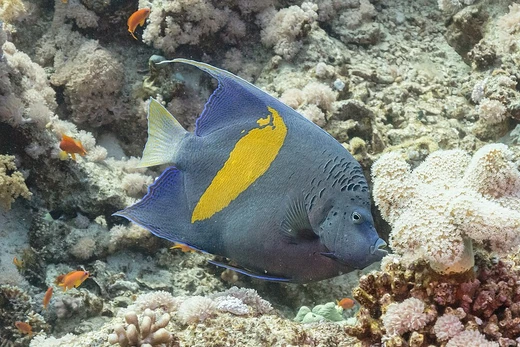
Spotted angelfish
A sexually dichromatic angelfish from deep reefs of the northwestern Pacific.

The spotted angelfish (Genicanthus takeuchii), also known as Takeuchi's angelfish, is a species of marine ray-finned fish in the family Pomacanthidae. It is notable for its sexual dichromatism, with distinct color and pattern differences between males and females, and for its restricted distribution in the northwestern Pacific Ocean.
Quick Facts
- Taxon
- Genicanthus takeuchii
Facts from the source article.
Lore & Background
Genicanthus takeuchii was first formally described in 1997 by American ichthyologist Richard L. Pyle as Holocanthus semifasciatus, with the type locality given as Ani-jima, Mansakunohama in the Ogasawara Islands of Japan. The specific name honors the Japanese diver Hiroshi Takeuchi, who discovered the species. This species is known to hybridize with the Japanese swallow (Genicanthus semifasciatus).
The species shows sexual dichromatism: males are greyish white on the upper body with six to eight horizontal stripes, while the lower body is pale white; the dorsal and caudal fins are marked with large black spots. Females are overall greyish white with a dense pattern of black spots on the upper body and caudal fin. Juveniles have a honeycomb pattern on the upper body. The dorsal fin contains 15 spines and 16 soft rays, while the anal fin has 3 spines and 17-18 soft rays. It attains a maximum total length of 25 cm.
Genicanthus takeuchii is found in the northwestern Pacific Ocean, restricted to Marcus Island and the Ogasawara Islands southeast of Japan, with additional records from the Marianas Islands. It inhabits deep coral reefs at depths between 25 and 60 meters. The species is little known and does not appear in the aquarium trade.
Reader's Guide
The spotted angelfish is significant primarily for its restricted geographic range and its role in understanding hybridization among angelfishes. The article notes that it is known to hybridize with Genicanthus semifasciatus, the Japanese swallow, indicating overlapping ranges or spawning interactions in the Ogasawara region. Its description in 1997 by Richard L. Pyle, with the specific name honoring diver Hiroshi Takeuchi, highlights the contribution of field collectors to ichthyology. The species' sexual dichromatism—males with horizontal stripes and black-spotted fins, females with dense black spotting—is typical of the genus Genicanthus and aids in identification. Its absence from the aquarium trade suggests limited accessibility or low demand. The species is little known biologically, with only basic habitat data (deep coral reefs at 25–60 m) and distribution records (Marcus Island, Ogasawara Islands, Marianas Islands) available. The article provides no information on population status, diet, or behavior beyond these facts.
Did You Know?
- The male spotted angelfish has six to eight horizontal stripes on the upper body and large black spots on the dorsal and caudal fins.
- This species hybridizes with the Japanese swallow (Genicanthus semifasciatus).
- It is not found in the aquarium trade.
More in Marine Angelfish, Part 2 1-24
Spotted an error? Know more?
Reader corrections go straight into our review queue. Suggest an edit · How this site is sourced