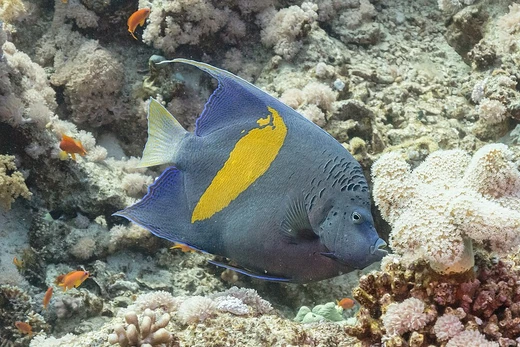
Spotbreast angelfish
A sexually dichromatic angelfish with a black spot on the male's breast.

The spotbreast angelfish (Genicanthus melanospilos), also known as the blackspot angelfish or swallowtail angelfish, is a species of marine angelfish in the family Pomacanthidae. It occurs in the Indo-West Pacific region and is notable for its sexual dichromatism, with males and females displaying distinctly different colouration.
Quick Facts
- Taxon
- Genicanthus melanospilos
Facts from the source article.
Lore & Background
Genicanthus melanospilos was first formally described in 1857 as Holocanthus melanospilos by Dutch ichthyologist and herpetologist Pieter Bleeker, with the type locality given as Ambon Island in Indonesia. The specific name is a compound of melanos meaning 'black' and spills meaning 'spot', referring to the black spot on the male's chest. The species shows sexual dichromatism: males have a bluish white body with reddish black vertical stripes, yellow spots on the dorsal, caudal and anal fins, a light yellow caudal fin with blue margins and long filamentous lobes, and a sizeable black spot on the breast near the base of the pelvic fins. Females have a yellow dorsal half and bluish white ventral half, with a bluish tail bearing a black stripe along its upper and lower margins. Both sexes have a forked tail that narrows at its base to create a 'swallow tail'.
Reader's Guide
The spotbreast angelfish is a widespread species found in the eastern Indian Ocean and western Pacific Ocean, ranging throughout the Malay Archipelago into the southwestern Pacific as far east as Fiji, north to the Ryukyu Islands, and south to Australia. In Australian waters it occurs at the Cocos (Keeling) Islands, Christmas Island, Ashmore Reef in the Timor Sea, and the Great Barrier Reef off Cairns, Queensland. It inhabits depths between 20 and 80 metres on outer reef slopes and drop-offs rich in coral. Adults typically form small harems consisting of one male and several females. Like all angelfish, it is a protogynous hermaphrodite: all individuals are initially female, and the dominant ones change to males. It feeds on zooplankton in the water above reefs. The species is common in the aquarium trade, contributing to its significance as a popular ornamental fish.
Did You Know?
- Females have a yellow dorsal half and bluish white ventral half, with a black stripe along the upper and lower margins of the tail.
- This species is a protogynous hermaphrodite, with all individuals starting as females and dominant ones changing to males.
More in Marine Angelfish, Part 2 1-24
Spotted an error? Know more?
Reader corrections go straight into our review queue. Suggest an edit · How this site is sourced