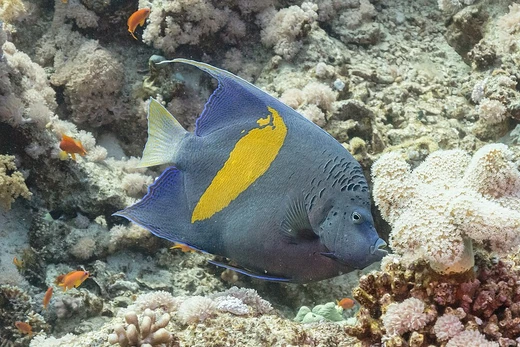
Pitcairn angelfish
A sexually dichromatic angelfish of the southwestern Pacific.

The Pitcairn angelfish (Genicanthus spinus) is a species of marine ray-finned fish in the family Pomacanthidae, found in the southwestern Pacific Ocean. It is notable for its sexual dichromatism, with males and females displaying distinct color patterns, and for its association with remote islands such as Pitcairn and the Austral Islands.
Quick Facts
- Taxon
- Genicanthus spinus
Facts from the source article.
Lore & Background
The Pitcairn angelfish, like other Genicanthus species, exhibits sexual dichromatism: males have a white body with many vertical black stripes, while females are bluish white. Both sexes have a forked tail that narrows at the base, forming a swallow tail. The dorsal fin has 15 spines and 17 soft rays; the anal fin has 3 spines and 18–19 soft rays. This species reaches a maximum total length of 35 cm (14 in).
It is found on rock and coral reefs at depths between 30 and 60 m (98 and 197 ft), typically in groups that swim high in the water column. These groups are harems of one male and up to four females. The diet consists mostly of zooplankton, though it may also eat some benthic invertebrates.
The species was first formally described in 1975 by American ichthyologist John E. Randall, with the type locality given as Bounty Bay on Pitcairn Island. The specific name spinus means 'spine,' referring to the very large anterior spine in front of the eye.
Reader's Guide
The Pitcairn angelfish is a relatively recently described species, first formally named in 1975 by John E. Randall. Its specific name, spinus, highlights a distinctive anatomical feature: the very large anterior spine in front of the eye. The species is recorded from a limited range in the southwestern Pacific, including Raivavae and Rurutu in the Austral Islands, Dulcie Atoll in the Pitcairn Islands, and Rarotonga in the Cook Islands. Its habitat on rock and coral reefs at depths of 30 to 60 meters, and its harem-based social structure of one male with up to four females, are key aspects of its biology. The species feeds primarily on zooplankton, with occasional benthic invertebrates. As a member of the genus Genicanthus, it shares the trait of sexual dichromatism with its congeners. The Pitcairn angelfish is notable for its association with remote island groups and for the distinctive spine that gives it its scientific name.
Did You Know?
- The Pitcairn angelfish was first formally described in 1975 by John E. Randall.
- It is found at depths between 30 and 60 meters on rock and coral reefs.
More in Marine Angelfish, Part 2 1-24
Spotted an error? Know more?
Reader corrections go straight into our review queue. Suggest an edit · How this site is sourced