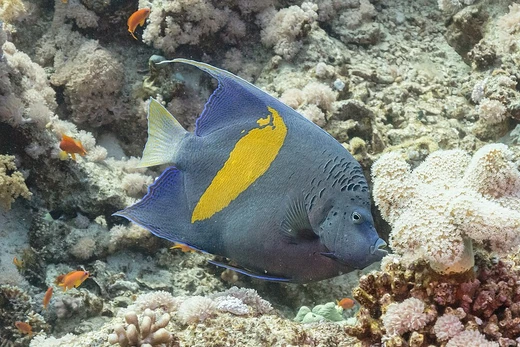
Masked angelfish
A rare Hawaiian angelfish that changes color and sex with age.

The masked angelfish (Genicanthus personatus) is a species of marine ray-finned fish in the family Pomacanthidae, endemic to the Hawaiian Islands. It is notable for its striking color changes with age and sex, and for being extremely rare in the aquarium trade, where it commands high prices.
Quick Facts
- Taxon
- Genicanthus personatus
Facts from the source article.
Lore & Background
Genicanthus personatus is largely brilliant white at all ages. Juveniles have a black area covering most of the head; as the fish grows, the black breaks up, starting with the lips turning bluish white and the caudal fin darkening to black. The black on the head reduces until it only surrounds the eyes, appears on the chin, and along the edge of the operculum and its spine. The pelvic fins are yellow. This species is a sequential protogynous hermaphrodite: younger sexually mature adults are all females. Once they reach 15 to 18 cm in length, they may change sex to males. When they do, they develop vivid orange-yellow pigmentation on the pectoral fins, the whole face, and the margins of the dorsal, anal, and pelvic fins. Males also develop long filamentous extensions to the caudal fin lobes.
Reader's Guide
The masked angelfish is endemic to the Hawaiian Islands, where it is more numerous in the northwestern islands. It is found at depths between 10 and 150 meters over rocky reefs and on outer reef slopes. Its diet includes green algae of the genus Codium, planktonic organisms, and fish eggs. Like all marine angelfish, it is a protogynous hermaphrodite, with all individuals initially female and dominant ones changing to males. The species was first formally described in 1975 by American ichthyologist John Ernest Randall, with the type locality given as Honolulu on Oahu. Its specific name personatus means 'masked'. In the aquarium trade, it is very rare and commands high prices; it has been bred in captivity.
Did You Know?
- It is a sequential protogynous hermaphrodite: all young adults are female, and some change to males at 15–18 cm length.
- Males develop vivid orange-yellow pigmentation on the face and fins, plus long filamentous extensions to the caudal fin lobes.
- It was first formally described in 1975 by John Ernest Randall.
More in Marine Angelfish, Part 2 1-24
Spotted an error? Know more?
Reader corrections go straight into our review queue. Suggest an edit · How this site is sourced