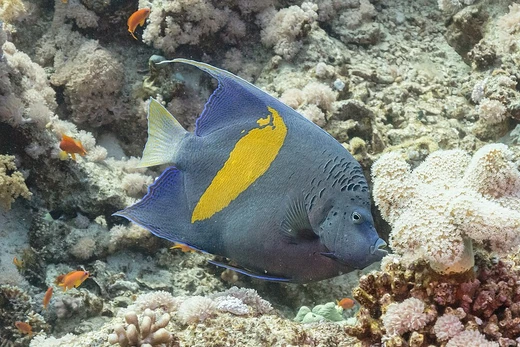
Holacanthus ciliaris
A blue-and-yellow reef fish with a distinctive forehead crown.

The queen angelfish, also called the blue, golden, or yellow angelfish, is a marine angelfish that lives in the western Atlantic Ocean. It is a bottom-dwelling, warm-water species found on coral reefs. Its body is blue and yellow, and it has a distinctive spot, or “crown,” on its forehead. This crown sets it apart from the similar Bermuda blue angelfish, which shares its range and can interbreed with it.
Adults are picky eaters, feeding mainly on sponges. They live in harems made up of one male and up to four females. The group occupies a territory where the females forage separately while the male watches over them. Breeding happens around the time of a full moon. The transparent eggs float in the water until they hatch. Young queen angelfish look different from adults and act as cleaner fish, removing parasites from other fish.
This species is popular in the aquarium trade and has been a common export from Brazil. In 2010, it was listed as least concern by the IUCN because its wild population seemed stable.
The queen angelfish was first described by Carl Linnaeus in 1758 as *Chaetodon ciliaris*, with the type location given as the western Atlantic or Caribbean. In 1802, Bernard Germain de Lacépède moved it to the genus *Holacanthus*, which comes from Greek words meaning “full” and “spine.” Its species name, *ciliaris*, means “fringed,” referring to its ciliate scales. Other common names include “blue angelfish,” “golden angelfish,” and “yellow angelfish.”
Marine angelfish in the genus *Holacanthus* likely appeared between 10.2 and 7.6 million years ago. The Guinean angelfish, found off West Africa, is the sister to all other species in the genus, suggesting the lineage moved into the Atlantic from the Indian Ocean. The closing of the Isthmus of Panama about 3.5 to 3.1 million years ago caused the Tropical Eastern Pacific species to split off. The queen angelfish’s closest relative is the Bermuda blue angelfish, from which it split around 1.5 million years ago. They interbreed, producing a fertile hybrid called the Townsend angelfish, which can breed with both parent species and with other hybrids.
The queen angelfish has a broad, flat, oval body, a triangular tail fin, a blunt snout, and a small mouth with bristle-like teeth. Its dorsal fin has 14 spines and 19 to 21 soft rays, and its anal fin has 3 spines and 20 to 21 soft rays.
Quick Facts
- Taxon
- Holacanthus ciliaris
Facts from the source article.
Lore & Background
The queen angelfish was first described as Chaetodon ciliaris in 1758 by Carl Linnaeus, with the type locality given as the 'Western Atlantic/Caribbean'. In 1802 it was moved to the genus Holacanthus by Bernard Germain de Lacépède. Its specific name ciliaris means 'fringed', a reference to its ciliate scales. Marine angelfish of the genus Holacanthus likely emerged between 10.2 and 7.6 million years ago. The queen angelfish's closest relative is the sympatric Bermuda blue angelfish (Holacanthus bermudensis), from which it split around 1.5 million years ago; they can interbreed, producing a fertile hybrid known as the Townsend angelfish.
The species has a broad, flattened, oval-shaped body with a triangular tail fin. It is covered in yellow-tipped blue-green scales, with a bright yellow tail, pectoral and pelvic fins. The forehead bears an eye-like crown that is cobalt blue with an electric blue outer ring. Juveniles are dark blue with bright blue vertical stripes and a yellow pectoral area, and they act as cleaner fish. Seven other color morphs have been recorded off the Saint Peter and Saint Paul Archipelago, Brazil, including a mostly gold or bright orange morph.
Reader's Guide
The queen angelfish is a benthic warm-water species that lives in coral reefs in the western Atlantic Ocean, from Florida along the Gulf of Mexico and Caribbean Sea down to Brazil, and as far east as Bermuda and the Saint Peter and Saint Paul Archipelago. Adults are selective feeders that primarily eat sponges; off St. Thomas Island and Salvador, Bahia, 90% of the adult diet is sponges. Their social structure consists of harems with one male and up to four females, living within a territory where females forage separately and are tended to by the male. Breeding occurs near a full moon, and the transparent eggs float in the water until they hatch. The species is popular in the aquarium trade, particularly as an export from Brazil; from 1995 to 2000, 43,730 individuals were traded at Fortaleza. In 2010, it was assessed as least concern by the IUCN, as the wild population appeared stable. Introduced individuals have been recorded in the eastern Adriatic Sea, the Mediterranean Sea, and the Red Sea, likely from the aquarium industry, with one in the Red Sea carrying a disease-causing bacterium not previously recorded in native fish.
Did You Know?
- The queen angelfish can interbreed with the Bermuda blue angelfish, producing a fertile hybrid called the Townsend angelfish.
- Juveniles act as cleaner fish, removing ectoparasites from larger fish.
- Off the Saint Peter and Saint Paul Archipelago, 68% of the adult diet consists of sponges.
More in Marine Angelfish, Part 2 1-24
Spotted an error? Know more?
Reader corrections go straight into our review queue. Suggest an edit · How this site is sourced