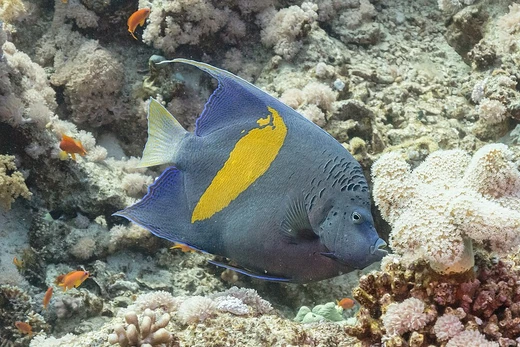
Holacanthus africanus
A West African angelfish with distinct juvenile and adult coloration.

Holacanthus africanus, called the Guinean angelfish or West African angelfish, is a marine ray-finned fish in the family Pomacanthidae. It lives in the warmer parts of the eastern Atlantic Ocean, along the coast of West Africa.
Juveniles and adults of this species have different coloring. Young Guinean angelfish have a dark blue body with thin, light blue vertical bars on each side of the eye, a yellow tail fin, yellow lips, and a broad white vertical band across the middle of the body. As they mature, the blue shifts to olive green, the white band widens and becomes more yellowish, and the tail stalk turns almost black. They may keep yellow edges on the dorsal and anal fins, and a dark spot (ocellus) appears behind the gill cover. The maximum total length is 45 centimeters (18 inches).
The species ranges from Senegal to the Congo River estuary, including the Cape Verde and São Tomé islands. In 2017, it was reported for the first time in the Mediterranean Sea, in Valletta harbour, Malta.
It lives in clear water over rocky reefs at depths between 1 and 40 meters (3 to 131 feet). The Guinean angelfish has a varied diet, feeding mainly on sponges, but also on tunicates, jellyfish, soft corals, algae, and plankton. Around the Cape Verde islands, it often forms dense mixed-species shoals, where it is the dominant fish.
The species was first formally described in 1951 by French ichthyologist Jean Cadenat (1908–1992), with the type location given as Gorée, Senegal.
It appears in the aquarium trade only a few times each year and commands high prices. Availability increased in the late 2010s.
Quick Facts
- Taxon
- Holacanthus africanus
Facts from the source article.
Lore & Background
Holacanthus africanus was first formally described in 1951 by French ichthyologist Jean Cadenat, with the type locality given as Gorée in Senegal. The species shows marked differences between juveniles and adults: juveniles have a dark blue body with thin light blue vertical bars on either side of the eye, a yellow caudal fin, yellow lips, and a broad vertical white band in the middle of their flanks. As they mature, the blue changes to olive green, the white vertical bar widens and becomes more yellowish, and they gain an almost black coloration on the caudal peduncle. Adults may retain yellow areas along the margins of the dorsal and anal fins, and a dark ocellus is visible behind the operculum. The species attains a maximum total length of 45 centimeters.
Did You Know?
- Adults gain an almost black colour on the caudal peduncle.
- It was first reported in the Mediterranean Sea in Valletta harbour, Malta in 2017.
- Around the Cape Verde islands, it is often found in dense mixed species shoals where it is dominant.
More in Marine Angelfish, Part 2 1-24
Spotted an error? Know more?
Reader corrections go straight into our review queue. Suggest an edit · How this site is sourced