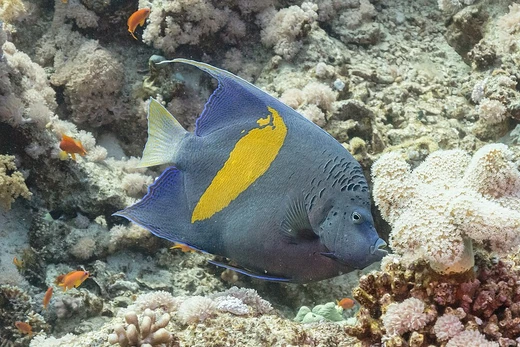
Genicanthus spinus
A sexually dichromatic angelfish from the southwestern Pacific.

The Pitcairn angelfish (*Genicanthus spinus*) is a marine angelfish in the family Pomacanthidae. Males and females look different: males have a white body with many vertical black stripes, while females are bluish white. Both sexes have a forked tail that narrows at the base, giving it a swallow-like shape. The dorsal fin has 15 spines and 17 soft rays; the anal fin has 3 spines and 18–19 soft rays. It can reach a total length of 35 cm.
This fish lives in the southwestern Pacific Ocean, recorded from Raivavae and Rurutu in the Austral Islands (French Polynesia), Dulcie Atoll in the Pitcairn Islands (UK Overseas Territory), and Rarotonga in the Cook Islands. It inhabits rock and coral reefs at depths of 30 to 60 meters, often in groups of one male and up to four females swimming high in the water column. It mainly eats zooplankton but may also take some benthic invertebrates.
First formally described in 1975 by John E. Randall, the type locality is Bounty Bay on Pitcairn Island. The species name *spinus* means “spine,” referring to the large anterior spine in front of the eye.
Quick Facts
- Taxon
- Genicanthus spinus
Facts from the source article.
Lore & Background
The Pitcairn angelfish, like other angelfishes in the genus Genicanthus, shows sexual dichromatism: males have a white body marked with many vertical black stripes, while females have an overall bluish white colouration. In both sexes, the forked tail narrows at its base to create a 'swallow tail'. The dorsal fin contains 15 spines and 17 soft rays, while the anal fin has 3 spines and 18-19 soft rays. This species attains a maximum total length of 35 centimetres (14 in).
Genicanthus spinus is found on rock and coral reefs at depths between 30 and 60 metres (98 and 197 ft) (at least). It is normally encountered in groups that swim high in the water column; these are harems of 1 male and as many as 4 females. They feed mostly on zooplankton but may eat some benthic invertebrates.
The species was first formally described in 1975 by the American ichthyologists John E. Randall (1924–2020) with the type locality given as Bounty Bay on Pitcairn Island. The specific name spinus means 'spine' and refers to the very large anterior spine in front of the eye.
Reader's Guide
The Pitcairn angelfish is significant as a distinct species within the genus Genicanthus, known for its pronounced sexual dichromatism and swallowtail morphology. Its distribution is limited to the southwestern Pacific Ocean, with recorded occurrences at Raivavae and Rurutu in the Austral Islands of French Polynesia, Dulcie Atoll in the Pitcairn Islands, and Rarotonga in the Cook Islands. The species inhabits rock and coral reefs at depths of 30 to 60 metres, forming harems of one male and up to four females that feed primarily on zooplankton. Its description in 1975 by John E. Randall, with the type locality at Bounty Bay on Pitcairn Island, underscores its connection to the remote Pitcairn Islands. The specific name spinus, meaning 'spine', highlights the prominent anterior spine before the eye, a distinctive anatomical feature. This angelfish contributes to the biodiversity of its reef ecosystems and exemplifies the specialized adaptations of the Pomacanthidae family.
More in Marine Angelfish, Part 2 1-24
Spotted an error? Know more?
Reader corrections go straight into our review queue. Suggest an edit · How this site is sourced