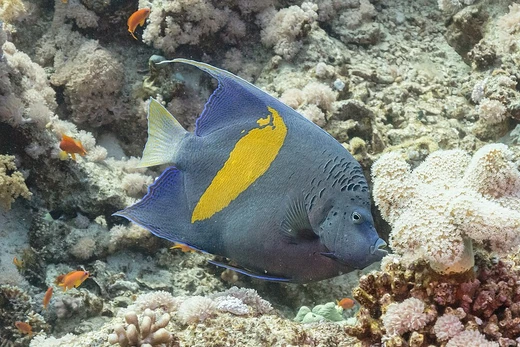
Genicanthus semifasciatus
A sexually dichromatic marine angelfish with a swallow-like tail.

Genicanthus semifasciatus, the Japanese swallow, is a marine angelfish from the family Pomacanthidae. Males and females look quite different: males have a yellow head and front sides, with a darker yellow back marked by dusky vertical bars; females are greyish-brown on top and white underneath, with a yellow-edged dorsal fin and black on the head and tail. Both sexes share a forked tail that narrows at the base, forming a swallow-like shape. The dorsal fin has 15 spines and 15–16 soft rays, while the anal fin has 3 spines and 17 soft rays. This fish reaches a maximum total length of 21 cm.
It lives in the western Pacific, from southern Japan (including the Ogasawara, Izu, and Ryukyu Islands) to the northern Philippines. Found at depths of 15 to 200 metres, it inhabits the seaward sides of rocky and coral reefs. The species is protogynous hermaphroditic, typically forming harems of one male and several females, and feeds on plankton in the water column.
First formally described in 1934 as *Holocanthus semifasciatus* by Japanese ichthyologist Toshiji Kamohara, the type locality is Kashiwajima in Kochi Prefecture, Japan. The specific name combines *semi* ("half") and *fasciatus* ("banded"), referring to the male’s back bands that do not reach the belly.
The Japanese swallow appears infrequently in the aquarium trade, and specimens usually come from the Philippines.
Quick Facts
- Taxon
- Genicanthus semifasciatus
Facts from the source article.
Lore & Background
Genicanthus semifasciatus was first formally described in 1934 as Holocanthus semifasciatus by Japanese ichthyologist Toshiji Kamohara, with the type locality given as Kashiwajima in the Kochi Prefecture of Japan. The specific name is a compound of semi meaning 'half' and fasciatus meaning 'banded', referring to the banding on the males' backs which does not extend onto the abdomen. The species is sexually dichromatic: the male has a yellow head and anterior flanks with a darker yellow dorsal area marked with dusky vertical bars, while the female has a greyish brown dorsal area and white ventrally, with a yellow margin to the dorsal fin and a black head and caudal fin. In both sexes, the forked tail narrows at its base to create a 'swallow tail'. The dorsal fin contains 15 spines and 15–16 soft rays, and the anal fin has 3 spines and 17 soft rays.
Reader's Guide
Genicanthus semifasciatus is found in the Western Pacific Ocean, ranging from southern Japan (including the Ogasawara Islands, the Izu Islands, and the Ryukyu Islands) to the northern Philippines. It occurs at depths between 15 and 200 meters on the seaward sides of rocky and coral reefs. This species is protogynously hermaphroditic and is normally encountered in harems consisting of a male and several females. It feeds on plankton in the water column. In the aquarium trade, Genicanthus semifasciatus is rather infrequently found, and specimens that do appear usually come from the Philippines. Its distinctive swallow-like tail and sexual dichromatism make it a notable member of the marine angelfish family.
Did You Know?
- The specific name semifasciatus means 'half-banded', referring to the banding on the males' backs that does not extend onto the abdomen.
- This species is protogynously hermaphroditic, typically living in harems of one male and several females.
- It was first described in 1934 by Japanese ichthyologist Toshiji Kamohara as Holocanthus semifasciatus.
- The Japanese swallow attains a maximum total length of 21 centimeters (8.3 inches).
More in Marine Angelfish, Part 2 1-24
Spotted an error? Know more?
Reader corrections go straight into our review queue. Suggest an edit · How this site is sourced