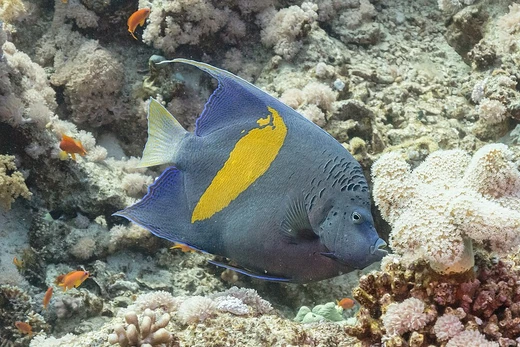
Genicanthus semicinctus
A sexually dichromatic angelfish from the southwestern Pacific.

The halfbanded angelfish (Genicanthus semicinctus) is a species of marine ray-finned fish, a marine angelfish belonging to the family Pomacanthidae. It is found in the southwestern Pacific Ocean, notably around Lord Howe Island and the Kermadec Islands. This species is notable for its sexual dichromatism, with males and females displaying distinctly different colors and patterns.
Quick Facts
- Taxon
- Genicanthus semicinctus
Facts from the source article.
Lore & Background
Genicanthus semicinctus was first formally described as Holocanthus semicinctus in 1900 by the British-born Australian ichthyologist Edgar Ravenswood Waite, with the type locality given as Lord Howe Island. The specific name is a compound of semi meaning 'half' and cinctus meaning 'bands'. Males are marked with thin close-set wavy black vertical bars running from the back to two-thirds down the flanks, with the lower third of the body being yellowish-orange. They have a yellow dorsal fin and yellow lobes with long filaments on the caudal fin, which has black spots; the chest also has black spots. Females are plain dark grey on the back with a whitish abdomen and have dark lobes to the caudal fin; their fins have thin blue margins, and there is a black blotch above the eye with a vivid blue margin. The dorsal fin contains 15 spines and 15-16 soft rays, while the anal fin has 3 spines and 17 soft rays. This species attains a maximum total length of 21 centimetres (8.3 in).
Reader's Guide
Genicanthus semicinctus is found in the southwestern Pacific Ocean, only around Lord Howe Island (an Australian territory in the Tasman Sea) and the New Zealand outlying islands of the Kermadec Islands. It inhabits depths between 10 and 100 metres (33 and 328 ft) on the deep outer slopes of coral and rocky reefs. It normally occurs in small groups, harems of a male and as many as 4 females. This species is a protogynous hermaphrodite: if the male in a group disappears, the dominant female will change into a male, a process that takes a few weeks. In the aquarium trade, Genicanthus semicinctus is very rare. Its restricted distribution and distinctive sexual dimorphism make it a notable species among marine angelfish, though its rarity in captivity limits its broader recognition.
Did You Know?
- Males have thin close-set wavy black vertical bars and a yellowish-orange lower body.
- It is a protogynous hermaphrodite; the dominant female changes into a male if the male disappears.
- It is found only around Lord Howe Island and the Kermadec Islands in the southwestern Pacific.
More in Marine Angelfish, Part 2 1-24
Spotted an error? Know more?
Reader corrections go straight into our review queue. Suggest an edit · How this site is sourced