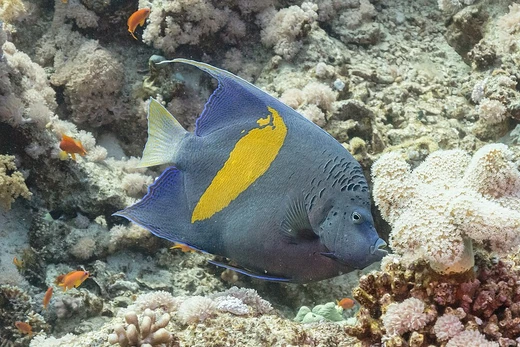
Genicanthus caudovittatus
A sexually dichromatic marine angelfish of the Indian Ocean.

Genicanthus caudovittatus is a species of marine ray-finned fish, a marine angelfish belonging to the family Pomacanthidae. It is found in the Indian Ocean and is known by the common names zebra angelfish, swallowtail angelfish, and lyretail angelfish. It is notable for its sexual dichromatism, with males and females displaying differing colouration.
Quick Facts
- Taxon
- Genicanthus caudovittatus
Facts from the source article.
Lore & Background
Genicanthus caudovittatus was first formally described in 1860 as Holocanthus caudovittatus by the German-born British ichthyologist and herpetologist Albert Günther, with the type locality given as Mauritius. The specific name is a compound of caudus meaning 'tail' and vittatus meaning 'banded', referring to the black markings on the tail. Both sexes have a markedly forked caudal fin. The dorsal fin contains 15 spines and 15–17 soft rays while the anal fin has 3 spines and 17–19 soft rays. This species attains a maximum total length of 20 centimetres.
Reader's Guide
Genicanthus caudovittatus is distributed in the western Indian Ocean, occurring along the eastern coast of Africa from the Red Sea in the north to KwaZulu-Natal in South Africa, east to Madagascar, Maldives, Mauritius, and Réunion. It has also been recorded from Weh Island off northwestern Sumatra. It is found at depths between 15 and 70 metres, on steep outer reef slopes, where it lives in small groups made up of a male and a few females. It feeds on plankton. Juveniles live at greater depth than the adults. In the Red Sea it can be found in shallower water than in the Andaman Sea. The species occasionally appears in the aquarium trade.
Did You Know?
- Males are whitish-blue with vertical dark brown barring and a black band along the dorsal fin base.
- Females are pale pinkish grey with a black band over the eye and black bands on the upper and lower margins of the caudal fin.
- It was first described in 1860 by Albert Günther as Holocanthus caudovittatus.
More in Marine Angelfish, Part 2 1-24
Spotted an error? Know more?
Reader corrections go straight into our review queue. Suggest an edit · How this site is sourced