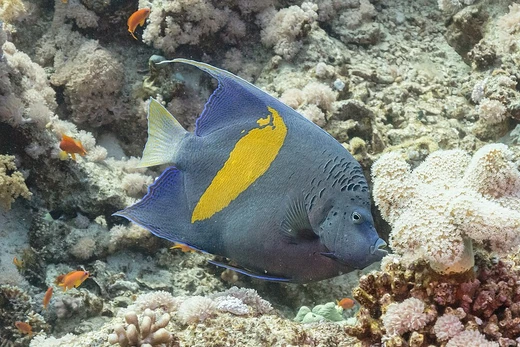
Genicanthus bellus
A deep-reef angelfish with vivid sexual dimorphism and a lek-like mating system.

Genicanthus bellus, called the ornate angelfish, bellus angelfish, or bellus lyretail angelfish, is a marine ray-finned fish in the family Pomacanthidae. Males and females look very different—a trait known as sexual dichromatism. Females and juveniles have a greyish to bluish body with wide black bands and a blue horizontal stripe low on the sides. Males are pale bluish to greyish, with horizontal golden stripes along the middle of the flanks and another along the lower back; the bases of their pectoral and dorsal fins match these stripes. Their caudal fin is usually clear but often has orange patches, filamentous extensions, and bright blue coloring, and their lips are also bright blue. In females and juveniles, a black stripe runs vertically from the nape through the eye but stops below the lower part of the orbit. A second black stripe starts just behind the first, forms a right angle at the start of the dorsal fin, and continues along that fin’s base. A third stripe begins at that right angle and runs diagonally down to the lower lobe of the caudal fin. A fourth stripe runs along the upper edge of the dorsal fin’s upper lobe, starting at the caudal peduncle. Each of these four stripes has white or very pale blue margins. The anal fin’s color varies, and it may have a single or double orange stripe at the edge, or no stripe at all. The dorsal fin is mostly black, though the largest, oldest females may show variable shades of red. Females also have two silvery-white dots on their black upper lips. The dorsal fin has 15 spines and 15–16 soft rays; the anal fin has 3 spines and 16–17 soft rays. Maximum total length is 18 cm (7.1 in).
This species has a wide but patchy distribution in the western Pacific and eastern Indian Oceans. In the Pacific, it occurs near Tahiti, Guam, Palau, Tonga, the Cook Islands, the Marshall Islands, the Philippines, southern Japan, and southern Indonesia. Its preference for deep water may mean it is under-recorded. In Australian waters, it is found around the Cocos (Keeling) Islands and Christmas Island in the Indian Ocean, and at Holmes Reef in the Coral Sea.
It lives at depths of 25 to 100 m (82 to 328 ft), on deep reefs, often in areas with strong currents on outer drop-offs. It is a social fish that forms schools, with harems of 3–7 fish inside them, though the mating system resembles lekking.
Quick Facts
- Taxon
- Genicanthus bellus
Facts from the source article.
Lore & Background
Genicanthus bellus was first formally described in 1979 by American ichthyologist John Ernest Randall, with the type locality given as outside the barrier reef off the District of Paea, Tahiti, Society Islands, at a depth of 60 meters. The specific name bellus means 'beautiful'. The species is sexually dichromatic: females and juveniles have greyish to bluish bodies with wide black bands and a blue longitudinal stripe on the lower flanks, while males display pale bluish to greyish bodies with horizontal golden stripes along the flanks and lower back. Males also have bright blue lips and caudal fins with filamentous extensions and orange patches. Females have a black stripe running vertically from the nape through the eye, and additional black stripes with white or pale blue margins. The anal fin color is variable, sometimes edged with a single or double orange stripe. The dorsal fin is largely black, but in the largest females it may show variable shades. Females also have two silvery-white dots on the black upper lips.
Reader's Guide
Genicanthus bellus is significant in the aquarium trade due to its rarity and high price, a direct consequence of its deep-water habitat (25–100 m) which makes collection infrequent. When collecting effort increases, it may become more numerous in the trade, but mortality among collected specimens can be high. However, healthy, acclimated individuals are described as very hardy and resilient in captivity. The species is found in the western Pacific Ocean and eastern Indian Ocean, with records from Tahiti, Guam, Palau, Tonga, the Cook Islands, the Marshall Islands, the Philippines, southern Japan, southern Indonesia, and Australian waters including the Cocos (Keeling) Islands, Christmas Island, and Holmes Reef in the Coral Sea. Its preference for deep water may lead to under-recording. Ecologically, it lives on deep reefs, often in areas swept by strong currents on outer drop-offs. It is sociable, forming schools with harems of 3–7 fish, and its mating system has been described as more like lekking. Like all angelfish, it is a sequential protogynous hermaphrodite: newly adult fish are female, but dominant females can change sex to male in as little as a fortnight. It feeds mainly on plankton, forming shoals in midwater, and also consumes benthic invertebrates such as polychaetes and bryozoans, as well as algae. The ornate angelfish is only known to hybridize with the blackstriped angelfish (Genicanthus lamarck).
Did You Know?
- Genicanthus bellus is sexually dichromatic, with males and females showing different coloration and patterning.
- It is a sequential protogynous hermaphrodite; dominant females can change sex to male in as short a time as a fortnight.
Frequently Asked Questions
What is Genicanthus bellus and what are its common names?
Genicanthus bellus is a small marine ray-finned angelfish belonging to the family Pomacanthidae. It goes by several names in the hobby, including ornate angelfish, bellus angelfish, and bellus lyretail angelfish.
How do male and female Genicanthus bellus differ in appearance?
The species displays dramatic sexual dichromatism: females and juveniles carry a greyish-blue body marked with broad black bands and a low blue lateral stripe, whereas adult males are pale bluish-grey with golden horizontal stripes running along the mid-flanks and lower back. A male's pectoral and dorsal fin bases mirror those gold stripes, and the caudal fin is usually transparent with occasional orange tinges.
How big does Genicanthus bellus get?
Adults top out at roughly 18 cm (about 7.1 inches) in total length, placing them among the smaller members of the angelfish family.
At what depth does Genicanthus bellus live?
It is a deep-reef species typically encountered from 25 to 100 meters (approximately 82 to 328 feet) below the surface.
What is the mating behavior of Genicanthus bellus?
Genicanthus bellus employs a lek-like mating system in which males congregate at a shared display site to court females as they pass by. This arrangement, paired with the species' vivid sexual dimorphism, makes it a standout example of sexual selection in reef-dwelling fish.
More in Marine Angelfish, Part 2 1-24
Spotted an error? Know more?
Reader corrections go straight into our review queue. Suggest an edit · How this site is sourced