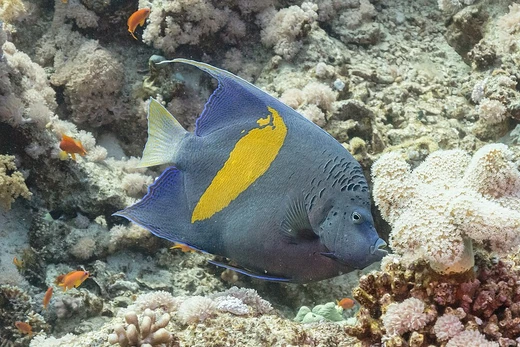
Blackstriped angelfish
A striped angelfish with sex-changing males and harems.

The blackstriped angelfish (Genicanthus lamarck), also known as Lamarck's angelfish, is a species of marine ray-finned fish in the family Pomacanthidae. It occurs in the Indo-West Pacific region and is notable for its distinctive striped pattern and sexual dimorphism.
Quick Facts
- Taxon
- Genicanthus lamarck
Facts from the source article.
Lore & Background
Genicanthus lamarck adults are pale greyish to whitish with 4-5 irregular black undulating stripes radiating from the eye and running horizontally along the flanks. The dorsal fin has a wide black submarginal band, and the caudal fin is finely spotted. Females and juveniles have a wider topmost stripe. Males have a yellow patch on the crown, black pelvic fins, and very elongated caudal fin lobes; females have white pectoral fins and black caudal fin lobes. The species attains a maximum total length of 25 cm.
It is found from the Gulf of Thailand east through the Malayan Archipelago to the Solomon Islands, north to southern Japan, and south to the Great Barrier Reef, including Ashmore Reef and Cartier Island in the Timor Sea. It inhabits depths between 10 and 50 m in areas of dense coral growth on seaward slopes and steep drop-offs. Its diet consists of zooplankton.
Genicanthus lamarck is a sequential protogynous hermaphrodite: small harems with a dominant male and 2-6 females are typical, and if the male disappears, the dominant female changes sex to become male. It was first formally described in 1860 as Holocanthus caudovittatus by Bernard Germain de Lacépède, with no type locality given. The specific name honors Jean-Baptiste Lamarck. It is known to hybridize with the ornate angelfish (Genicanthus bellus).
Reader's Guide
The blackstriped angelfish is frequently found in the aquarium trade, making it a notable species for marine hobbyists. In the Moluccas, it is also regarded as a delicacy. Its striking appearance—pale body with black undulating stripes and sexually dimorphic features—contributes to its popularity. The species' reproductive strategy as a sequential protogynous hermaphrodite, where females can transform into males to maintain harem structure, is a key biological characteristic. Its occurrence across a wide Indo-West Pacific range, from the Gulf of Thailand to the Solomon Islands and southern Japan, underscores its adaptability to coral reef environments. The known hybridization with Genicanthus bellus adds to its evolutionary interest. The species was described by Lacépède in 1860, honoring Lamarck, and its taxonomy remains stable within the family Pomacanthidae.
Did You Know?
- Males have a yellow patch on the crown and black pelvic fins, while females have white pectoral fins and black caudal fin lobes.
- It is a sequential protogynous hermaphrodite: if the male in a harem disappears, the dominant female changes sex to become male.
- This species hybridizes with the ornate angelfish (Genicanthus bellus).
- It is regarded as a delicacy in the Moluccas.
More in Marine Angelfish, Part 2 1-24
Spotted an error? Know more?
Reader corrections go straight into our review queue. Suggest an edit · How this site is sourced