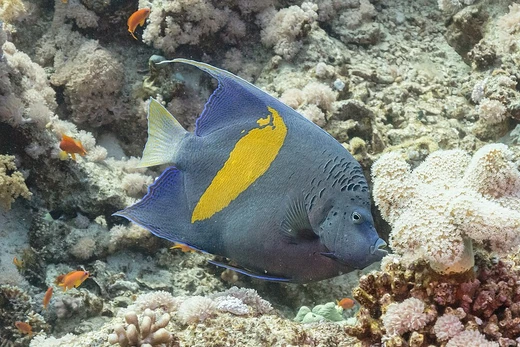
Blackedged angelfish
A Pacific angelfish with distinct male and female coloration.

The blackedged angelfish (Genicanthus watanabei), also known as Watanabe's angelfish, is a species of marine ray-finned fish in the family Pomacanthidae. It is notable for its sexual dichromatism, with males and females displaying distinct color patterns, and for its occurrence across a wide range of the Pacific Ocean.
Quick Facts
- Taxon
- Genicanthus watanabei
Facts from the source article.
Lore & Background
Genicanthus watanabei exhibits strong sexual dichromatism: males are pale blue to bluish-grey on the upper third of the body, with eight thin black horizontal stripes on the lower two-thirds, the highest ending in a yellow patch. Females are overall light blue with wide black bars across the head and a black spot on the snout. Juveniles resemble females. Both sexes have a wide submarginal band on the dorsal and anal fins and on the lobes of the caudal fin, and a forked tail that narrows at the base to form a swallow tail. The dorsal fin has 15-16 spines and 15-16 soft rays; the anal fin has 3 spines and 14-17 soft rays.
The species is found in the Pacific Ocean from Taiwan east to the Cook Islands and Tuamotu Archipelago, north to the Ryukyu Islands, south to New Caledonia and the Austral Islands, and on the Great Barrier Reef, with juveniles reaching as far south as Sydney. It occurs on outward reef slopes and drop-offs with strong currents at depths of 12 to 81 meters. It feeds on plankton in the water column. Like all congeners, it is a protogynous hermaphrodite, starting life as female; the dominant female may change into a male. It has a lek mating system: large males control territories, and females move freely between them. Receptive females are courted by males that swim on their sides and vibrate their fins; the largest, most dominant males prefer to breed with younger females.
Reader's Guide
The blackedged angelfish was first formally described in 1970 by Japanese ichthyologists Fujio Yasuda and Yoshiaki Tominaga, with the type locality given as Onna Beach on Okinawa. The specific name honors Japanese ichthyologist Masao Watanabe of Waseda University, who originally collected the fish but identified it as Genicanthus caudovittatus. The species is not frequently traded in the aquarium trade; specimens that do enter the trade mostly come from the Philippines and Melanesia. Its significance lies in its clear sexual dichromatism, its role as a protogynous hermaphrodite with a lek mating system, and its wide but patchy distribution across the Pacific, including the Great Barrier Reef. The species contributes to understanding of reef fish reproductive strategies and color variation within the genus Genicanthus.
Did You Know?
- Males have eight thin black horizontal stripes on the lower two-thirds of the body, with the highest ending in a yellow patch.
- Females have a black spot on the snout and wide black bars across the head.
- The species is a protogynous hermaphrodite: it starts life as female, and the dominant female may change into a male.
- The specific name honors Masao Watanabe, who originally collected the fish but misidentified it as Genicanthus caudovittatus.
More in Marine Angelfish, Part 2 1-24
Spotted an error? Know more?
Reader corrections go straight into our review queue. Suggest an edit · How this site is sourced