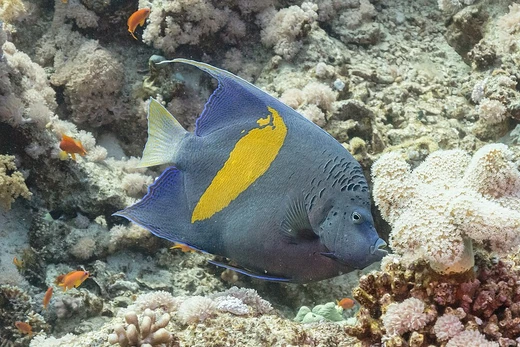
Bermuda blue angelfish
A western Atlantic angelfish that hybridizes with the queen angelfish.

The Bermuda blue angelfish, also known simply as the blue angelfish, is a marine ray-finned fish belonging to the angelfish family Pomacanthidae. It lives in the western Atlantic Ocean.
This species was first formally described in 1876 by American ichthyologist George Brown Goode as a subspecies of the queen angelfish. The original type specimens came from Bermuda, but were later replaced by a neotype that was originally the holotype of a species called *Angelichthys isabelita*, described from Key West, Florida. That name is now considered a synonym of *Holacanthus bermudensis*. The blue angelfish frequently hybridizes with the queen angelfish, which shares its range.
The fish has a deep, oval body that is strongly compressed from side to side. Its snout is short, and its small mouth contains tiny, brush-like teeth. Juveniles are yellowish on the front half of the body, turning brownish-yellow toward the rear. They have bright yellow tail, pectoral, and pelvic fins, along with several vertical white bars on the body and blue margins on the dorsal and anal fins. Adults are bluish-yellow overall with a vivid yellow face, blue highlights on the chest and forehead, and blue-and-yellow pectoral fins. The tail fin has yellow edges, and the dorsal and anal fins also have yellow margins and long yellow streamers. The dorsal fin has 15 spines and 19 to 21 soft rays, while the anal fin has 3 spines and 20 to 21 soft rays. The maximum total length is 45 centimeters (18 inches).
The blue angelfish ranges from North Carolina to Bermuda, into the Bahamas and Florida, the Gulf of Mexico, and east to Yucatán, Mexico, as well as Puerto Rico and the Virgin Islands. It is a benthic species, living close to the seabed in areas with sponges, coral, or rock at depths between 2 and 93 meters (6.6 to 305.1 feet). It is active during the day and hides in the reef at night. Juveniles prefer sheltered spots like bays, channels, and inshore reefs. Its diet consists mostly of sponges, though it occasionally eats tunicates, corals, and algae. Juveniles act as cleaner fish, feeding on ectoparasites from other fish at cleaning stations. They can produce loud thumping sounds, thought to startle predators or alert other blue angelfish.
Adults are usually seen in pairs throughout the year, which suggests they are monogamous.
Quick Facts
- Genus
- Holacanthus
- Species
- bermudensis
Facts from the source article.
Lore & Background
Holacanthus bermudensis was first formally described in 1876 by American ichthyologist George Brown Goode as a subspecies of Holacanthus ciliaris. The original syntypes from Bermuda were later replaced by a neotype, which was the holotype of Angelichthys isabelita described by David Starr Jordan and Cloudsley Louis Ritter from Key West, Florida. This species frequently hybridizes with the sympatric queen angelfish (Holacanthus ciliaris). The name H. isabelita was formerly considered a separate species but is now regarded as a synonym of H. bermudensis.
Juveniles are yellowish anteriorly, changing to brownish-yellow posteriorly, with vivid yellow fins and vertical white bars on the body, plus bright blue margins on the dorsal and anal fins. Adults are bluish-yellow with a vivid yellow face, blue highlights on the chest and forehead, and yellow margins on the caudal, dorsal, and anal fins, the latter having long yellow streamers. The species attains a maximum total length of 45 cm.
It is a benthic, diurnal species found from North Carolina to Bermuda, the Bahamas, Florida, the Gulf of Mexico, Yucatan, and east to Puerto Rico and the Virgin Islands, at depths of 2 to 93 m. Its diet consists largely of sponges, occasionally tunicates, corals, and algae. Juveniles act as cleaner fish, feeding on ectoparasites from other fish, and can produce loud thumping sounds thought to startle predators and attract conspecifics.
Reader's Guide
The Bermuda blue angelfish is not commercially important but is common in the aquarium trade. Its significance lies in its ecological role as a benthic sponge feeder and as a cleaner fish in its juvenile stage, where it establishes cleaning stations that attract other fish. The species is also notable for its frequent hybridization with the queen angelfish, a phenomenon documented in the wild. Its breeding behavior suggests monogamy, with pairs remaining together year-round and spawning by releasing large numbers of pelagic eggs—up to 10 million per season. The rapid development from egg to settled juvenile within weeks highlights its reproductive strategy. The taxonomic history, involving a neotype replacement and synonymization of H. isabelita, reflects ongoing refinement in angelfish classification. Its vivid coloration and manageable size make it a popular aquarium species, though it is not targeted commercially.
Did You Know?
- The species was first described in 1876 by George Brown Goode as a subspecies of Holacanthus ciliaris.
- Females may lay up to 10 million eggs in a single spawning season.
More in Marine Angelfish, Part 2 1-24
Spotted an error? Know more?
Reader corrections go straight into our review queue. Suggest an edit · How this site is sourced