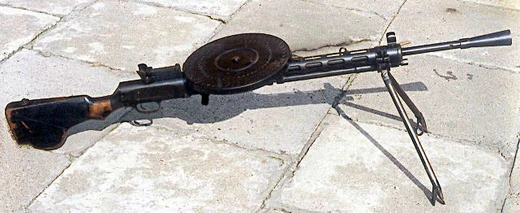
ZB vz. 26
Czechoslovak light machine gun that influenced the Bren and Type 97.

The ZB vz. 26 is a Czechoslovak light machine gun developed in the 1920s. It is notable for its reliability, simple components, quick-change barrel, and ease of manufacturing, and it influenced many other light machine gun designs, including the British Bren gun and the Japanese Type 97 heavy tank machine gun.
Quick Facts
- Origin
- Czechoslovakia
- Is Ranged
- yes
- Service
- 1926–2001
- Designer
- Václav Holek
- Design Date
- 1924
- Manufacturer
- Zbrojovka Brno · Zastava Arms (License)Zastava Arms (License) · Gongxian Arsenal (License)
- Production Date
- 1924–1953
- Weight
- 9.65 kg
- Length
- 1161 mm
- Part Length
- 672 mm
- Cartridge
- 7.92×57mm Mauser
Facts from the source article.
Lore & Background
The ZB-26 was developed after the Czechoslovak Brno arms factory was built in 1923, following early trials of foreign and domestic designs. Designer Václav Holek and his team created a prototype based on the Praha II, initially belt-fed, but later changed to a top-feeding box magazine. Production began at ZB by late 1926, and it became the standard light machine gun of the Czechoslovak Army by 1928.
The ZB-26 is gas-operated, air-cooled, and fires from an open bolt. It has a finned, quick-detachable barrel and a long-stroke gas piston below the barrel. The charging handle is on the right side and does not reciprocate. The 20-round magazine feeds from the top, and spent cartridges eject downward. The sight line is offset to the left due to the overhead magazine. It has an integral folding bipod and a wooden butt with a spring-buffered buttplate.
The ZB-26 saw service with Czechoslovak infantry from 1928 and was used on Škoda armored vehicles. It was exported to 24 countries, with large batches going to Bolivia, Bulgaria, China, Romania, Turkey, and Yugoslavia. After the German occupation of Czechoslovakia, the Wehrmacht adopted it as the MG 26(t). Chinese forces used it extensively, and Chinese factories produced it as the Type 26.
Reader's Guide
The ZB-26's significance lies in its widespread adoption and influence. It was the basis for the British Bren light machine gun, modified by ZB and British technicians, and the Japanese Type 97 heavy tank machine gun, designed from captured ZB-26s. Its design emphasized reliability and ease of manufacturing, with a quick-change barrel and simple components. The ZB-26 was used by numerous countries in various conflicts, including World War II, the Second Sino-Japanese War, the Korean War, and the First Indochina War. Chinese Communist forces employed it against UN forces in Korea, and it was used by both North Vietnamese Army and Viet Minh guerrillas. The ZB factory produced over 120,000 ZB-26 guns between 1926 and 1939 in various calibers, and 7,136 were produced after the war from 1945 to 1953. Its legacy is that of a reliable and influential light machine gun that served in many theaters and inspired later designs.
Did You Know?
- The ZB-26 was officially designated LK vz. 26 in Czechoslovak army service, with 'LK' meaning lehký kulomet (light machine gun).
- The British Bren light machine gun was a modified ZB vz. 26 licensed to Britain by Czechoslovakia.
- The Japanese Type 97 heavy tank machine gun was designed from captured ZB-26s during the Second Sino-Japanese War.
- Chinese factories produced the ZB-26 as the Type 26 during the high demand of the Second Sino-Japanese War.
More in Machine Guns, Part 2 1-24
Spotted an error? Know more?
Reader corrections go straight into our review queue. Suggest an edit · How this site is sourced