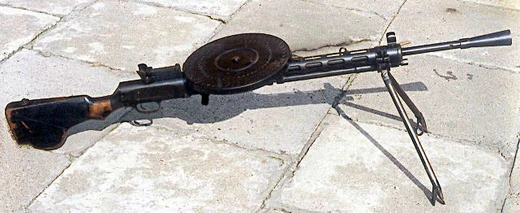
Maxim–Tokarev
First domestic Soviet light machine gun, adapted from the Maxim M1910.
The Maxim–Tokarev, also called the MT or M-T, was the first light machine gun of Soviet design to enter service with the Red Army. Fedor Tokarev based it on the earlier Maxim M1910.
During World War I and the Russian Civil War, Soviet forces relied on foreign light machine guns like the Lewis, Chauchat, and Hotchkiss M1909. By the 1920s, these weapons were worn out, and the Soviet Union’s diplomatic isolation made it difficult to obtain spare parts or ammunition. In 1923, the GAU launched an emergency program to equip the Red Army with a light machine gun firing the domestic 7.62×54mmR cartridge.
The first design submitted was the Maxim-Kolesnikov by Ivan Kolesnikov at the Kovrov Arms Factory. Tokarev’s rival design came from the Tula Arsenal. Field tests in early 1925 favored Tokarev’s model, and it was adopted on May 26. Production at Tula (TOZ) ran from 1926 to 1927, totaling 2,500 guns. Between 1938 and 1939, 1,400 were sent to China under the Sino-Soviet Aid Program; the remainder went to Republican forces in the Spanish Civil War. The much lighter DP later replaced it in Soviet service.
A U.S. Army analysis noted that Tokarev was likely influenced by the German Parabellum and British Vickers, and that the trigger and stock arrangement closely resembled a 1909 U.S. patent by Dawson and Buckham, assigned to Vickers. The water jacket of the M1910 was replaced with a thin perforated steel jacket. The barrel was shortened and lightened from 2.1 kg to 1.7 kg, and a field-changeable barrel mechanism was added. Spade grips gave way to a rifle-type stock, and the thumb trigger was replaced with a rifle-type trigger. A folding bipod with tubular legs attached to the barrel jacket. The canvas-belt feed system remained the same as on the PM M1910, but the standard belt held 100 rounds, usually carried in drum-type containers inspired by the German MG 08/15. The barrel had four right-hand rifling grooves with a 240 mm twist.
The Maxim–Tokarev saw use in the Spanish Civil War, the Second Sino-Japanese War, World War II, and the Korean War.
Quick Facts
- Origin
- Soviet Union
- Is Ranged
- yes
- Designer
- Fedor Tokarev
- Number
- 2,500
- Cartridge
- 7.62×54mmR
- Caliber
- 7.62 mm
- Action
- Short recoil, toggle locked
Facts from the source article.
Lore & Background
During World War I and the Russian Civil War, the Soviet army was equipped with light machine guns of foreign manufacture, mostly with the Lewis gun, the Chauchat and the Hotchkiss M1909. By the 1920s, these guns were showing their age, and owing to the Soviet Union's international diplomatic isolation, neither spare parts nor ammunition could be easily obtained for these guns. In 1923 GAU emergency program was initiated for equipping the Red army with a light machine gun chambered for the domestic 7.62×54mmR.
The first design submitted was the Maxim-Kolesnikov, designed by Ivan Nikolaevich Kolesnikov at the Kovrov Arms Factory, followed soon thereafter by the Maxim–Tokarev, designed by Fedor Vasilievich Tokarev at the Tula Arsenal. During field tests conducted in early 1925, Tokarev's model proved superior, so it was adopted on May 26. Of the 2,500 Maxim–Tokarev guns were produced by Tula arms factory (TOZ) in 1926–27; 1,400 were supplied to China between 1938 and 1939 in the Sino-Soviet Aid Program. The rest were sent to the Republican forces during the Spanish Civil War. It was replaced in Soviet service by the much lighter DP.
Reader's Guide
The Maxim–Tokarev represents a transitional step in Soviet light machine gun development, adapting the heavy Maxim M1910 into a more portable form. Its water jacket was discarded and replaced by a thin perforated steel jacket; the barrel was shortened and lightened from 2.1 kg to 1.7 kg. A mechanism for changing the barrel in field conditions was provided. The spade grips were replaced with a rifle-type stock and the thumb-trigger was replaced by a rifle-type trigger. A folding bipod with tubular legs was attached to the barrel jacket. The canvas-belt feed system was the same as on PM M1910 guns, except the standard belt capacity was reduced to 100 rounds. The 100-round belts were usually carried in separate drum-type containers, inspired from the German MG 08/15. The barrel rifling was 4 right-turns in 240 mm. A US Army analysis mentions that 'Tokarev was doubtless inspired by both the German Parabellum and the British Vickers. The arrangement of the trigger and the shoulder stock resembles very strongly that illustrated in United States Patent No. 942167, which was granted in 1909 to Dawson and Buckham, assignors to Vickers.' The gun saw use in the Spanish Civil War, the Second Sino-Japanese War, World War II, and the Korean War.
Did You Know?
- The Maxim–Tokarev was the first domestic Soviet light machine gun accepted for service.
- It was developed from the Maxim machine gun M1910 by Fedor Tokarev.
- The rest were sent to Republican forces during the Spanish Civil War.
Origins and the 1923 Emergency Program
During the First World War and the subsequent Russian Civil War, the Red Army relied heavily on light machine guns built abroad—the Lewis gun, the French Chauchat, and the Hotchkiss M1909 all saw widespread use. By the 1920s, however, these foreign-designed weapons were deteriorating, and the Soviet Union's diplomatic isolation made it nearly impossible to source replacement parts or compatible ammunition. Recognizing the urgency, the General Armaments Directorate launched an emergency program in 1923 to field a domestically produced light machine gun chambered for the standard 7.62×54mmR cartridge. Two competing entries emerged: the Maxim-Kolesnikov, engineered by Ivan Nikolaevich Kolesnikov at the Kovrov Arms Factory, and the Maxim–Tokarev, designed by Fedor Vasilievich Tokarev at the Tula Arsenal. Both were essentially reworked versions of the venerable Maxim M1910. When field trials were conducted in the early months of 1925, Tokarev's iteration demonstrated clear superiority over Kolesnikov's. The Maxim–Tokarev was formally adopted into Soviet service on May 26 of that year, marking a significant step toward self-sufficiency in small-arms production.
Engineering Choices and External Influences
A US Army technical assessment noted that Tokarev's design drew clear inspiration from both the German Parabellum and the British Vickers machine guns. In particular, the layout of the trigger mechanism and the shoulder stock bore a striking resemblance to the configuration described in United States Patent No. 942167, granted in 1909 to Dawson and Buckham and assigned to Vickers. Structurally, the most visible change from the parent Maxim M1910 was the elimination of the heavy water jacket, which was swapped for a slim perforated steel sleeve. The barrel itself was both shortened and lightened, dropping from 2.1 kilograms to 1.7 kilograms, and a field-change mechanism was incorporated so crews could swap barrels without specialized tools. The awkward spade grips gave way to a conventional rifle-style stock, and the thumb-trigger was replaced with a standard rifle-type trigger. A folding bipod with tubular legs was mounted to the barrel jacket. For feeding, the canvas-belt system carried over from the M1910, though belt capacity was trimmed to 100 rounds, typically stored in drum-shaped containers modeled on the German MG 08/15. The rifling featured four right-hand turns over 240 millimeters.
Production, Export, and Combat Service
The Tula Arms Factory (TOZ) manufactured a total of 2,500 Maxim–Tokarev units during 1926 and 1927. Rather than being stockpiled for peacetime use, the majority of these weapons were quickly dispatched abroad. Between 1938 and 1939, 1,400 of the guns were shipped to China as part of the Sino-Soviet Aid Program, where they entered service with the Republic of China's forces during the Second Sino-Japanese War. The remaining weapons were transferred to the Republican side during the Spanish Civil War. In Soviet service, the Maxim–Tokarev was eventually superseded by the significantly lighter DP light machine gun, which offered a more practical weight-to-firepower ratio for infantry use. Despite its relatively short career in the Red Army, the weapon saw action across a remarkable span of conflicts: the Spanish Civil War, the Second Sino-Japanese War, World War II, and the Korean War. Its users extended beyond the original Soviet and Chinese recipients to include the People's Republic of China and North Korea, underscoring how a single production run of just 2,500 guns could influence combat operations on multiple continents over two decades.
A Pioneering Step in Soviet Small-Arms History
The Maxim–Tokarev, often abbreviated as MT or M-T, holds a distinctive place in the history of Soviet weaponry as the first domestically designed light machine gun to be formally accepted into Red Army service. Developed by Fedor Vasilievich Tokarev as a reworking of the long-serving Maxim M1910, it represented a critical transition from reliance on foreign-manufactured weapons to indigenous production. The competitive process that led to its adoption—pitting Tokarev's Tula Arsenal design against Ivan Kolesnikov's Kovrov entry—illustrated the structured, test-driven approach the Soviet military applied to weapons procurement during the 1920s. Although its production run was modest and its service life in the Soviet inventory was brief, the weapon's export to China and Spain, and its subsequent appearance in four major conflicts, gave it a combat footprint far exceeding its numbers. Its eventual replacement by the DP did not diminish its significance; rather, it marked the next evolutionary step in a lineage of Soviet light machine guns that would go on to shape infantry tactics for generations.
Gallery

More in Machine Guns, Part 2 1-24
Spotted an error? Know more?
Reader corrections go straight into our review queue. Suggest an edit · How this site is sourced