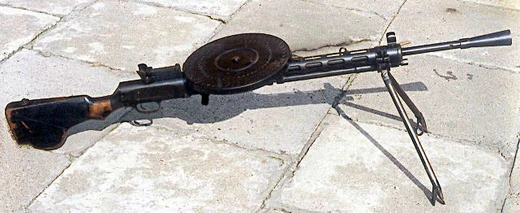
MG 29
Swiss aircraft and anti-aircraft machine gun with toggle locking.
The MG 29, also known as the Flieger MG 29, Flab MG, or FLab MG 29/38, is a Swiss light machine gun developed in the 1920s. It was notable for its use in aircraft and later as an anti-aircraft gun, though its weight prevented it from serving as an infantry support weapon. The design employed a closed bolt system with a toggle locking system derived from the LMG25.
Quick Facts
- Origin
- Switzerland
- Is Ranged
- YES
- Designer
- Adolf Furrer
- Design Date
- 1920s
- Manufacturer
- W+F Bern
- Production Date
- 1920s-1930s
- Variants
- Single and twin gun variants
- Cartridge
- 7.5x55 mm GP11
- Caliber
- 7.5 mm
- Barrels
- 1-2
- Action
- Recoil, toggle lock firing from closed bolt
- Rate
- 1200RPM
Facts from the source article.
Lore & Background
The MG 29 was developed in the 1920s and produced until shortly before the Second World War. It was initially mounted on aircraft and later adapted for anti-aircraft use. Two versions existed: a standard single gun and a 'Doppel-MG' that bolted two guns together to fire from a single trigger. Both air and water cooling were used for single and double guns depending on the application. A water-cooled version was tested using the MG11 Maxim tripod, but only a few were built.
The gun was too heavy for infantry support. After the Second World War, Switzerland acquired better anti-aircraft systems and aircraft weapons, and the infantry support role was filled by the MG 51. The MG 29, with its higher rate of fire but greater weight, was mounted on the first prototype of the Panzer 58, the precursor to the Panzer 61 tank, before being retired.
Reader's Guide
The MG 29's significance lies in its role as a transitional Swiss machine gun bridging interwar aircraft armament and early Cold War tank armament. Its toggle locking system, shared with the LMG25, was a distinctive mechanical feature. The Doppel-MG variant, which paired two guns to fire from one trigger, represented an early approach to increasing firepower without developing a new weapon. However, the gun's weight limited its versatility; it could not serve as an infantry support weapon, and its primary roles were aerial and anti-aircraft. After the Second World War, the MG 29 was superseded by more modern systems, but it saw final use on the first prototype of the Panzer 58 tank, linking it to the development of Swiss armored vehicles. Its legacy is that of a specialized weapon that filled niche roles until more capable designs became available.
Did You Know?
- The MG 29 was also called the Flab MG or FLab MG 29/38.
- Some guns could attach a large box to the bottom to hold the ammunition belt.
- The Doppel-MG version bolted two guns together to fire from the same trigger.
From Captured Blueprints to a New Standard
At the close of World War II, the technical drawings for the MG 42 fell into Soviet hands and were subsequently transferred to Czechoslovakia and Yugoslavia, leaving German manufacturers without their own reference documents. Rheinmetall was compelled to reconstruct the first postwar machine guns by working directly from a surviving MG 42 specimen. In 1958, the factory began producing the MG 1, a re-chambered version for the 7.62×51mm NATO round, at the express request of the newly formed Bundeswehr. Successive refinements followed rapidly: the MG 1A1 added a chrome-lined barrel and recalibrated sights, while the MG 1A2 introduced a heavier 950-gram bolt that reduced the cyclic rate to 700–900 rounds per minute, a new friction ring buffer, bolt-bounce preventing catches, and compatibility with both German DM1 and American M13 ammunition belts. Wartime MG 42s still in inventory were converted to NATO chambering and designated MG 2. The culmination of this evolutionary chain arrived in 1968 with the MG 3, which brought an improved belt retaining pawl, an anti-aircraft sight, and a redesigned ammunition box. Production ran until 1979, with Heckler & Koch contributing additional output, and the entire family retained a high degree of parts interchangeability with the original MG 42.
A Global Workhorse
Standardized in the late 1950s and adopted by the Bundeswehr, the MG 3 quickly outgrew its German origins. Armed forces in more than forty nations acquired the weapon or its derivatives, and production licenses were sold to a broad coalition of manufacturers: Italy produced it as the MG 42/59, Iran designated its version the MGA3, Pakistan fielded it as the MG 1A3, and Greece, Sudan, Spain, and Turkey all secured their own manufacturing rights. Even after Rheinmetall's original German production line closed in 1979, the gun continued to be built in Turkey and Pakistan, ensuring a steady supply for allied and partner militaries. The weapon's enduring relevance was reaffirmed in 2019, when the German government announced plans to manufacture several thousand new MG 3 receivers specifically for vehicle-mounted (MG 3A0A1) and turret-mounted (MG 3A1A1) applications. This decision underscored that, despite more than six decades of service, the MG 3 remained a practical and trusted choice for the Bundeswehr's armored and light-vehicle fleets, serving simultaneously as a squad support weapon in the infantry and as a primary armament on platforms ranging from the Leopard 2 to the ATF Dingo.
Doctrine, Discipline, and the Barrel
German military doctrine treats the MG 3 as a precision tool rather than a firehose. In the bipod-mounted light machine gun role, soldiers are drilled to deliver controlled bursts of three to five rounds, re-aiming between each burst. On a tripod, the permissible burst length extends to twenty or thirty rounds, but the principle of measured, deliberate fire remains absolute. Perhaps the most critical discipline involves barrel management: after one hundred and fifty live rounds, or one hundred blanks, of sustained fire, the barrel must be swapped for a cool spare. The old barrel may not be reused until it has cooled to the point where a soldier can hold it bare-handed for thirty seconds. Because an overheated barrel can approach white-hot temperatures, the crew member performing the change is issued protective asbestos gloves or a cloth. The effective rate of fire in combat conditions is roughly two hundred and fifty rounds per minute. In 1974, the US Army evaluated the MG 3 against eight competing designs; it ranked sixth of nine, trailing the M60 and FN MAG in reliability and accuracy metrics, though it excelled in ease of training, barrel change speed, and safety features.
Engineering the Cyclic Rate
The MG 3's internal architecture reflects a design philosophy centered on simplicity and operator control. It fires exclusively in automatic mode from an open bolt position, with a cross-bolt safety button on the receiver that, when engaged, disables the bolt release entirely. One of the gun's most distinctive mechanical features is its adjustable cyclic rate: by swapping the bolt and recoil spring, the operator can tune the firing speed. The standard bolt, weighing approximately 650 grams, yields a rate of one thousand to one thousand two hundred rounds per minute, while an extra-heavy bolt of roughly 900 grams demands more recoil energy to move its additional mass, thereby slowing the overall cycle. This modular approach to rate control, combined with the belt retaining pawl that secures the ammunition belt when the top cover is lifted for maintenance, gives the MG 3 a level of field-serviceability that has kept it in continuous frontline service. Throughout its variants, the weapon maintains a high degree of parts interchangeability with the original MG 42, a legacy that simplifies logistics for every nation that fields it.
Gallery


More in Machine Guns, Part 2 1-24
Spotted an error? Know more?
Reader corrections go straight into our review queue. Suggest an edit · How this site is sourced