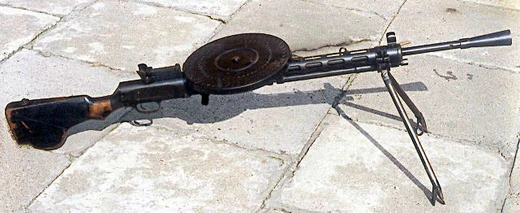
M1941 Johnson machine gun
American recoil-operated light machine gun with adjustable fire rate.
The M1941 Johnson light machine gun, sometimes called the Johnson or the Johnny gun, was an American recoil-operated light machine gun from the late 1930s. It was designed by Melvin Johnson, a Boston lawyer and Marine Corps Reserve captain, who initially aimed to build a semi-automatic rifle that could outperform the M1 Garand. By late 1937, he had built and tested both a semi-automatic rifle and a prototype light machine gun, which shared many parts and the same short-recoil operating principle with a multi-lug rotating bolt—a design first used on the Fosbery Pump Shotgun. Johnson assembled the M1941 light machine gun by swapping parts from other firearms.
The weapon fed from a curved, single-column magazine on the left side of the receiver, with a standard 20-round capacity. It could also be loaded via stripper clips through the ejection port or by single rounds into the breech. The rate of fire was adjustable between 200 and 600 rounds per minute. Two versions existed: the M1941, with a wooden stock and metal bipod, and the M1944, with a tubular steel butt and wooden monopod. The design directed recoil forces in a straight line to the gunner’s shoulder, reducing muzzle climb, but this required the sights to be mounted higher above the bore.
The Johnson LMG shared several features with the German FG 42 automatic rifle: both fed from the left, fired from an open bolt in automatic mode and a closed bolt in semi-automatic, and both were awkward to carry loaded due to their side-mounted magazines. The Johnson’s long single-column magazine especially unbalanced the weapon. However, there is no evidence that either design influenced the other; they simply solved similar problems in similar ways. Prototypes of semi-automatic rifles based on the Johnson LMG, including the M1947 Johnson auto carbine, were also produced, as was a belt-fed variant called the T48 light machine gun.
Johnson sold small quantities of the LMG to the U.S. Army and Marine Corps. During World War II, Allied special forces wanted a lighter, more portable, and more accurate automatic rifle with stopping power equal to the American BAR. The Johnson was adapted as a BAR replacement for commandos operating behind Axis lines. The First Special Service Force—a joint Canadian-American unit known as the Devil’s Brigade—traded the Marine Corps 125 Johnson light machine guns for plastic explosives.
Quick Facts
- Is Ranged
- yes
- Origin
- United States
- Design Date
- 1940
- Production Date
- 1940–1945
- Service
- 1940–1961
- Wars
- World War II / Korean War / Hukbalahap Rebellion / Cuban Revolution
- Weight
- 13 lb
- Part Length
- 22 in
- Length
- 42 in
- Cartridge
- .30-06 Springfield
- Feed
- 20-round, single stack-column detachable box magazine
- Action
- Short recoil
Facts from the source article.
Lore & Background
The M1941 Johnson light machine gun was designed by Melvin Johnson Jr., a Boston lawyer and captain in the Marine Corps Reserve. His goal was to build a semi-automatic rifle that would outperform the M1 Garand. By late 1937, he had designed, built, and successfully tested both a semi-automatic rifle and a prototype light machine gun. Each shared a significant number of physical characteristics and common parts, and both operated on the principle of short recoil with a multi-lug rotating bolt, first used on the Fosbery Pump Shotgun. Johnson took parts of other guns, switching them out and creating the M1941 light machine gun.
The weapon fed from a curved, single-column magazine attached to the left side of the receiver; company brochures list a 20-round magazine as standard. It could also be loaded by stripper clip at the ejection port or by single rounds fed into the breech. The rate of fire was adjustable from 200 to 600 rounds per minute. Two versions were built: the M1941 with a wooden stock and a metal bipod, and the M1944 with a tubular steel butt and a wooden monopod. The design intended recoil forces to travel in a direct line to the shoulder, minimizing muzzle climb, though the sights had to be placed higher above the bore.
The weapon has many parallels with the German FG 42 automatic rifle. Both feed from the left side, and both fire from an open bolt while in automatic and a closed bolt while in semi-auto. Both weapons were awkward to carry loaded, with a side-mounted magazine; the Johnson had an especially lengthy single-column magazine that tended to unbalance the weapon. Despite these similarities, there is no evidence that either weapon had any effect on the design of the other.
Reader's Guide
The M1941 Johnson light machine gun saw limited but notable deployment. Johnson sold small quantities to the U.S. Army and Marine Corps. During World War II, Allied special forces demanded a more portable, lighter, more accurate automatic rifle providing equivalent stopping power to the American BAR. The Johnson was adapted as the BAR replacement for commandos operating behind Axis lines. The First Special Service Force traded the Marine Corps 125 Johnson light machine guns for plastic explosives; they were used in lieu of BARs but were replaced by BARs as they wore out or were lost in combat.
The Johnson LMG was used by the Philippine Army and Philippine Constabulary during World War II under Japanese occupation and post-war through the Hukbalahap Rebellion and by the Philippine Expeditionary Forces to Korea. Shortly after the 1948 Arab–Israeli War, Haganah developed a close copy, the Dror, in .303 British and 7.92×57mm Mauser, but Israeli forces found it unreliable due to jamming from sand and dust, and it was discontinued. Ernesto 'Che' Guevara notably used a Johnson in the Cuban Revolution.
Melvin Johnson continued developing small arms. In 1955, he assisted Fairchild/ArmaLite in promoting the AR-10, then with ArmaLite and Colt's as an advocate for the AR-15. The AR-15 used a similar bolt design to the M1941 Johnson. A prototype using hydrazine for a caseless firearm was also developed, but concerns about pressure seal durability and toxicity prevented adoption.
Did You Know?
- The M1941 Johnson light machine gun shared many parts with the M1941 Johnson rifle and M1947 Johnson auto carbine.
- Its rate of fire could be adjusted from 200 to 600 rounds per minute.
- The First Special Service Force traded 125 Johnson light machine guns to the Marine Corps for plastic explosives.
- Ernesto 'Che' Guevara used a Johnson light machine gun during the Cuban Revolution.
A Design Acquired in Exile
In 1946, as the Haganah—the precursor organization to what would become the Israel Defense Forces—sought to field an indigenous light machine gun, its engineers at Ta'as began studying plans for a domestic weapon. The solution came from across the Atlantic: the Haganah purchased the manufacturing rights to the M1941 Johnson light machine gun directly from the Winchester Repeating Arms Company. Alongside those rights, they acquired manufacturing tools that had been bought cheaply as scrap in the United States, a pragmatic move for a fledgling arms program operating under secrecy. The resulting weapon, named the Dror (Hebrew for "Sparrow"), was developed in clandestine workshops rather than a formal factory. Yisrael Galili was placed in charge of overseeing production, a role that put him at the center of one of the earliest examples of a new nation building its own small-arms capability from foreign blueprints and salvaged equipment.
Mechanical Philosophy
The M1941 Johnson's operating system carried forward into the Dror with notable fidelity. The weapon is air-cooled and recoil-operated, relying on a rotary bolt secured by multiple radial lugs rather than a tilting or pivoting mechanism. One of the design's most distinctive features is its dual firing mode: in full automatic, the gun fires from an open bolt, a choice that improves heat dissipation during sustained bursts; in semi-automatic, it fires from a closed bolt, trading some thermal margin for tighter shot grouping. The Pattern 1 Dror bore a clear physical resemblance to its American ancestor, retaining the Johnson's characteristic tall front sight and the barrel release mechanism. These visual and mechanical echoes made the lineage unmistakable to anyone familiar with the original Winchester design, even as the weapon was being adapted to entirely different ammunition and production conditions in a small, newly independent state.
From Pattern to Pattern
The Dror's production history reveals a design in iterative correction. The Pattern 1 was chambered in .303 British, a practical choice given the large quantities of British rifle ammunition already in hand. However, only around 800 to 1,000 examples were completed before feeding problems that the armourers could not resolve forced a halt to production. The Pattern 2, built by IMI, addressed these issues by switching to the rimless 7.92×57 mm Mauser cartridge, taking advantage of large quantities of recently imported Mauser ammunition. This change necessitated a redesign of the magazine system: modified 20-round BAR LMG magazines were mounted vertically beneath the receiver to balance the weapon. The barrel release was relocated to the front barrel bearing, now fitted with a heat shield colored orange or brown that could be removed without protective gloves. A folding cover over the magazine well protected the action from dust, a fire selector sat on the right side above the pistol grip, and the metal butt consisted of two parallel steel tubes capped with a sheet-steel buttplate.
A Brief Chapter in Service
Despite its promising design heritage, the Dror never achieved the combat record its developers had hoped for. The weapon proved oversensitive to dusty environments, a critical flaw in the arid conditions of the region, and as a result it did not see combat service during the 1947–1949 War of Independence. The Israel Defense Forces conducted combat simulation testing to evaluate the weapon's suitability, and the results were not in its favor. In 1952, the IDF made the decision to replace the Dror with the FN Model D, a derivative of the M1918 Browning Automatic Rifle, a choice that reflected the need for a more robust and field-reliable light machine gun. The Johnson-based design's story thus ended not in battle but in a testing range. Today, some surviving Drors are preserved on display at the IDF History Museum, serving as tangible reminders of a nation's early, ambitious, and ultimately short-lived attempt to field its own light machine gun based on an American design.
Gallery


More in Machine Guns, Part 2 1-24
Spotted an error? Know more?
Reader corrections go straight into our review queue. Suggest an edit · How this site is sourced