Lmg 25
Swiss recoil-operated light machine gun with toggle-lock action.
The Lmg 25 is a Swiss light machine gun that uses recoil to operate. It was designed in the 1920s by Colonel Adolf Furrer, who was the director of Waffenfabrik Bern, and the weapon was manufactured there. Production ran from 1925 into the 1960s. It was the first light machine gun the Swiss Army adopted as a portable infantry weapon. It fires the 7.5 mm Swiss Service cartridge from a 30-round box magazine, with a cyclic rate of about 500 rounds per minute. The Swiss Army replaced it in 1957 with the Stgw 57.
The action is recoil-operated with a toggle-lock mechanism, a system Furrer developed. This toggle sits on the right side of the receiver and works through linked components during firing and reloading. The design is similar to the Luger P08 pistol, but unlike the Luger, the Lmg 25’s toggle is not bent by a control curve; instead, a support joint attached to the extension of the rear joint does the work. The weapon is accurate but prone to problems from dirt because of its large friction surfaces, tight manufacturing tolerances, and the large lateral opening needed for the toggle joint. The breech block’s closing flap opens automatically with the first shot.
Ammunition feeds from a magazine on the right, and empty casings eject to the left. The Lmg 25 typically fires with pre-ignition—the shot is released while the locked system is still moving forward. This prevents the bolt from hitting the housing, giving the weapon a constant push rather than a sharp kick, which helps accuracy. Because the cartridge’s recoil and the barrel’s return must be precisely timed, a switch was added to keep the gun working properly when tilted sharply downward.
The Swiss Army adopted the Lmg 25 to give light infantry units more firepower. In fusilier squads, it was operated by two men, with the team leader commanding when to fire. The rest of the squad carried K31 rifles or submachine guns. The bipod at the front also served as a target aid for more accurate fire at longer ranges. The rear support, attached to the butt, was adjustable in length and could be moved to the fore-end as a handle, making standing shots easier. With anti-aircraft sights, the Lmg 25 could be mounted on the rear leg of a tripod for use against planes, though the tripod was used only occasionally after World War II.
Quick Facts
- Origin
- Switzerland
- Is Ranged
- yes
- Designer
- Adolf Furrer
- Manufacturer
- W+F Bern
- Production Date
- 1925–c. 1960s
- Weight
- 8.65 kg
- Length
- 1163 mm
- Part Length
- 585 mm
- Cartridge
- 7.5×55mm Swiss
- Action
- Recoil-operated, toggle-lock
- Rate
- Approximately 500 rounds/min
- Velocity
- 731.5–762 m/s
Facts from the source article.
Lore & Background
The Lmg 25 uses a recoil-operated action with a toggle-lock mechanism derived from the system developed by Adolf Furrer. The toggle mechanism is located on the right side of the receiver and operates through a series of linked components during firing and reloading. In contrast to the Luger P08, the toggle lock is not bent by a control curve, but by a support joint attached to the extension of the rear joint. The weapon fires with pre-ignition, meaning the shot is released when the locked system is still in advance, which gives a constant backward thrust rather than a kick, positively affecting precision. A changeover switch was installed to ensure proper function when the weapon was tilted sharply downward.
The Lmg 25 was lighter than water-cooled machine guns of the time, but its more complicated design made it difficult to manufacture and raised its price. It is considered accurate but susceptible to contamination due to large friction surfaces, low manufacturing tolerances, and the large lateral opening of the breech block necessary for the knee joint. Ammunition is fed from the right via a magazine, with casings ejected to the left. In battle, a barrel change was planned after 6 magazines (180 rounds) to avoid overheating, though less frequent changes were made when only short bursts of 5–8 rounds were fired. Theoretically, a barrel change took 17 seconds.
The weapon was designed for infantry use and could be adapted for other roles. In fusilier squads, it was operated by two men, with firing commanded by the team leader. It used a bipod front support and an adjustable rear support attached to the butt, which could also be attached to the fore-end as a handle for standing shots. With anti-aircraft sights, it could be mounted on a tripod for use against airplanes, though the tripod was used only sporadically after the Second World War. The Lmg 25 was also used in numerous forts, where the front bipod was removed and a bracket attached for shooting from openings.
Reader's Guide
The Lmg 25 holds significance as the first light machine gun adopted by the Swiss Army, providing increased firepower to light infantry units. Its toggle-lock action, derived from the system developed by Adolf Furrer, was a distinctive mechanical feature that set it apart from contemporary designs. While lighter than water-cooled machine guns, its complex construction made it expensive and difficult to manufacture, and its susceptibility to contamination was a noted drawback. The weapon's pre-ignition firing system contributed to its accuracy by producing a constant backward thrust rather than a sharp recoil. The Lmg 25 remained in Swiss service until 1957, when it was replaced by the Stgw 57. Its legacy includes use in fortifications and adaptation for cavalry with a folding stock, as well as a variant with a telescopic sight rail. The weapon's design influenced Swiss small arms development and demonstrated the country's independent approach to infantry weaponry during the mid-20th century.
Did You Know?
- The Lmg 25 was the first light machine gun adopted by the Swiss Army as a portable infantry weapon.
- Its toggle-lock mechanism is derived from the system developed by Colonel Adolf Furrer, similar to the Luger P08 pistol.
- The weapon fires with pre-ignition, releasing the shot while the locked system is still moving forward.
- A barrel change was theoretically possible in 17 seconds.
Design & Mechanics
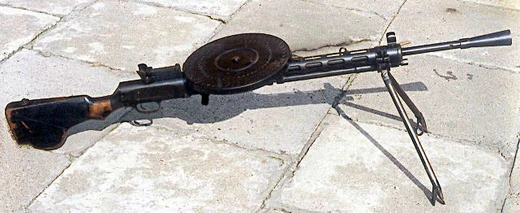
The Degtyaryov light machine gun employed a gas-operated long-stroke piston system with a regulator positioned beneath the barrel. Its bolt locking was accomplished through two lugs that spread laterally as the firing pin advanced; once the bolt reached full forward travel, a widened section of the pin—linked to the bolt carrier—forced the lug ends outward into receiver grooves, securing the lock. Unlocking reversed this process as the carrier drove the firing pin back and bevels on the carrier pulled the lugs inward. The barrel, quick-detachable and partially shrouded, was fitted with a conical flash hider (absent on earliest models). However, its thin walls made it vulnerable to rapid overheating, particularly in later variants where ribbed radiators had been dropped for manufacturing simplicity, limiting sustained combat fire to roughly eighty rounds per minute. Swapping a hot barrel in the field demanded a special wrench and carried a real burn risk. The recoil spring, also mounted under the barrel, could lose tension under prolonged firing—one of the weapon's few but notable mechanical weaknesses.
The Pan Magazine & Firing System
Ammunition was fed through flat, disc-shaped pan magazines—affectionately called "platters"—in which cartridges sat in a circle with their bullet tips pointing inward toward the center. This arrangement proved reliable for the rimmed 7.62×54mmR round but introduced practical headaches: the empty magazine was bulky and heavy, awkward to carry and reload, and prone to warping under the rigors of combat. Early magazines held forty-nine rounds; later versions were trimmed to forty-seven for improved reliability. A gunner typically received three magazines plus a metal transport box. Though the pan visually echoed the Lewis gun's disk, the underlying mechanics were entirely different: the Lewis relied on bolt-driven lever action to rotate its disk, whereas the DP's magazine was driven by a pre-tensioned internal spring. The trigger group permitted only fully automatic fire from an open bolt and lacked a conventional safety; instead, an automatic lever disengaged when the shooter gripped the stock's neck. During extended bursts this constant pressure fatigued the hand, and the rifle-style stock offered little help in maintaining a firm hold. The tank-mounted DT variant and the later DPM both adopted a more ergonomic trigger frame with a standard safety and pistol grip.
Wartime Service & Global Proliferation
The DP first saw combat action with Republican forces in the Spanish Civil War, arriving in shipments aboard vessels such as the SS Kursk in October 1936 and the SS Bonafacio in early 1938. During the Winter War and the Continuation War, Finnish troops captured large numbers and partially swapped them in for their own Lahti-Saloranta M/26; by the summer of 1944 the Finnish front fielded roughly nine thousand captured Degtyarevs alongside about three thousand four hundred domestically produced Lahtis. The Finns dubbed the weapon "Emma" after a popular waltz, again referencing the record-disc magazine. German Volkssturm units also fielded captured examples, designating them Leichtes Maschinengewehr 120(r). The Chinese Nationalists received five thousand six hundred DPs from the Soviet Union for use in the Second Sino-Japanese War and the subsequent civil conflict, while North Korean and Chinese Communist forces employed the type in the Korean War and produced a copy as the Type 53. Soviet and Chinese Communists supplied all DP variants to the Viet Minh in the First Indochina War and to the NVA and Vietcong during the Vietnam War. DPMs have even been recovered from Taliban fighters in Afghanistan and spotted in the 2014 Northern Mali conflict.
Legacy & Successors
During World War II the Degtyaryov served as the standard Soviet infantry light machine gun, but its role extended far beyond the rifle squad. It was mounted in aircraft as a flexible defensive weapon and fitted to nearly every Soviet tank of the war, either as a bow-mounted flexible gun or as a co-axial weapon controlled by the gunner. In 1943 an improved variant, the DPM, entered production, yet the type was formally superseded in 1946 by the RP-46, which retained the basic DP architecture while switching to belt feeding. The RPD, introduced in the 1950s, further modernized Soviet light-machine-gun capability, and by the 1960s the general-purpose PK had entirely displaced the DP family from Soviet service. Despite these successors, the weapon's cultural footprint endured: Red Army soldiers called it the "record player" (proigryvatel) because of its spinning disc magazine, and that nickname, along with the Finnish "Emma," cemented its place in military folklore. Even as late as the 2022 Russian invasion of Ukraine, a small number of surplus DPMs were issued to backline Ukrainian units, a testament to the design's remarkable longevity spanning nearly a century of service.
More in Machine Guns, Part 2 1-24
Spotted an error? Know more?
Reader corrections go straight into our review queue. Suggest an edit · How this site is sourced