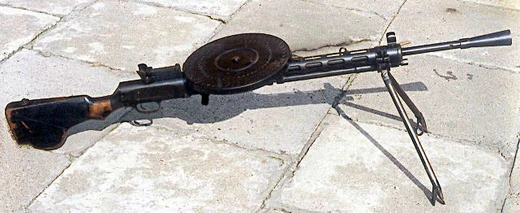
M1918 Browning automatic rifle
American automatic rifle designed for walking fire in trench warfare.
The M1918 Browning automatic rifle (BAR) is a family of American automatic rifles used by the United States and many other countries throughout the 1900s. John Browning designed it in 1917 for the American Expeditionary Forces in Europe. It fired the .30-06 Springfield cartridge and was meant to replace the French Chauchat and M1909 Benét–Mercié machine guns that U.S. troops had been using. The weapon was built so an infantryman could carry it during an assault, either with a sling over the shoulder or fired from the hip. This method, known as "walking fire," was considered necessary for trench warfare. The BAR never fully met the War Department's original expectations as either a rifle or a machine gun.
In practice, the U.S. Army used the BAR as a light machine gun, often firing it from a bipod that was added to models after 1938. One variant, the Colt Monitor machine rifle, remains the lightest production automatic firearm chambered for the .30-06 Springfield cartridge, though its standard 20-round magazine limited its effectiveness in that role. The weapon saw action late in 1918 during World War I, but it did not become standard issue in the U.S. Army until 1938, when it was issued to squads as a portable light machine gun. The BAR saw heavy use in World War II and the Korean War, and limited use in the Vietnam War. The U.S. Army began phasing it out in the 1950s, planning to replace it with a squad automatic weapon variant of the M14. This left the Army without a portable light machine gun until the M60 machine gun arrived in 1957.
Quick Facts
- Origin
- United States
- Is Ranged
- yes
- Service
- 1918–1973 (United States)
- Designer
- John Browning
- Design Date
- 1917
- Unit Cost
- $319
- Production Date
- 1917–1960 (original BAR Only) 2013–present (HCAR)
- Mass
- 7.25 kg (M1918) / approx. 11 kg (M1922) / 8.4 kg (M1918A1) / 8.8 kg (M1918A2)
- Length
- 1194 mm (M1918, M1922, M1918A1) / 1215 mm (M1918A2)
- Part Length
- 610 mm
Facts from the source article.
Lore & Background
The U.S. entered World War I with an inadequate assortment of domestic and foreign machine gun designs, due to bureaucratic indecision and lack of established doctrine. When war was declared on 6 April 1917, the high command had on hand only 670 M1909 Benét–Merciés, 282 M1904 Maxims, and 158 Colt-Browning M1895s. Browning began designing the weapon later known as the BAR in 1910, demonstrating prototypes to the U.S. military, which saw no immediate use until 1917. In 1917, Browning brought two automatic weapons to Washington, D.C. for demonstration: a water-cooled machine gun (later the M1917) and a shoulder-fired automatic rifle then called the Browning Machine Rifle (BMR). On 27 February 1917 at Congress Heights, a live-fire demonstration before 300 people—including military officials, congressmen, and the press—so impressed the crowd that Browning was awarded a contract. Additional tests at Springfield Armory in May 1917 led to unanimous recommendation for adoption. To avoid confusion with the belt-fed M1917, the weapon became known as the M1918 or Rifle, Caliber .30, Automatic, Browning, M1918.
Reader's Guide
The BAR saw action late in World War I, first issued to the U.S. Army's 79th Infantry Division on 13 September 1918. Despite its late introduction, it made an impact disproportionate to its numbers, used extensively during the Meuse–Argonne offensive. France alone requested 15,000 to replace their Chauchat machine rifles. The U.S. Army, in practice, used the BAR as a light machine gun, often fired from a bipod introduced on models after 1938. The Colt Monitor machine rifle variant remains the lightest production automatic firearm chambered for .30-06 Springfield, though its 20-round magazine limited utility. The BAR did not become standard issue until 1938, when it was issued to squads as a portable light machine gun. It saw extensive service in World War II and the Korean War, and limited service in the Vietnam War. The U.S. Army began phasing out the BAR in the 1950s, intending replacement by a squad automatic weapon variant of the M14, leaving the Army without a portable light machine gun until the M60 machine gun in 1957.
Did You Know?
- The BAR was designed by John Browning in 1917 for the American Expeditionary Forces in Europe.
- The first unit to receive the BAR was the U.S. Army's 79th Infantry Division, which took it into action on 13 September 1918.
- The BAR never entirely lived up to the original hopes of the War Department as either a rifle or a machine gun.
Origins & Urgent Adoption
The United States stumbled into World War I with a pitifully small arsenal of automatic weapons. When the declaration of war against Germany landed in April 1917, the high command discovered it possessed only 670 Benét–Mercié machine guns, 282 Maxims, and 158 Colt-Browning M1895s—a woefully inadequate stockpile for a trench war dominated by automatic fire. Worse still, the French and British surplus arms handed to American troops were often second-rate, chambered in 8mm Lebel, creating a logistical nightmare with mismatched ammunition. Bureaucratic indecision and the absence of a clear doctrine for employing machine guns had left the nation unprepared. Into this vacuum stepped John Browning, who personally carried two prototypes to Washington in early 1917. At a public live-fire demonstration at Congress Heights before roughly 300 spectators—including senators, congressmen, and foreign dignitaries—the shoulder-fired automatic rifle wowed the audience so thoroughly that a manufacturing contract was awarded on the spot. By mid-July, 12,000 rifles had been ordered, and the weapon was rushed into service under the designation M1918.
Design Philosophy & the Walking Fire Doctrine
Browning conceived the BAR not as a fixed emplacement weapon but as a tool for the individual infantryman in the midst of an assault. The guiding doctrine was 'walking fire'—the idea that a soldier should be able to carry the weapon slung over the shoulder during a forward advance and, if necessary, fire from the hip without stopping. This concept was born from the brutal reality of trench warfare, where infantry needed personal automatic firepower to push through fortified positions. In practice, however, the BAR never fully satisfied the War Department's dual expectation of it serving as both a rifle and a machine gun. The U.S. Army ultimately settled on employing it as a portable light machine gun, typically mounted on a bipod that appeared on models after 1938. Even the Colt Monitor variant, which remains the lightest production automatic firearm in .30-06 Springfield, was hampered by its modest 20-round magazine, limiting sustained suppressive fire. The weapon's identity as a hybrid—neither purely a rifle nor a true machine gun—shaped its operational role for decades.
Mass Production Under Wartime Pressure
The race to field the BAR exposed the fragility of American arms manufacturing under wartime urgency. Colt, which held the exclusive manufacturing concession under Browning's patent, was already stretched thin producing Vickers machine guns for Britain and requested a production delay to build a new facility in Meriden, Connecticut. The Army refused, and Winchester Repeating Arms was tapped as prime contractor. Winchester's engineers contributed critical refinements, including redirecting spent-case ejection to the right side rather than straight upward. Yet the schedule was so compressed that work did not truly begin until February 1918. The first batch of 1,800 rifles arrived out of specification, with components that failed to interchange between weapons, forcing a temporary production halt. Once procedures were corrected, Winchester hit 4,000 units by June and 9,000 per month by July. Marlin-Rockwell, operating out of a repurposed Mayo Radiator factory, peaked at 200 rifles daily, while Colt managed only 9,000 before the armistice. Together, the three manufacturers delivered roughly 52,000 BARs at a combined daily output of 706.
Service Career & the Postwar Gap
Though the BAR first saw combat in the closing months of 1918, it did not become standard issue in the U.S. Army until 1938, when it was formally adopted as a squad-level portable light machine gun. From that point, the weapon accompanied American soldiers through the full scope of World War II and the Korean War, and it even saw limited deployment in Vietnam. Its long service life reflected both its reliability and the Army's reluctance to replace a proven platform. The phase-out in the 1950s was intended to be seamless—the BAR was slated to be supplanted by a squad automatic weapon variant of the M14. That plan never materialized, leaving the Army without a dedicated portable light machine gun until the M60 arrived in 1957. The BAR's retirement thus created an awkward capability gap. Across its decades of service, the weapon served not only the United States but numerous other nations, cementing its place as one of the defining automatic rifles of the twentieth century.
Gallery


More in Machine Guns, Part 2 1-24
Spotted an error? Know more?
Reader corrections go straight into our review queue. Suggest an edit · How this site is sourced