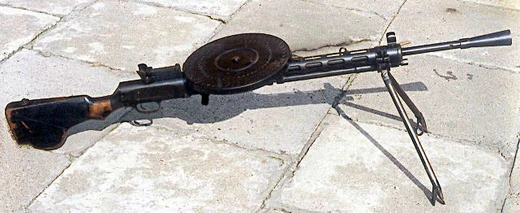
McCrudden light machine rifle
Australian light machine rifle with variable rate of fire.
The McCrudden light machine rifle is a light machine gun designed in Australia. Its creator, John Charles Reginald McCrudden, known as Reg, was a former Australian Imperial Force soldier who began work on the weapon after his discharge in 1917. Only two examples are known to survive: one at the Pattern Room in Leeds, England, and a Mk1 variant on extended loan to the Power House Museum in Sydney, Australia.
McCrudden built his first prototype at an engineering workshop in Randwick, Sydney. He then traveled with his guns to Jervis Bay to demonstrate them to Commodore J S Dumaresq and Lieutenant Commander Burgh. Dumaresq gave a favorable report, recommending that McCrudden take the weapon to England for assessment by the British War Office, as the Navy was then selecting a replacement for the Lewis Gun. Following this advice, McCrudden traveled to England and had additional weapons produced by Kingsway Manufacturing Company Ltd in London.
A press report from the Daily Telegraph on August 6, 1921, quoted McCrudden claiming his gun was foolproof, had only seven moving parts, and offered a variable rate of fire adjustable from one to 800 rounds per minute, as easily as operating a throttle. It could also be converted to water cooling for sustained fire. However, both the Mk1 and later models suffered chronic misfeeds, a problem attributed to the internal design and the side-mounted magazine. Relocating the magazine to the top might have produced a successful design.
Quick Facts
- Origin
- Australia
- Is Ranged
- YES
- Designer
- John McCrudden
- Design Date
- 1919, 1921
- Number
- 2
- Cartridge
- .303 British
- Action
- Recoil operated
- Rate
- 800rpm
Facts from the source article.
Lore & Background
The McCrudden light machine rifle was invented by ex-Australian serviceman John Charles Raginald McCrudden, known as Reg, following his discharge from the AIF in 1917. His first hand-built prototype was believed to have been manufactured at an engineering workshop in Randwick, Sydney. McCrudden and his guns traveled from Sydney to Jervis Bay for an audience with Commodore J S Dumaresq and Lt Cmdr Burgh. He was received favorably, and recommendations were made that he should take the gun to England for assessment by the British War Office, Dumaresq forwarding a favorable report in light of the Navy's pending trials to select a weapon to replace the Lewis Gun. Following Dumaresq's advice, McCrudden took his designs to England, where he had additional weapons made by Kingsway Manufacturing Company Ltd in London.
According to a press report, McCrudden alleged that his gun was foolproof, with only seven moving parts and had the advantage of having a variable rate of fire adjustable to 'fire one or 800 rounds per minute as easily as one can operate a throttle'. In addition, the gun could also be easily converted to water cooling for sustained fire. Both the Mk and the later Miki suffered chronic misfeeds due to the internal design of the gun and the location of the magazine at the side of the gun. Had McCrudden relocated the magazine to the top, he may well have had a successful design.
Reader's Guide
The McCrudden light machine rifle is significant as an Australian-designed light machine gun from the post-World War I period, reflecting the efforts of an individual inventor to address military needs. Its variable rate of fire and simple construction were notable claims, but the design's chronic misfeeds, attributed to the side-mounted magazine and internal design, prevented it from achieving success. The weapon's history includes a favorable reception from naval officers and a recommendation for assessment by the British War Office, yet only two surviving examples are known. The gun's legacy is that of an interesting but flawed design, with the potential for success had the magazine been relocated to the top. It remains a collector's item and a subject of study for those interested in early automatic weapons development.
Did You Know?
- Only two surviving examples are believed to exist, one in the Pattern Room in Leeds, England, and one on extended loan to the Power House Museum in Sydney, Australia.
- Both the Mk and later Miki suffered chronic misfeeds due to the side-mounted magazine.
Origins and the Rush to Adoption
The U.S. entered World War I with a woefully inadequate machine gun arsenal—just 670 Benét-Merciés, 282 Maxims, and 158 Colt-Browning M1895s. Bureaucratic indecision and the absence of established doctrine left American troops dependent on French and British surplus, often chambered in 8mm Lebel, which complicated logistics by forcing different ammunition types onto infantrymen and machine gunners alike. John Browning had been developing what would become the BAR since 1910, yet the military saw no immediate need for it until 1917. On February 27, 1917, a live-fire demonstration at Congress Heights in southern Washington, D.C., drew a crowd of 300 including senators, congressmen, and foreign dignitaries. The performance was so impressive that Browning received a contract on the spot. By July 16, 1917, an order for 12,000 BARs was placed. To avoid confusion with the belt-fed M1917 machine gun, the shoulder-fired weapon was designated M1918.
Manufacturing Under Wartime Pressure
Colt held exclusive manufacturing rights under Browning's patents but was already operating at peak capacity, contracted to produce Vickers machine guns for the British Army. Their request to delay BAR production while expanding into a new Meriden, Connecticut facility was denied given the urgent wartime need. Winchester Repeating Arms was designated prime contractor instead, and its engineers contributed valuable refinements to the final design, including redirecting spent casings to the right side of the weapon rather than straight upward. The first production batch of 1,800 rifles arrived out of specification, with components that failed to interchange between individual weapons, forcing a temporary halt until manufacturing procedures were upgraded. By June 1918, Winchester was delivering 4,000 units and scaling to 9,000 per month. Marlin-Rockwell, burdened by a Belgian government rifle contract, acquired the Mayo Radiator factory and peaked at 200 BARs per day. Colt managed only 9,000 by the armistice. The three companies combined for a daily output of 706 rifles, delivering approximately 52,000 total.
Design Philosophy and the Walking-Fire Concept
The BAR was conceived around the doctrine of 'walking fire'—an infantryman advancing under assault while firing from the hip or carrying the weapon slung over the shoulder. This concept was born of trench warfare, where individual soldiers needed automatic firepower to push forward. In practice, the War Department's original hopes for the BAR as either a true rifle or a true machine gun were never fully realized. The Army ultimately employed it as a light machine gun, typically fired from a bipod that appeared on models produced after 1938. The standard 20-round magazine, while keeping the weapon relatively light, limited sustained fire capability and tended to hamper its utility in the automatic role. The Colt Monitor variant remains the lightest production automatic firearm chambered for the .30-06 Springfield cartridge, yet even it suffered from the same magazine constraint. The BAR occupied an awkward middle ground between individual rifle and squad automatic weapon, satisfying neither role completely.
Service Career and the Post-War Gap
Although the BAR saw combat in the closing months of 1918, it was not standardized in the U.S. Army until 1938, when it was formally issued to squads as a portable light machine gun. It went on to serve extensively in both World War II and the Korean War, with limited employment in Vietnam. In the 1950s, the Army began phasing the BAR out, intending to replace it with a squad automatic weapon variant of the M14 rifle. This transition created a notable capability gap: the U.S. Army was left without a portable light machine gun entirely until the M60 arrived in 1957. The BAR's long but inconsistent service life—from emergency wartime adoption to decades of squad-level employment—reflects the Army's evolving understanding of automatic infantry weapons. Its legacy is that of a capable but perpetually compromised design, one that filled a tactical role no single weapon could perfectly occupy for over three decades.
Gallery

More in Machine Guns, Part 2 1-24
Spotted an error? Know more?
Reader corrections go straight into our review queue. Suggest an edit · How this site is sourced