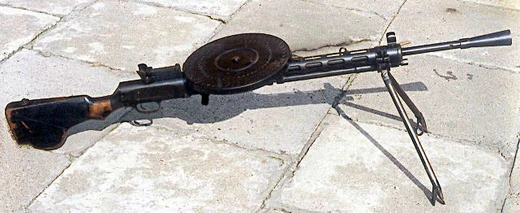
MG 13
German light machine gun converted from the Dreyse 1918 water-cooled design.
The MG 13, short for *Maschinengewehr 13*, is a German light machine gun that came from converting the earlier Dreyse Model 1918—a heavy, water-cooled, belt-fed weapon usually mounted on a tripod—into an air-cooled design. The Dreyse line began with a 1907 patent by Louis Schmeisser, named after the inventor of the Dreyse needle gun by the factory’s executives. A 1912 model followed, then a 1918 version, which later became the basis for the MG 13 after the Suhl-based Simson company was ordered to modernize it.
Introduced in 1930, the MG 13 served as Germany’s standard light machine gun until 1935, when the MG 34 and later the MG 42 replaced it. A notable feature was its double-crescent trigger: pressing the upper segment fired semi-automatically, the lower segment fully automatically, all without a separate selector switch. It fired from a closed bolt using an internal hammer.
Surplus MG 13s were supplied to Francisco Franco and his Falangist party during the Spanish Civil War, later sold to the Spanish State under the same designation. Portugal also bought them, keeping them in active service into the late 1940s as the *Metralhadora 7,92 mm m/1938 Dreyse*. As the MG 34 entered service, the MG 13 was phased out and stored, but reissued during World War II to static defense and lower-quality units, who found it easy to handle and reload. Later examples used a 75-round saddle drum magazine, and the gun had a folding buttstock and carrying handle. It was mounted in the turret of the Panzerkampfwagen I.
In 1936, the Chinese Nationalist government imported MG 13s alongside Panzerkampfwagen I light tanks; a year later, the National Revolutionary Army used them against Japan in the Second Sino-Japanese War. Portugal employed it as a squad automatic weapon during the Portuguese Colonial War under the name m/938. After World War II, the Norwegian Police Service received German-owned MG 13s and converted them into the MG 13k variant. A specimen is held by the Bundeswehr Museum of German Defense Technology in Koblenz.
Quick Facts
- Origin
- Weimar Republic
- Is Ranged
- yes
- Service
- 1930–1945 (Germany)
- Wars
- Spanish Civil War / World War II / Second Sino-Japanese War / Chinese Civil War / Portuguese Colonial War
- Design Date
- 1928
- Production Date
- 1930–1934
- Mass
- 13.3 kg
- Length
- 1443 mm
- Part Length
- 718 mm
- Cartridge
- 7.92×57mm Mauser
- Action
- Short recoil, fired from closed bolt
- Rate
- 600 rounds/min
Facts from the source article.
Lore & Background
The MG 13 traces its lineage to a machine gun patented in 1907 by Louis Schmeisser of Erfurt, named in honor of the inventor of the Dreyse needle gun by the executives of the factory where it was created, which was founded by Dreyse. After the 1912 version of the Dreyse machine gun was evaluated, a new version was designed in 1918 to replace it. This 1918 model, a heavy, usually tripod-mounted, belt-fed and water-cooled machine gun, eventually served as the base for the MG 13. At some point, an order was given to the Suhl-based Simson company to modernize the 1918 model, resulting in the creation of the Maschinengewehr 13.
The MG 13 was introduced into service in 1930 and served as Germany's standard light machine gun until 1935. An unusual feature was its double-crescent trigger, which provided select fire capability without a fire mode selector switch: pressing the upper segment produced semi-automatic fire, while pressing the lower segment produced fully automatic fire. It fired from a closed bolt using an internal hammer. Later examples used a 75-round double drum (saddle drum) magazine. It was equipped with a folding butt stock and a carrying handle, and was used in the turret of the Panzerkampfwagen I.
Reader's Guide
The MG 13's significance lies in its role as Germany's standard light machine gun during the early 1930s, bridging the gap between the heavy water-cooled Dreyse designs and the later MG 34 and MG 42. Though phased out after 1935, it was reissued during World War II, primarily to static defense and lower quality units, who found it fairly easy to handle and reload. Surplus units were supplied to Francisco Franco and his Falangist political party for the Spanish Civil War, later sold to his Spanish State, where they retained the German designation. Portugal purchased MG 13s, using them as the Metralhadora 7,92 mm m/1938 Dreyse, remaining in active service until the late 1940s and later as a squad automatic weapon during the Portuguese Colonial War under the name m/938. The Chinese Nationalist government imported the MG 13 together with Panzerkampfwagen I Ausf. A light tanks in 1936, and these were used against the Imperial Japanese Army during the Second Sino-Japanese War. After World War II, the Norwegian Police Service received MG 13s previously owned by Germany, which were converted into the MG 13k variant. A specimen is held by the Bundeswehr Museum of German Defense Technology in Koblenz.
Did You Know?
- The MG 13 was developed by converting the Dreyse Model 1918 heavy water-cooled machine gun into an air-cooled version.
- Its double-crescent trigger allowed select fire without a fire mode selector switch.
Postwar Origins and the Road to the MG 3
When the Second World War ended, the technical blueprints for the MG 42 fell into Soviet hands and were subsequently passed to Czechoslovakia and Yugoslavia, leaving Rheinmetall without the original design documentation. To meet the Bundeswehr's urgent need for a modern general-purpose machine gun, engineers at the Rheinmetall arms factory were forced to reverse-engineer the weapon directly from a surviving MG 42 example. Their first postwar product, the MG 1, entered production in 1958, chambered for the 7.62×51mm NATO round. A quick revision, the MG 1A1, added a chrome-lined barrel and sights recalibrated for the new cartridge. The MG 1A2 then introduced a substantially heavier bolt weighing 950 grams, a redesigned friction ring buffer, bolt-bounce-preventing catches, and the ability to feed both German non-disintegrating and American M13 disintegrating belts. The MG 1A3 refined the muzzle device, bipod, and bolt further. In 1968 the definitive MG 3 arrived, featuring an improved belt-retaining pawl, an anti-aircraft sight, and a new ammunition box. Rheinmetall produced the type until 1979, with Heckler & Koch handling some additional runs, and the entire family retained a high degree of parts interchangeability with the wartime MG 42.
Mechanical Philosophy and the Bolt-Weight System
The MG 3 operates on a deliberately simple mechanical philosophy. It fires exclusively in full-auto from an open-bolt position, and its only safety is a cross-bolt button operated by the shooting hand that, when engaged, disables the bolt release. The most distinctive engineering feature is the way cyclic rate is controlled: rather than a complex governor, the gun uses interchangeable bolts of different mass paired with corresponding recoil springs. A standard bolt of roughly 650 grams yields a rate between 1,000 and 1,200 rounds per minute, while an extra-heavy bolt near 900 grams absorbs more recoil energy to overcome its own inertia, slowing the action. This elegant approach means a gunner can swap a single part to fundamentally change the weapon's tempo. The MG 3's feeding mechanism includes a belt-retaining pawl that holds the ammunition belt in place when the top cover is lifted, a practical improvement over earlier variants. Crucially, every model in the MG 3 family shares a high level of parts interchangeability with the original MG 42, a legacy that simplifies logistics enormously for any operator maintaining the type.
In the Field: Roles, Doctrine, and Barrel Discipline
The MG 3 occupies a wide spectrum of combat roles within the Bundeswehr. It serves as the standard secondary armament on heavy platforms such as the Leopard 2, PzH 2000, and Marder, while acting as the primary weapon on lighter vehicles like the LKW 2to, MAN gl-series trucks, and the ATF Dingo. At the infantry level it is mounted on light bipods or various tripods. German doctrine is emphatic: sustained fire must be avoided at all costs. In the bipod role, soldiers fire controlled bursts of three to five rounds, re-aiming between each. On the tripod, bursts of 20 to 30 rounds are acceptable. After 150 live rounds of heavy fire, the barrel must be swapped for a cool one; a spent barrel may only be reused once it is cool enough to hold bare-handed for thirty seconds. Because an extended-fire barrel can approach white-hot temperatures, the crew member performing the change wears protective asbestos gloves or a cloth. The practical sustained rate of fire sits around 250 rounds per minute. Since 2015 the MG 3 has been supplemented by the Heckler & Koch MG5, and in 2019 Germany planned new receivers to keep vehicle-mounted and turret-mounted MG 3 variants in service.
Global Proliferation and the 1974 Reliability Verdict
The MG 3's influence extends far beyond German borders. Armed forces in more than forty countries have acquired the weapon or its derivatives, and production rights were licensed to Italy (where it became the MG 42/59), Greece, Iran (designated MGA3), Pakistan (as the MG 1A3), Sudan, Spain, and Turkey. As of recent years, Turkey and Pakistan continue to manufacture the type, ensuring a steady supply for their own forces and potentially for export. Yet the gun's international reputation is complicated by a notable 1974 US Army evaluation. Testing nine general-purpose machine gun designs to replace the unreliable M219, the Army found the MG 3 ranked third worst in mean rounds between failure, fourth worst in mean rounds between stoppage, and last in both cookoff rate and accuracy. It did outperform the M60 and FN MAG in ease of training, barrel-change speed, and safety. Overall it placed sixth of nine, and the Army concluded no reasonable weighting of attributes would make it the winner. Despite that verdict, the MG 3's simplicity, parts commonality, and proven durability have kept it in active service across the globe for over six decades.
Gallery


More in Machine Guns, Part 2 1-24
Spotted an error? Know more?
Reader corrections go straight into our review queue. Suggest an edit · How this site is sourced