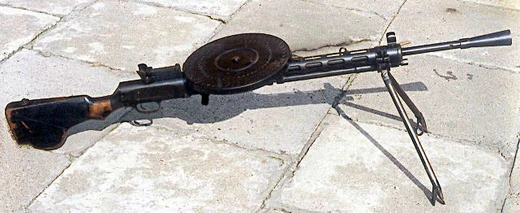
Madsen machine gun
World's first true light machine gun produced in quantity.
The Madsen light machine gun was the first mass-produced weapon of its kind. Designed by Julius A. Rasmussen and Theodor Schouboe, it was championed by Colonel Vilhelm Herman Oluf Madsen, Denmark’s Minister of War, and adopted by the Royal Danish Army in 1902. Over the next century, it saw combat worldwide, sold in twelve calibres to more than thirty-four countries, and remained in limited use into the present day. The primary manufacturer was Compagnie Madsen A/S, later known as Dansk Rekyl Riffel Syndikat A/S and then Dansk Industri Syndikat A/S.
The design originated in the 1880s. In 1883, Danish artillery officer Captain Vilhelm Herman Oluf Madsen and weapons technician Julius A. Rasmussen began work on a recoil-operated self-loading rifle. Madsen conceived the idea; Rasmussen built the prototypes. This early rifle used a non-removable stripper clip that fed rounds by gravity; when not in use, the clip folded down to cover the opening. It fired the 8×58RD cartridge, initially in black-powder and later in a more powerful smokeless version. The design failed. An improved 1896 model had an enclosed, gravity-fed magazine. About fifty to sixty of these rifles were produced and issued only to Danish coastal fortification troops.
In 1898, investors formed Dansk Riffel Syndikat (DRS) to commercialise the rifle, buying patent rights from Madsen and Rasmussen in exchange for royalties. Madsen had left the project to become Denmark’s Minister of War. In 1899, Lieutenant Jens Schouboe became DRS manager, and many subsequent patents bear his name—the rifle is sometimes called the Schouboe rifle. In 1901, Schouboe patented the Madsen machine gun design. Early versions using black-powder cartridges jammed frequently, but the design worked well with 6.5mm smokeless rounds.
The Madsen’s operating cycle is complex and unique. It uses a mixed recoil-operated locking system with a hinged bolt, patterned after the Peabody Martini breechblock. The recoil is partly short, partly long. After firing, the barrel, barrel extension, and bolt move rearward. A pin on the bolt’s right side travels in grooves on a cam plate mounted to the receiver. After 12.7 mm of travel, the bolt cams upward, away from the breech (the short recoil portion).
Quick Facts
- Origin
- Denmark
- Is Ranged
- yes
- Service
- 1902–present
- Designer
- Julius A. Rasmussen / Theodor Schouboe
- Design Date
- 1896-1902
- Manufacturer
- Dansk Rekyl Riffel Syndikat A/S / Rexer Arms Company / Guangdong Arsenal
- Production Date
- 1902–1955
- Mass
- 9.07 kg
- Length
- 1143 mm
- Part Length
- 584 mm
- Action
- Mixed recoil-operated
- Rate
- 450 rounds/min
Facts from the source article.
Lore & Background
The design dates to the 1880s, with the Danish Self Loading rifle M.1888 being a precursor. In 1883 Captain Vilhelm Herman Oluf Madsen and a weapons technician at the Danish Arsenal began working on a recoil-operated self-loading rifle; Madsen developed the idea and Rasmussen fabricated the weapons. The rifle used a non-removable stripper clip that used gravity to feed rounds; an improved 1896 design gave it an enclosed gravity-fed magazine, with 50–60 rifles produced for the Danish navy. Investors formed the Dansk Riffel Syndikat in 1898 to commercialise the rifle, buying patent rights from Madsen and Rasmussen. In 1899 Lieutenant Jens Schouboe became manager, and in 1901 he patented the design for the Madsen machine gun. The original Madsens used black-powder cartridges that quickly jammed, but the design worked well with 6.5mm smokeless powder rounds.
The Madsen uses a mixed recoil-operated locking system with a hinged bolt patterned after the Peabody Martini breechblock, combining short and long recoil. After firing, the barrel, barrel extension, and bolt move rearward; after 12.7 mm of travel the bolt is cammed upward, while the barrel and extension continue rearward. An extractor/ejector under the barrel ejects the empty case through the bottom of the receiver. The bolt then pivots downward, aligning a cartridge feed groove with the chamber, and a cartridge-rammer lever loads a fresh cartridge.
Operational use spanned World War I, the inter-war era, and World War II. The Imperial Russian Army bought 1,250 Madsens initially for cavalry, deploying them in the Russo-Japanese War and WW1. The German Army deployed the Madsen in 7.92 mm calibre as the Musket M.15 in 1915, after intercepting a shipment of 660 guns. China acquired about 150 Madsens by 1913 and began manufacturing a domestic copy at Guangdong Arsenal in 1909. Paraguay bought Madsens in the 1920s and early 1930s, fielding almost 400 in the Chaco War. During World War II, the Norwegian Army used 3,500 M/22s in 6.5×55 Krag as its standard light machine gun. Germany used captured examples from several countries, and limited manufacture continued until 1943.
Reader's Guide
The Madsen's significance lies in its pioneering role as the first true light machine gun produced in quantity, a status that enabled its sale to over 34 countries in 12 calibres. Its design, originating from a self-loading rifle project in the 1880s, evolved through patents by Rasmussen, Schouboe, and Madsen, and was commercialised by a dedicated company. The weapon's sophisticated recoil-operated locking system, combining short and long recoil with a hinged bolt, contributed to a low rate of fire and reliability, though it was considered expensive to produce. Its combat usage spanned over a century, from the Russo-Japanese War through World War I, the Chaco War, and World War II, with continued limited use into the modern day. The Madsen's adaptability to multiple calibres and its presence in diverse conflicts—from the Mexican Revolution to the Norwegian campaign—underscore its legacy as a widely distributed and enduring machine gun design. Its production by Compagnie Madsen A/S and later entities, and its copying by China, further cement its historical importance.
Did You Know?
- The Madsen was the world's first true light machine gun produced in quantity.
- It was sold in 12 calibres to over 34 countries.
- The design originated from a self-loading rifle project begun in 1883 by Captain Vilhelm Herman Oluf Madsen and a weapons technician.
Origins and the Road to Adoption
The Madsen machine gun traces its lineage to the 1880s, when Captain Vilhelm Herman Oluf Madsen, a Danish artillery officer, teamed up with Alexander Bjarnov, a weapons technician at the Danish Arsenal, to explore recoil-operated self-loading rifles. Their first attempt, the M.1888 trial recoil rifle, relied on a non-removable stripper clip that fed rounds by gravity, and it proved unsuccessful. An 1896 revision introduced an enclosed gravity-fed magazine, yielding roughly fifty to sixty rifles that found a narrow home in Danish coastal fortification units. In 1898, investors pooled capital to form the Dansk Riffel Syndikat, purchasing the patent rights from Madsen and Rasmussen in return for production royalties. By then Madsen had stepped away from the project to serve as Denmark's Minister of War. Lieutenant Jens Schouboe took over as manager in 1899, and his name appears on several subsequent patents, which is why the weapon is occasionally called the Schouboe rifle. Schouboe patented the machine gun design in 1901, and the Royal Danish Army formally adopted it in 1902.
A Unique Operating Cycle
The Madsen's firing cycle is among the most intricate in early machine gun history. It employs a mixed recoil-operated locking system built around a hinged bolt modeled on the lever-action Peabody Martini breechblock. When a round is fired from the open-bolt position, the initial recoil impulse drives the barrel, barrel extension, and bolt rearward together. A pin on the bolt's right side slides through grooves in an operating cam plate fixed to the receiver. After just 12.7 millimetres of travel, the bolt is cammed upward, clearing the breech in what constitutes the short-recoil phase. The barrel and extension then continue rearward beyond the combined length of the case and projectile, a long-recoil stroke that gives the weapon its characteristically low rate of fire. Once the breech is exposed, a lever-type extractor and ejector beneath the barrel pivots rearward to pull the spent case and throw it out the bottom of the receiver. The operating cam then rotates the bolt face downward, aligning a feed groove with the chamber. As the assembly returns forward, a cartridge-rammer lever on the barrel extension swings forward to seat a fresh round.
Global Buyers and First-World-War Service
Before and during the First World War, the Madsen found buyers in thirty-four nations across a dozen calibres, a testament to its reputation for reliability despite its high production cost. Mexico imported a hundred guns by 1911, and every faction in the Mexican Revolution fielded them. In Britain, the Rexer Arms Company held a manufacturing licence from 1905 to 1907, producing the weapon for sale in Britain and the Commonwealth, but a licensing dispute with the Danish syndicat forced Rexer to dissolve, its assets absorbed by the original company. The Imperial Russian Army purchased 1,250 Madsens for cavalry and later other units, deploying them in the Russo-Japanese War and World War I. Russian aviators even mounted them on Morane-Saulnier monoplanes, though the open-bolt cycle made firing through a propeller impractical, so the guns had to be positioned above it. Germany converted intercepted Bulgarian-bound Madsens into the 7.92 mm Musket M.15 in 1915, and Austria-Hungary used them on the Isonzo front. China acquired roughly 150 by 1913 and began domestic production at the Guangdong Arsenal as early as 1909.
A Century of Continued Service
Few weapons of the early twentieth century sustained active combat service for more than a century, yet the Madsen managed just that, with limited quantities still in use worldwide in the modern era. In the inter-war period, Czechoslovak Legionnaires carried Madsens against Bolshevik forces in Siberia, while Chinese warlord armies kept them in their arsenals. Paraguay stockpiled nearly four hundred before the Chaco War of 1932 to 1935 and purchased additional units as the campaign against Bolivia dragged on; the Bolivian army also fielded the same 7.65×53 Mauser calibre variant. By 1935, China had accumulated roughly three hundred Madsens, with fewer than a hundred adapted for aircraft such as those built by Malmö Flygindustri, SIAI, and Caproni. The weapon's production line passed through several corporate identities, beginning with Compagnie Madsen A/S, later operating as Dansk Rekyl Riffel Syndikat A/S, and eventually Dansk Industri Syndikat A/S, each iteration keeping the design in commercial circulation well beyond its 1902 adoption.
Gallery


More in Machine Guns, Part 2 1-24
Spotted an error? Know more?
Reader corrections go straight into our review queue. Suggest an edit · How this site is sourced