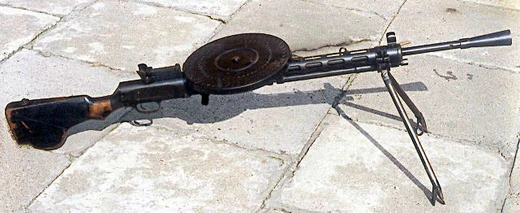
MG 30
German-designed machine gun that led to the MG 34 and MG 42.
The MG 30 was a machine gun designed in Germany, though it was used by several different countries during the 1930s. Its main historical importance is that it served as the basis for the MG 34 and, through that, the MG 42, making it a key forerunner of many firearms that remained in service well into the 2000s.
The weapon was developed by Louis Stange at Rheinmetall’s Sömmerda office, with patents filed in 1928 and 1929. Because the Versailles Treaty banned Germany from producing machine guns, Rheinmetall got around this by buying a controlling stake in the Swiss company Waffenfabrik Solothurn and moving production there, hoping to get orders for the Reichswehr’s rearmament. The German military rejected the design in favor of the MG 13, so Rheinmetall licensed it to Solothurn and to Steyr-Daimler-Puch in Austria. It entered service in Switzerland as the Solothurn S2-200 and in Austria as the Maschinengewehr Solothurn 1930, or MG 30.
Hungary bought 1,250 guns from Solothurn, calling them the Solothurn 31.M Golyószóró. Licensed production began at the FÉG factory in Budapest, with a few hundred made each year from 1931 to 1937. By 1938, around 3,000 had been acquired. Between 1938 and 1943, another 7,350 were produced. In 1943, Hungary decided to switch all new rifles and machine guns from 8x56mmR to 7.92x57mm, so production shifted to the Solothurn 43.M Golyószóró—essentially a 31.M in the new caliber—of which 1,683 were made in 1943 and 1944. In total, more than 13,000 of these guns were acquired by the Hungarian Armed Forces and the Székely National Guard of Transylvania. Those that survived the war were stored until 1956, after which nearly all were melted down.
The MG 30 is an air-cooled, recoil-operated weapon that fires 8x56mmR ammunition from a slightly curved 25-round magazine inserted on the left side. It uses a locking ring at the end of the barrel extension to lock the bolt; inside the ring are six sets of locking lugs arranged as an interrupted thread that mate with lugs at the rear of the bolt. A mount on the outside of the ring controls the ring’s rotation, which locks and unlocks the bolt. Most parts have a round cross-section, and the tubular receiver is an extension of the barrel jacket. The butt contains a tube holding the return spring and its guide, and the safety is on the receiver.
Quick Facts
- Origin
- Switzerland / Austria
- Is Ranged
- yes
- Service
- 1930–1950s
- Wars
- Austrian Civil War / Slovak–Hungarian War / World War II / Hungarian Revolution of 1956
- Designer
- Louis Stange
- Design Date
- 1929
- Production Date
- Solothurn S2-200: / 1930–1940 · Solothurn 31.M: / 1931–1943 · Solothurn 43.M: / 1943–1944
- Number
- ~17,000
- Weight
- Solothurn S2-200: / 9.5 kg · Solothurn 31.M: / 8.4 kg
- Length
- 1162 mm
- Part Length
- 600 mm
- Cartridge
- 7.92×57mm Mauser / 8×56mmR / 7×57mm Mauser / .303 British
Facts from the source article.
Lore & Background
Development of the MG 30 took place under the direction of Louis Stange at Rheinmetall's Sömmerda office, from where he filed several patent claims in 1928–1929. Actual production of machine guns was prohibited in Germany under the Versailles Treaty, so Rheinmetall circumvented the provisions by acquiring the majority shareholding of the Swiss manufacturer Waffenfabrik Solothurn and relocating production there. The design was rejected by the German Reichswehr, which adopted the MG 13. Rheinmetall then licensed the design to Solothurn in Switzerland and Steyr-Daimler-Puch in Austria. Production soon followed, entering the armed forces of both countries as the Solothurn S2-200 and Maschinengewehr Solothurn 1930, or MG 30, respectively.
The gun is an air-cooled, recoil-operated design firing standard 8×56mmR ammunition, fed from a slightly curved 25-round magazine inserted in the left side. It uses a locking ring at the end of the barrel extension to lock the bolt, with six sets of locking lugs arranged as an interrupted thread. The tubular receiver is an extension of the barrel jacket, and the butt hosts a tube containing the return spring and its guide. The MG 30 fired both semi-automatic and full automatic depending on how far the two-stage trigger is pulled, with a rate of fire between 450 and 500 rounds per minute. It included a folding bipod attached two-thirds down the barrel.
Reader's Guide
The MG 30's primary significance lies in its role as the design pattern that led to the MG 34 and indirectly the MG 42, making it one of the major ancestors of many weapons that would see widespread use into the 21st century. Rheinmetall's Borsig office modified the MG 30 design for use as an aircraft gun, producing the MG 15, which used a double-drum magazine holding 75 rounds and removed the stock for use inside bombers. Further modification in 1936 led to the MG 17, which included provisions for belt-fed ammunition, increased the rate of fire to about 1,200 rpm, and was suitable for synchronization gear systems on aircraft.
Hungary purchased 1,250 guns from Solothurn, known as the Solothurn 31.M Golyószóró, and licensed production at FÉG produced several hundred each year from 1931 to 1937, with around 3,000 acquired by 1938. From 1938 to 1943, an additional 7,350 were produced. In 1943, production switched to the Solothurn 43.M Golyószóró in 7.92×57mm, of which 1,683 were made between 1943 and 1944. A total of more than 13,000 of these guns were acquired by the Hungarian Armed Forces and Székely National Guard of Transylvania. The examples that survived the war were kept in storage until 1956, after which almost all were melted down.
Did You Know?
- Production was moved to Switzerland via Waffenfabrik Solothurn to circumvent the Versailles Treaty's prohibition on German machine gun production.
- Hungary produced more than 13,000 of the Solothurn 31.M and 43.M variants, most of which were melted down after 1956.
More in Machine Guns, Part 2 1-24
Spotted an error? Know more?
Reader corrections go straight into our review queue. Suggest an edit · How this site is sourced