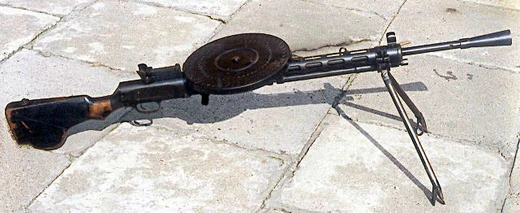
M249 Squad Automatic Weapon
U.S. adaptation of the FN Minimi, adopted in 1982.
The M249 SAW is the U.S. military’s version of the Belgian FN Minimi, a light machine gun from FN Herstal. It is made in the U.S. by FN America in Columbia, South Carolina. Adopted in 1982, it was meant to fill the gap in sustained automatic fire at the squad level. It blends a machine gun’s rate of fire with the accuracy and portability of an assault rifle.
It is gas-operated and air-cooled, with a quick-change barrel that lets the operator swap out an overheated or blocked barrel fast. It can use a folding bipod on the gas block or mount to an M192 tripod. Its dual-feed system works mainly as a belt-fed gun but also accepts STANAG magazines from the M16 and M4.
The M249 has been used in major U.S. conflicts since the 1989 invasion of Panama. In 2009, the Marine Corps chose the M27 Infantry Automatic Rifle to partially replace it. In 2022, the Army picked the SIG Sauer M250 light machine gun to replace the M249.
**Developmental history**
In 1965, the main U.S. Army and Marine machine guns were the M2 Browning and M60. The M2 was a heavy, large-caliber gun usually mounted on vehicles. The M60 was a more mobile general-purpose gun meant to be carried. Both were heavy and needed at least two people to run well. The BAR, the main individual machine gun since World War I, was phased out in 1957 when the M14 rifle (with a full-auto mode) came in. Squads had “designated riflemen” use their M14s on full auto, while others used semi-auto to save ammo and improve accuracy. Since the M14 and M16 weren’t built for sustained auto fire, they often overheated or jammed. Their 20- and 30-round magazines also limited sustained fire compared to belt-fed guns.
The Army wanted an individual machine gun lighter than the M60 but with more firepower than the M16, so troops wouldn’t rely on rifles for auto fire. Through the 1960s, studies looked at adding a machine gun to the squad. Most experiments focused on the Stoner 63 modular system, which could be changed for different roles. The Stoner 63 LMG saw brief combat in Vietnam with the Marines and later wider use with Navy SEALs.
In 1968, the Army Small Arms Program planned a new 5.56mm LMG, but no money was set aside (many thought 5.56mm was underpowered). Studies of better 5.56mm ammo began. The first look at other calibers came in 1969. In July 1970, the Army approved developing an LMG but didn’t pick a caliber.
Quick Facts
- Service
- 1984–present
- Design Date
- 1976
- Manufacturer
- FN America
- Production Date
- Late 1970s–present
- Unit Cost
- US$4,087
- Action
- Gas-operated long-stroke piston system, open bolt, rotating bolt
- Origin
- Belgium / United States
- Is Ranged
- Yes
- Weight
- 7.5 kg empty / 10 kg with 200-round soft pouch
- Length
- 40.75 in
- Part Length
- 465 mm / 521 mm
- Cartridge
- 5.56×45mm NATO
Facts from the source article.
Lore & Background
The M249 SAW was developed to replace the reliance on rifles for automatic fire at the squad level, following the phase-out of the Browning automatic rifle in 1957 and the limitations of the M14 and M16 in sustained automatic roles. The U.S. Army's Squad Automatic Weapon program began in 1970, and after trials involving several candidates—including the Colt M16 HBAR, FN Minimi, and HK23A1—the FN Minimi was selected in May 1980 and designated XM249. Official adoption followed in February 1982, with U.S. production at the FN factory in Columbia, South Carolina.
The M249 SAW entered U.S. Army service in 1984 and U.S. Marine Corps service in 1985. Production was suspended in August 1985 due to safety hazards including sharp edges and an exposed hot barrel, and a product improvement program was developed. Over 1,100 issued M249s were retrofitted, and over 7,000 remained in storage until corrective changes were made. Initial reactions were mixed: it performed well when fired from a prone position but was less effective from the shoulder or hip, and criticisms included a fragile bipod, awkward sling attachment, and dirt accumulation.
The M249 SAW has been fielded in major conflicts since the United States invasion of Panama in 1989, including the Persian Gulf War, Somalia, Bosnia, Kosovo, Afghanistan, and Iraq. Surplus M249s were donated to Bolivia, Colombia, and Tunisia. The base ammunition load was originally 600 rounds in three 200-round boxes; the modern load is 1,000 rounds in five 200-round belts, with up to 500 extra rounds in 100-round soft pouches.
Reader's Guide
The M249 SAW addressed a critical gap in U.S. infantry firepower by providing a belt-fed light machine gun at the squad level, replacing the practice of using rifles on automatic fire. Its dual-feeding mechanism allowed it to accept both belts and STANAG magazines, offering flexibility in combat. The weapon's quick-change barrel enabled sustained fire, while its gas-operated, air-cooled design kept weight manageable. Despite initial production halts and mixed user feedback, the M249 was used in every major U.S. conflict from the 1991 Gulf War onward. Its tactical role included both handheld use with maneuvering units and stationary positioning for covering fire. The M249's service life spanned decades, but by 2009 the U.S. Marine Corps selected the M27 Infantry Automatic Rifle to partially replace it, and in 2022 the U.S. Army selected the M250 light machine gun from SIG Sauer to replace the M249 SAW entirely.
Did You Know?
- The M249 SAW is the U.S. adaptation of the Belgian FN Minimi, manufactured in Columbia, South Carolina.
- It features a dual-feeding mechanism that accepts both belts and STANAG magazines.
- Production was suspended in August 1985 due to safety hazards, leading to a product improvement program.
- The M249 SAW has been used in every major U.S. conflict since the 1991 Gulf War.
The Long Road to a Squad-Level Machine Gun
For much of the Cold War era, American infantry squads relied on the M2 Browning and the M60 for automatic firepower. Both weapons were substantial, typically demanding at least two crew members to operate effectively. When the Browning Automatic Rifle was retired in 1957 alongside the arrival of the M14, squads fell back on designated riflemen firing their rifles in full-auto mode. The problem was clear: neither the M14 nor its successor, the M16, was engineered for sustained automatic fire. Barrels overheated, mechanisms jammed, and the modest twenty- and thirty-round magazines simply could not match the endurance of a belt-fed gun. Through the 1960s, studies examined whether a lighter, individual machine gun could slot into the infantry squad. The Stoner 63 saw limited combat use with Marines and Navy SEALs in Vietnam, but no permanent solution emerged. In 1970 the Army formally approved development of a new weapon and coined the Squad Automatic Weapon designation. A decade of cartridge debates, prototype competitions, and multi-candidate trials followed, with the FN Minimi ultimately prevailing over the Colt M16 HBAR, the Heckler & Koch XM262, and the Ford-built XM248. The Army officially adopted the weapon in February 1982.
Engineering a Bridge Between Rifle and Machine Gun
The M249 occupies a unique niche in small-arms design: it marries the high cyclic rate of a true machine gun with the portability and precision of an assault rifle. At its core, the weapon is gas-operated and air-cooled, a configuration that keeps the system relatively simple while allowing a single soldier to carry and deploy it without a support crew. A quick-change barrel sits at the heart of the design philosophy, letting an operator swap out an overheating or obstructed barrel in seconds rather than waiting for it to cool. Feeding flexibility is another hallmark. The M249 is configured primarily as a belt-fed light machine gun, yet its dual-feeding mechanism also accepts the standard STANAG magazines used by the M16 and M4 carbine, giving squads the option to draw from either ammunition source in the field. For sustained fire, a folding bipod clamps to the gas block, or the weapon can be mounted on an M192 lightweight ground tripod. All of this is produced domestically by FN Manufacturing, LLC, the Columbia, South Carolina subsidiary of Belgian maker FN Herstal, ensuring a steady U.S. supply chain for the 5.56 mm caliber platform.
From Panama to the Modern Battlefield
The M249 entered U.S. Army service in 1984 and joined the Marine Corps a year later in 1985, with the American production variant distinguished from the original Belgian Minimi by a different buttstock. From that point forward, the weapon filled a gap that had plagued infantry squads for decades: a single soldier could now deliver sustained, reliable automatic fire without the logistical burden of a two-man M60 crew. Its first major combat deployment came during the 1989 U.S. invasion of Panama, and from that operation onward the M249 appeared in virtually every significant conflict involving American forces. Operators generally regarded the weapon as both reliable and accurate in the field. However, the service record was not without blemish; multiple safety hazards were identified in the design, including issues with sharp edges that posed a risk to the handler. Despite these concerns, the M249 remained the backbone of squad-level automatic fire for more than three decades, serving as the default answer to how a small team could generate suppressive fire in both close-quarters and open-terrain engagements alike.
A Four-Decade Watch and the Passing of the Torch
No weapon in the U.S. arsenal stays in front-line service forever, and the M249's long watch is now drawing to a close. In 2009, the Marine Corps made the first formal move away from the SAW, selecting the M27 Infantry Automatic Rifle to partially replace the M249 in its inventory. That decision signaled a broader doctrinal shift: the Marine Corps was rethinking the role of the automatic rifleman within the infantry squad, favoring a weapon that blurred the line between rifle and light machine gun even further. The Army's replacement came later. In 2022, the service selected the M250 light machine gun, produced by SIG Sauer, to succeed the M249 in its own ranks. Together, these two procurement decisions mark the end of an era that began in 1982. For four decades, the M249 defined what squad automatic weapon meant in American military doctrine, bridging the gap between the individual rifle and the heavier crew-served guns that preceded it. Its retirement does not diminish the role it played; rather, it underscores how the very concept it embodied has become so deeply embedded in modern infantry thinking that its absence will be felt long after the last M249 is decommissioned.
Gallery


More in Machine Guns, Part 2 1-24
Spotted an error? Know more?
Reader corrections go straight into our review queue. Suggest an edit · How this site is sourced