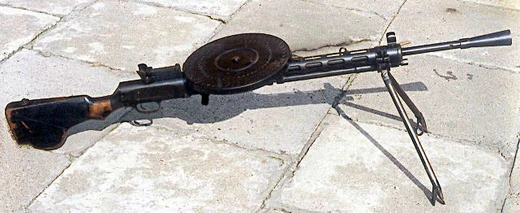
M1919 Browning machine gun
Air-cooled .30 caliber medium machine gun used from WWII through Vietnam.
The M1919 Browning is a .30 caliber medium machine gun that saw extensive use throughout the 20th century, particularly in World War II, the Korean War, and the Vietnam War. It was employed by the United States and numerous other nations in roles including light infantry support, coaxial mounting on vehicles, aircraft armament, and anti-aircraft defense. This weapon was an air-cooled evolution of John M. Browning's earlier water-cooled M1917, which had been the standard U.S. machine gun of World War I.
The M1919 originally fired the .30-06 M1906 ball cartridge, later switching to the .30 caliber M2 ball cartridge, fed from a woven cloth belt that moved from left to right. Eventually, a disintegrating metal M1 link belt was introduced. To load, the operator inserted the pull tab of the ammunition belt—whether metal links or a cloth belt's metal tab—into the left side of the gun until the feeding pawl at the feed way entrance engaged the first round. The cocking handle was then pulled back with the right hand, palm facing up to protect the thumb if a cook-off occurred, and released. This advanced the first round in front of the bolt, where the extractor/ejector could grab it. A second pull and release of the cocking handle caused the extractor to remove that round from the belt and chamber it. As the bolt slid forward, the extractor engaged the next round waiting in the feed way.
Each time the gun fired, the bolt moved rearward, extracting the spent casing and pulling the next round from the belt, which then ejected the empty case. As the bolt moved forward, it chambered the fresh round, advanced the belt, and engaged the following round. The cycle repeated about ten times per second until the trigger was released or the belt ran out.
Because the M1919 fired from a closed bolt, it had a dangerous tendency to cook off when the barrel became extremely hot from sustained fire. A cartridge resting in a red-hot barrel could ignite on its own, causing the gun to fire uncontrollably until the ammunition was exhausted—though this usually produced random discharges rather than full automatic fire, as heat needed time to soak into each cartridge. Gunners were trained to cock the weapon with their palm up to avoid a dislocated thumb from a cook-off, and to grab the ammunition belt and pull it away to stop feeding if the gun began cycling on its own.
Quick Facts
- Is Ranged
- yes
- Origin
- United States
- Designer
- John M. Browning
- Design Date
- 1919
- Manufacturer
- Buffalo Arms Corporation · Rock Island Arsenal · Saginaw Steering Gear division of General Motors
- Production Date
- 1919–1945
- Service
- 1919–present
- Part Length
- 24 in
- Cartridge
- .30-06 Springfield · 7.62×51mm NATO · .303 British · 7.92×57mm Mauser · 6.5×55mm · 7.62×54mmR · 8×63mm patron m/32 · 7.65×53mm Argentine · 7.5×54mm French
- Max Range
- 1500 m
- Feed
- 250-round cloth or disintegrating belt
- Action
- Recoil-operated/short-recoil operation, closed bolt
Facts from the source article.
Lore & Background
The M1919 Browning was an air-cooled development of the water-cooled M1917 Browning machine gun, designed by John M. Browning. Its original design as a closed-bolt weapon created a potentially dangerous situation: if the gun was very hot from prolonged firing, a cartridge resting in a red-hot barrel could ignite on its own (a cook-off), causing the gun to fire uncontrollably until the ammunition ran out. Gunners were taught to cock the gun with the palm facing up to protect the thumb in the event of a cook-off, and to seize the ammunition belt to stop feeding if uncontrollable firing began. To manage barrel heat, gunners were trained to fire in controlled bursts of three to five rounds.
Loading was accomplished by inserting the pull tab on the ammunition belt from the left side until the feeding pawl engaged the first round. The cocking handle was pulled back twice: the first time advanced the first round in front of the bolt, and the second time chambered it. Every firing cycle repeated the sequence of extracting the spent round, pulling the next round from the belt, chambering it, advancing the belt, and firing. The belt feed lever, connected to the feeding pawl, moved the belt to the right as the bolt came forward, and loose M1 links were ejected from the right side of the receiver. A recoil buffer tube extended from the back of the receiver to smooth the bolt cycle and provide a mounting point for the pistol grip.
Except for the M1919A6, all variants had to be mounted on a tripod or other mount. The infantry tripod allowed traverse and elevation, with an adjustment screw for vertical aim and free traverse to either side. The gun was aimed using iron sights: a small folding post at the front and a rear aperture sight on a sliding leaf with range graduations in 100-yard divisions up to 2,400 yards. The rear sight also had windage adjustment.
Reader's Guide
The M1919 Browning machine gun served as a company support weapon requiring a five-man crew. The original M1919A1 featured a light barrel and bipod but proved too heavy to be easily moved while too light for sustained fire, leading to the M1919A2 with a heavier barrel and tripod for longer sustained fire. The emergence of general-purpose machine guns in the 1950s pushed the M1919 into secondary roles in many cases, especially after the arrival of the M60 in US Army service. The United States Navy converted many to 7.62 mm NATO, designating them Mk 21 Mod 0, commonly used on riverine craft in the 1960s and 1970s in Vietnam. Many NATO countries also converted their examples to 7.62 mm caliber, and these remained in service well into the 1990s, as well as up to the present day in some countries. The M1919's design as a closed-bolt, air-cooled weapon without quick-change barrels or open-bolt operation limited its sustained-fire capability compared to later designs, but its widespread adoption and long service life across multiple conflicts and nations attest to its durability and effectiveness as a medium machine gun.
Did You Know?
- The M1919 was an air-cooled development of John M. Browning's water-cooled M1917 machine gun from World War I.
- If the barrel became red-hot from prolonged firing, a cartridge could cook off and cause the gun to fire uncontrollably until the ammunition ran out.
- The United States Navy converted many M1919s to 7.62 mm NATO as the Mk 21 Mod 0 for use on riverine craft in Vietnam.
From Patent to Prototype: The Long Gestation
In the year 1900, John Moses Browning filed a patent describing a recoil-powered automatic firearm, yet he set the project aside for a full decade. It was not until 1910 that he returned to the concept, constructing a water-cooled prototype based on that original 1900 architecture. During this second phase of development, Browning refined several key elements: he swapped side ejection for bottom ejection, introduced a buffer to smooth the cycling action, and replaced the conventional hammer with a two-piece firing pin. Despite these refinements, the underlying mechanical philosophy remained rooted in the 1900 design. The resulting weapon weighed just 47 pounds, making it dramatically lighter than the 137-pound German Maschinengewehr 08 of the era, while still rivalling the British Vickers in mass. Browning's sliding-block locking mechanism, a hallmark of his earlier work, eliminated the need for a heavy toggle-lock assembly and reduced both weight and mechanical complexity. The belt fed from left to right, with cartridges packed more tightly than in Maxim or Vickers systems, and the gun bore no lineage to Maxim's toggle-lock principle whatsoever.
The Springfield Trials and Army Adoption
When the United States declared war in April 1917, the Army Ordnance Department found itself with a pitiful inventory of roughly 1,100 machine guns, the majority of them obsolete. The government scrambled to solicit designs from multiple manufacturers. Browning seized the moment and arranged a demonstration at the Springfield Armory in May of that year. The results were staggering: in the initial firing trial, the weapon cycled through 20,000 rounds with only a handful of malfunctions, most traceable to poorly loaded cloth belts rather than the gun itself. Undeterred, Browning pushed the same weapon through another 20,000 rounds, and the only component to fail was a sear that broke at approximately 39,500 rounds. The Ordnance Board, while impressed, doubted a production model could replicate such reliability. Browning answered by bringing a second gun that not only matched the original trial but also sustained continuous fire for 48 minutes and 12 seconds, expelling over 21,000 rounds without stopping. The Army subsequently adopted the weapon as its principal heavy machine gun, chambered for the M1906 .30-06 cartridge with its 150-grain flat-base bullet.
A Late Arrival on the Western Front
Because of slow ramp-up in production, the M1917 reached the Western Front in too small a number to shape the outcome of World War I. Only around 1,200 of the guns actually saw combat, and they did so during the final two and a half months of the conflict. The 6th Machine Gun Battalion, attached to the Second Division, did not swap out its French Hotchkiss M1914 guns for the new Browning until November 14, a mere three days after the armistice took effect. The United States managed to equip roughly one-third of the divisions it sent to France with the Model 1917; the remaining divisions received French-made Hotchkiss 8 mm guns or British Vickers built by Colt domestically. In fact, the French Hotchkiss ended up being the most common heavy machine gun in American Expeditionary Force hands. Where the M1917 did fire in anger, its rate of fire and mechanical reliability proved highly effective. However, in indirect-fire roles it fell short of the Vickers and Hotchkiss, whose cartridges enjoyed roughly 50 percent greater range than the .30-06 round, a deficiency rooted in the poor aerodynamics of the flat-base bullet that would later be corrected by the boat-tailed M1 Ball cartridge.
From the Pacific to the Memorial
The M1917's story did not end with the Great War. Its successor iteration, the M1917A1, saw service through World War II, the Korean War, and the Vietnam War, and was also fielded by allied and other nations. In the Pacific theatre, the weapon's weight and bulk made it best suited to fixed defensive positions or battalion- and regimental-level support. Machine gun squads would carry the disassembled gun on foot during advances, then rapidly reassemble it to provide suppressive fire for infantry. One of the most dramatic engagements involving the M1917 occurred at the Battle of Momote Airstrip in the Admiralties, where the 5th Cavalry's machine gunners used their Brownings to kill several hundred Japanese soldiers in a single night. After the fighting ended, one of the guns was left standing in its firing position as a memorial to the battle. In World War II the weapon was typically loaded with M2 ball, tracer, and armor-piercing ammunition, and a number of M1917s were even transferred to the United Kingdom for use by the Home Guard, as all domestic .303 Vickers production was needed to replace equipment lost during the Fall of France.
Gallery


More in Machine Guns, Part 2 1-24
Spotted an error? Know more?
Reader corrections go straight into our review queue. Suggest an edit · How this site is sourced